
Pulp Fiction, 1916 · page 86 of 212
The Argosy, Vol. 82, No. 3 — page 86: what you’re looking at
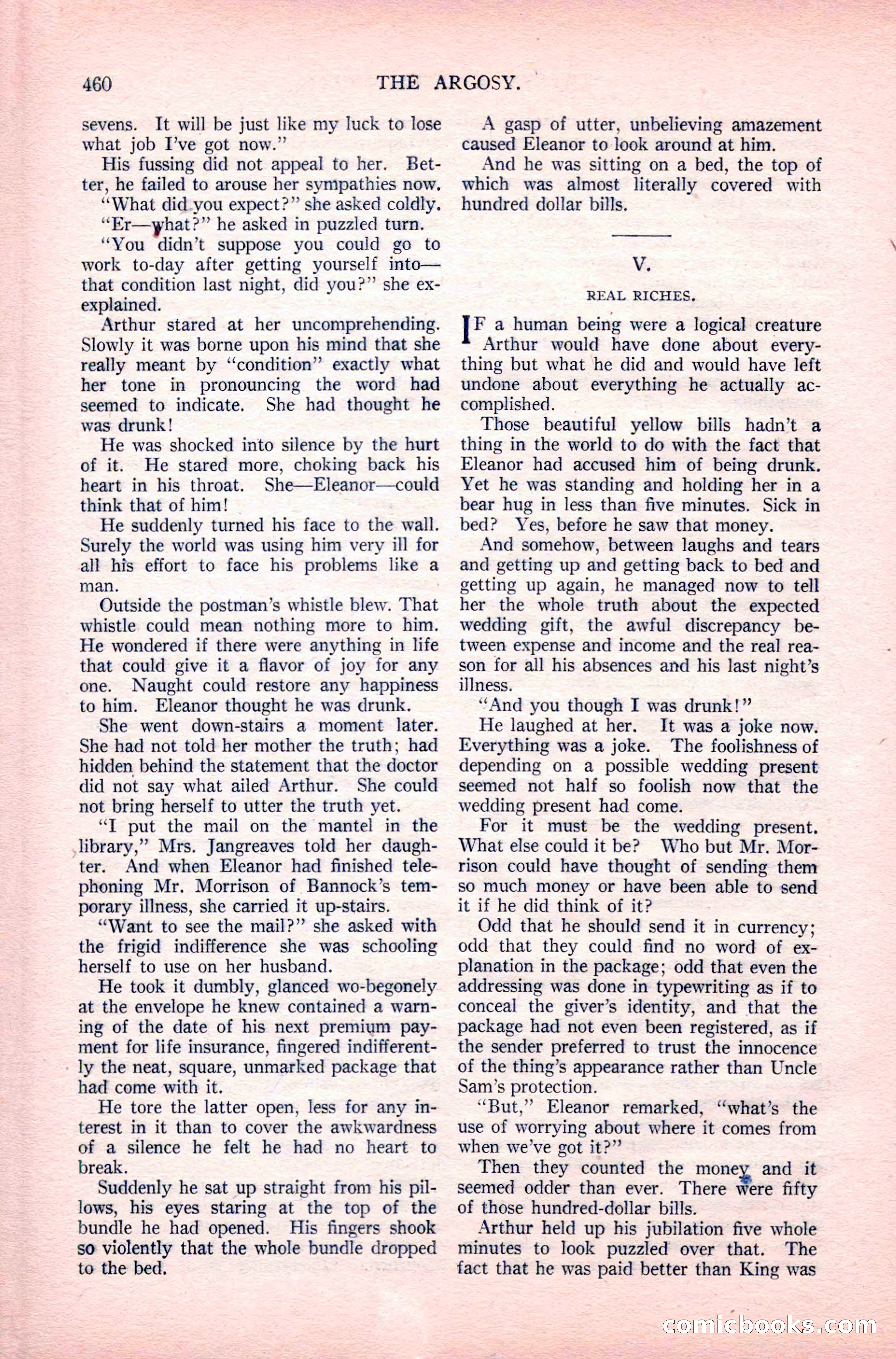
A restored page from Pulp Fiction, 1916. Page through the whole issue in the reader above.
📄 Transcribed text from this page (OCR, searchable)
Machine-transcribed from the original scan — historical spelling and the odd misread are preserved.
460 sevens. It will be just like my luck to lose what job I’ve got now.” His fussing did not appeal to her. Bet- ter, he failed to arouse her sympathies now, “What did-you expect?” she asked coldly. “Er—wphat?” he asked in puzzled turn. “You didn’t suppose you could go to work to-day after getting yourself into— that condition last night, did you?” she ex- explained. Arthur stared at her uncomprehending. Slowly it was borne upon his mind that she really meant by “condition” exactly what her tone in pronouncing the word had seemed to indicate. She had thought he was drunk! He was shocked into silence by the hurt of it. He stared more, choking back his heart in his throat. She—Eleanor—could think that of him! He suddenly turned his face to the wall. Surely the world was using him very ill for all his effort to face his problems like a man. Outside the postman’s whistle blew. That whistle could mean nothing more to him. He wondered if there were anything in life that could give it a flavor of joy for any one. Naught could restore any happiness to him. Eleanor thought he was drunk. She went down-stairs a moment later. She had not told her mother the truth; had hidden behind the statement that the doctor did not say what ailed Arthur. She could not bring herself to utter the truth yet. “T put the mail on the mantel in the library,” Mrs. Jangreaves told her daugh- ter. And when Eleanor had finished tele- phoning Mr. Morrison of Bannock’s tem- porary illness, she carried it up-stairs. “Want to see the mail?” she asked with the frigid indifference she was schooling herself to use on her husband. He took it dumbly, glanced wo-begonely at the envelope he knew contained a warn- ing of the date of his next premium pay- ment for life insurance, fingered indifferent- _ ly the neat, square, unmarked package that had come with it. He tore the latter open, less for any in- terest in it than to cover the awkwardness of a silence he felt he had no heart to break. Suddenly he sat up straight from his pil- lows, his eyes staring at the top of the bundle he had opened. His fingers shook so violently that the whole bundle dropped to the bed. THE ARGOSY. — A gasp of utter, unbelieving amazement caused Eleanor to look around at him. And he was sitting on a bed, the top of which was almost literally covered with hundred dollar bills. V. REAL RICHES. F a human being were a logical creature Arthur would have done about every- thing but what he did and would have left undone about everything he actually ac- complished. | Those beautiful yellow bills hadn’t a thing in the world to do with the fact that Eleanor had accused him of being drunk. Yet he was standing and holding her in a bear hug in less than five minutes. Sick in bed? Yes, before he saw that money. And somehow, between laughs and tears and getting up and getting back to bed and getting up again, he managed now to tell her the whole truth about the expected wedding gift, the awful discrepancy be- tween expense and income and the real rea- son for all his absences and his last night’s illness. ‘And you though I was drunk!” He laughed at her. It was a joke now. Everything was a joke. The foolishness of depending on a possible wedding present seemed not half so foolish now that the wedding present had come. For it must be the wedding present. What else could it be? Who but Mr. Mor- rison could have thought of sending them so much money or have been able to send it if he did think of it? Odd that he should send it in currency; odd that they could find no word of ex- planation in the package; odd that even the addressing was done in typewriting as if to conceal the giver’s identity, and that the package had not even been registered, as if the sender preferred to trust the innocence of the thing’s appearance rather than Uncle Sam’s protection. “But,” Eleanor remarked, “what’s the use of worrying about where it comes from when we’ve got it?” Then they counted the mone seemed odder than ever. There of those hundred-dollar bills. Arthur held up his jubilation five whole minutes to look puzzled over that. The fact that he was paid better than King was and it ere fifty NOOLKS Comic (E@)