
Pulp Fiction, 1916 · page 88 of 212
The Argosy, Vol. 82, No. 3 — page 88: what you’re looking at
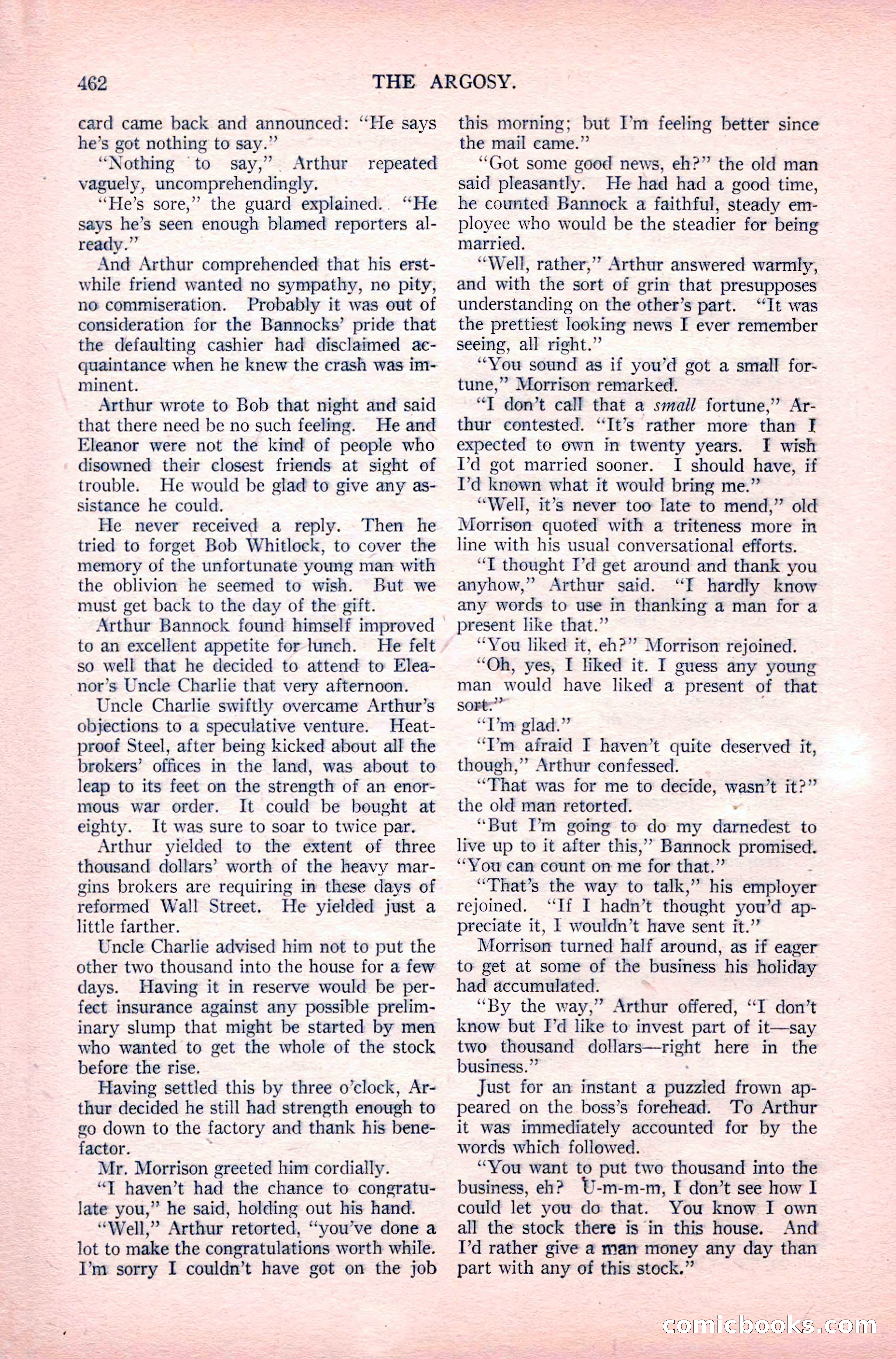
A restored page from Pulp Fiction, 1916. Page through the whole issue in the reader above.
📄 Transcribed text from this page (OCR, searchable)
Machine-transcribed from the original scan — historical spelling and the odd misread are preserved.
462 card came back and announced: “He says he’s got nothing to say.” “Nothing to say,” Arthur repeated vaguely, uncomprehendingly. ‘““He’s sore,” the guard explained.. “He says he’s seen enough blamed reporters al- ready.”’ And Arthur comprehended that his erst- while friend wanted no sympathy, no pity, no commiseration. Probably it was out of consideration for the Bannocks’ pride that the defaulting cashier had disclaimed ac- quaintance when he knew the crash was im- minent. Arthur wrote to Bob that night and said that there need be no such feeling. He and Eleanor were not the kind of people who disowned their closest friends at sight of trouble. He would be glad to give any as- sistance he could. He never received a reply. Then he tried to forget Bob Whitlock, to cover the memory of the unfortunate young man with the oblivion he seemed to wish. But we must get back to the day of the gift. Arthur Bannock found himself improved to an excellent appetite for lunch. He felt so well that he decided to attend to Elea- nor’s Uncle Charlie that very afternoon. Uncle Charlie swiftly overcame Arthur’s objections to a speculative venture. Heat- proof Steel, after being kicked about all the brokers’ offices in the land, was about to leap to its feet on the strength of an enor- mous war order. It could be bought at eighty. It was sure to soar to twice par. Arthur yielded to the extent of three thousand dollars’ worth of the heavy mar- gins brokers are requiring in these days of reformed Wall Street. He yielded just a little farther. Uncle Charlie advised him not to put the other two thousand into the house for a few days. Having it in reserve would be per- fect insurance against any possible prelim- inary slump that might be started by men who wanted to get the whole of the stock before the rise. Having settled this by three o’clock, Ar- thur decided he still had strength enough to go down to the factory and thank his bene- factor. Mr. Morrison greeted him cordially. “T haven’t had the chance to congratu- late you,” he said, holding out his hand. “Well,” Arthur retorted, “you’ve done a lot to make the congratulations worth while. I’m sorry I couldn’t have got on the job THE ARGOSY, this morning; but I’m feeling better since the mail came.” “Got some good news, eh?” the old man said pleasantly. He had had a good time, he counted Bannock a faithful, steady em- ployee who would be the steadier for being married. ‘Well, rather,” Arthur answered warmly, and with the sort of grin that presupposes understanding on the other’s part. “It was the prettiest looking news I ever remember seeing, all right.” ‘You sound as if you’d got a small for- tune,” Morrison remarked. “YT don’t call that a small fortune,” Ar- thur contested. “It’s rather more than f expected to own in twenty years. I wish I’d got married sooner. I should have, if I’d known what it would bring me.” “Well, it’s never too late to mend,” old Morrison quoted with a triteness more in line with his usual conversational efforts. “T thought I’d get around and thank you anyhow,” Arthur said. “I hardly know any words to use in thanking a man for a present like that.” “You liked it, eh?” Morrison rejoined. “Oh, yes, I liked it. I guess any young man w vould have liked a present of that sort: 2 “Tm glad.” ‘“T’m afraid I haven’t quite deserved it, though,” Arthur confessed. “That was for me to decide, wasn’t it?” the old man retorted. . “But I’m going to do my darnedest to live up to it after this,’ Bannock promised. ‘You can count on me for that.” “That’s the way to talk,” his employer rejoined. “If I hadn’t thought you'd ap- preciate it, | wouldn’t have sent it.” Morrison turned half around, as if eager to get at some of the business his holiday had accumulated. “By the way,” Arthur offered, “I don’t know but Id like to invest part of it—say two thousand doliars—right here in the business.” Just for an instant a rcisciod frown ap- peared on the boss’s forehead. To Arthur it was immediately accounted for by the words which followed. “You want to put two thousand into the business, eh? U-m-m-m, I don’t see how I could let you do that. You know I own all the stock there is in this house. I’d rather give a man money any day than part with any of this stock.” And (EO) DOOKS AAG (E@)