
Pulp Fiction, 1916 · page 85 of 212
The Argosy, Vol. 82, No. 3 — page 85: what you’re looking at
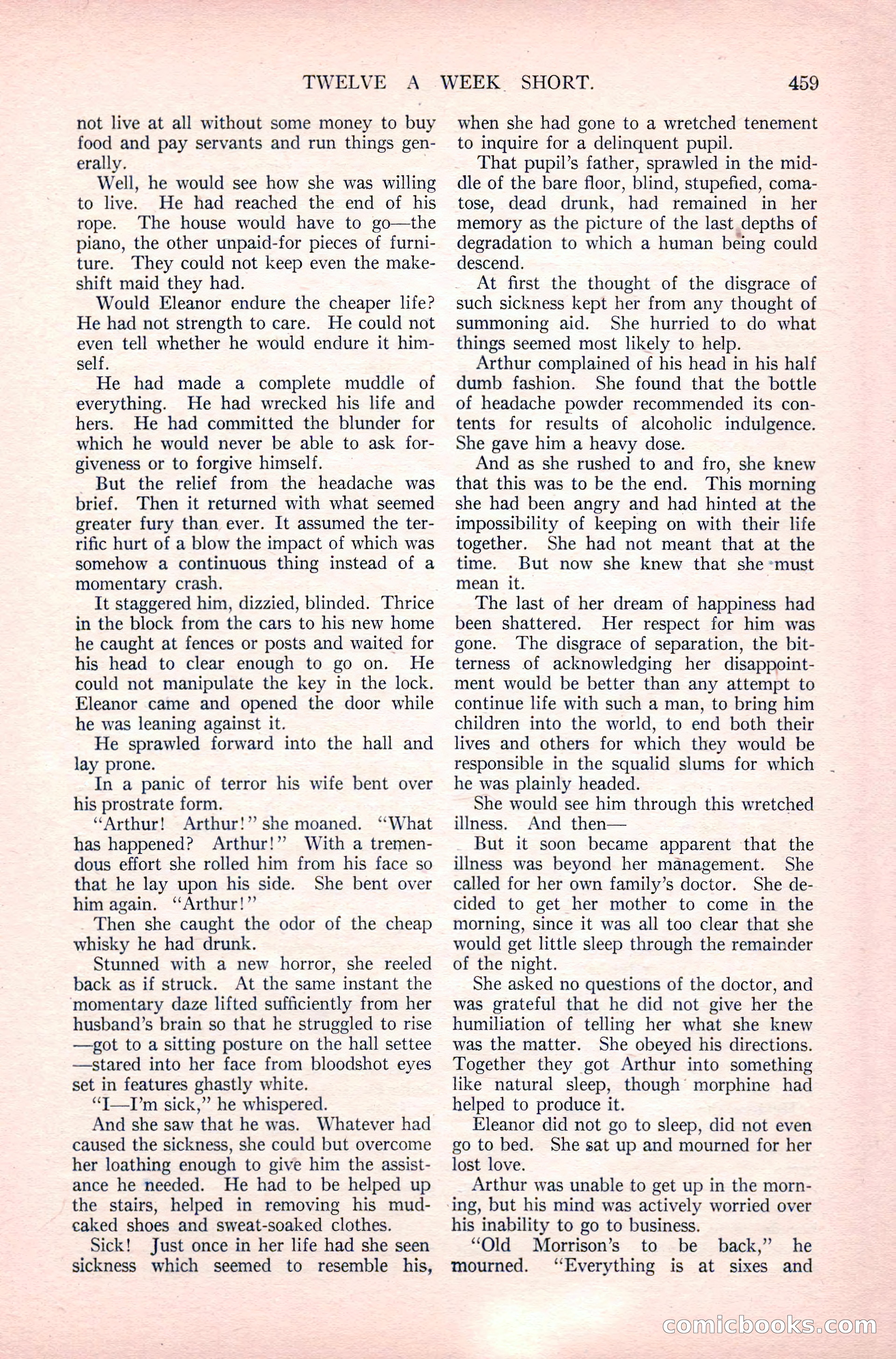
A restored page from Pulp Fiction, 1916. Page through the whole issue in the reader above.
📄 Transcribed text from this page (OCR, searchable)
Machine-transcribed from the original scan — historical spelling and the odd misread are preserved.
TWELVE A -WEEK SHORT. not live at all without some money to buy food and pay servants and run things gen- erally. Well, he would see how she was willing to live. He had reached the end of his rope. The house would have to go—the piano, the other unpaid-for pieces of furni- ture. They could not keep even the make- shift maid they had. Would Eleanor endure the cheaper life? He had not strength to care. He could not even tell whether he would endure it him- self. He had made a complete muddle of everything. He had wrecked his life and hers. He had committed the blunder for which he would never be able to ask for- giveness or to forgive himself. But the relief from the headache was brief. Then it returned with what seemed greater fury than ever. It assumed the ter- rific hurt of a blow the impact of which was somehow a continuous thing instead of a momentary crash. It staggered him, dizzied, blinded. Thrice in the block from the cars to his new home he caught at fences or posts and waited for his head to clear enough to go on. He could not manipulate the key in the lock. Eleanor came and opened the door while he was leaning against it. He sprawled forward into the hall and lay prone. In a panic of terror his wife bent over his prostrate form. “Arthur! Arthur!” she moaned. “What has happened? Arthur!” With a tremen- dous effort she rolled him from his face so that he lay upon his side. She bent over him again. ‘Arthur!”’ Then she caught the odor of the cheap whisky he had drunk. Stunned with a new horror, she reeled back as if struck. At the same instant the momentary daze lifted sufficiently from her husband’s brain so that he struggled to rise —got to a sitting posture on the hall settee —stared into her face from bloodshot eyes set in features ghastly white. “T—J’m sick,” he whispered. And she saw that he was. Whatever had caused the sickness, she could but overcome her loathing enough to give him the assist- ance he needed. He had to be helped up the stairs, helped in removing his mud- caked shoes and sweat-soaked clothes. Sick! Just once in her life had she seen sickness which seemed to resemble his, 459 when she had gone to a wretched tenement to inquire for a delinquent pupil. That pupil’s father, sprawled in the mid- dle of the bare floor, blind, stupefied, coma- tose, dead drunk, had remained in her memory as the picture of the last depths of degradation to which a human being could descend. At first the thought of the disgrace of such sickness kept her from any thought of summoning aid. She hurried to do what things seemed most likely to help. Arthur complained of his head in his half dumb fashion. She found that the bottle of headache powder recommended its con- tents for results of alcoholic indulgence. She gave him a heavy dose. And as she rushed to and fro, she knew that this was to be the end. This morning she had been angry and had hinted at the impossibility of keeping on with their life together. She had not meant that at the time. But now she knew that she *must mean it. The last of her dream of happiness had been shattered. Her respect for him was gone. The disgrace of separation, the bit- terness of acknowledging her disappoint- ment would be better than any attempt to continue life with such a man, to bring him children into the world, to end both their lives and others for which they would be responsible in the squalid slums for which he was plainly headed. She would see him through this wretched illness. And then— But it soon became apparent that the iulness was beyond her management. She called for her own family’s doctor. She de- cided to get her mother to come in the morning, since it was all too clear that she would get little sleep through the remainder of the night. She asked no questions of the doctor, and was grateful that he did not give her the humiliation of telling her what she knew was the matter. She obeyed his directions. Together they got Arthur into something like natural sleep, though morphine had helped to produce it. Eleanor did not go to sleep, did not even go to bed. She sat up and mourned for her lost love. Arthur was unable to get up in the morn- ing, but his mind was actively worried over his inability to go to business. “Old Morrison’s to be back,” he mourned. “Everything is at sixes and CORMICLOOOKS (C@)