
Pulp Fiction, 1916 · page 84 of 212
The Argosy, Vol. 82, No. 3 — page 84: what you’re looking at
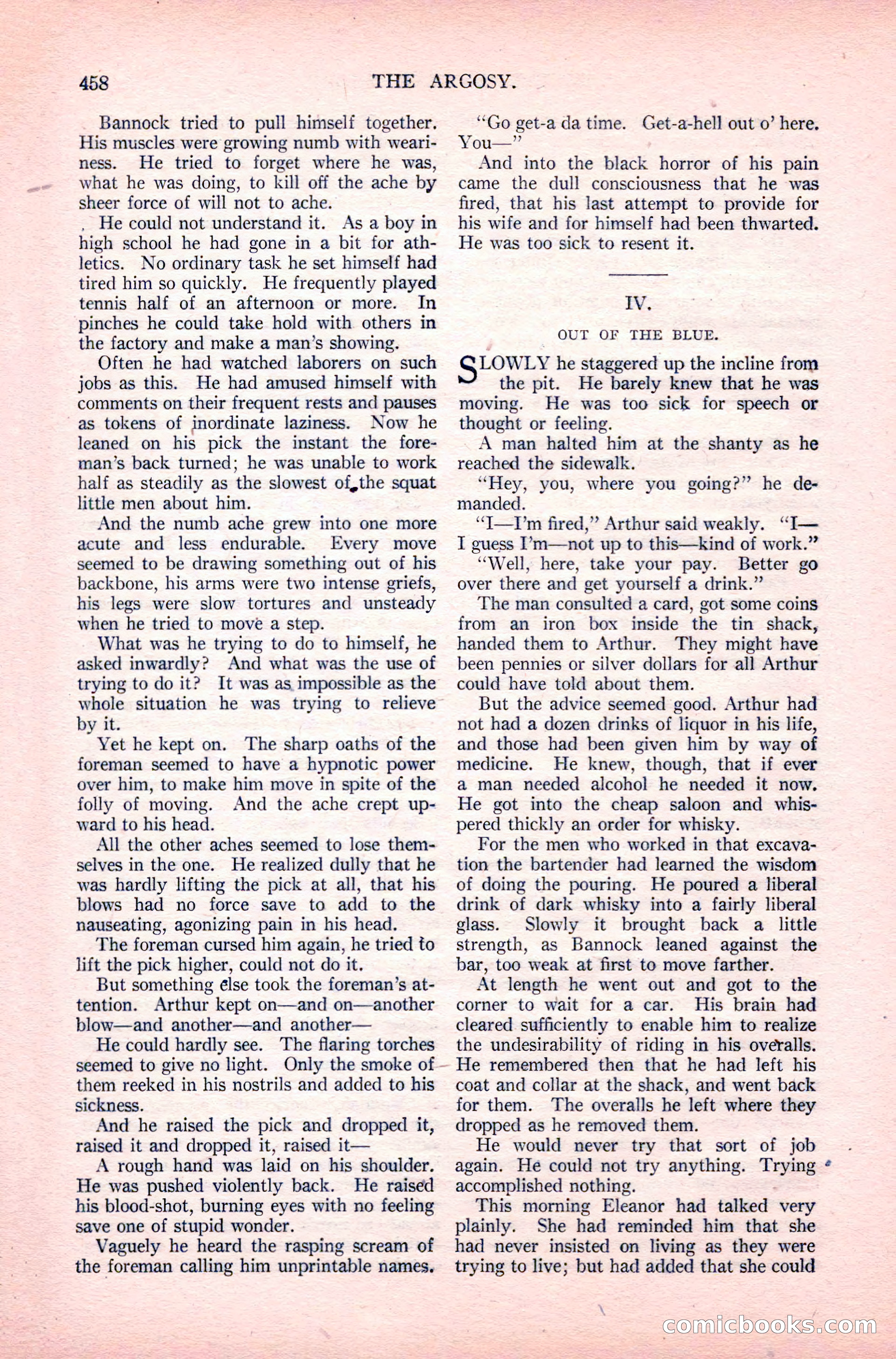
A restored page from Pulp Fiction, 1916. Page through the whole issue in the reader above.
📄 Transcribed text from this page (OCR, searchable)
Machine-transcribed from the original scan — historical spelling and the odd misread are preserved.
458 Bannock tried to pull himself together. His muscles were growing numb with weari- ness. He tried to forget where he was, what he was doing, to kill off the ache by sheer force of will not to ache. . He could not understand it. As a boy in high school he had gone in a bit for ath- letics. No ordinary task he set himself had tired him so quickly. He frequently played tennis half of an afternoon or more. In pinches he could take hold with others in the factory and make a man’s showing. Often he had watched laborers on such jobs as this. He had amused himself with comments on their frequent rests and pauses as tokens of inordinate laziness. Now he leaned on his pick the instant the fore- man’s back turned; he was unable to work half as steadily as the slowest of, the squat little men about him. And the numb ache grew into one more acute and less endurable. Every move seemed to be drawing something out of his backbone, his arms were two intense griefs, his legs were slow tortures and unsteady when he tried to move a step. What was he trying to do to himself, he asked inwardly? And what was the use of trying to do it? It was as impossible as the whole situation he was trying to relieve by it. Yet he kept on. The sharp oaths of the foreman seemed to have a hypnotic power over him, to make him move in spite of the folly of moving. And the ache crept up- ward to his head. All the other aches seemed to lose them- selves in the one. He realized dully that he was hardly lifting the pick at all, that his blows had no force save to add to the nauseating, agonizing pain in his head. The foreman cursed him again, he tried to lift the pick higher, could not do it. But something élse took the foreman’s at- tention. Arthur kept on—and on—another blow—and another—and another— He could hardly see. The flaring torches seemed to give no light. Only the smoke of them reeked in his nostrils and added to his sickness. And he raised the pick and dropped it, raised it and dropped it, raised it— A rough hand was laid on his shoulder. He was pushed violently back. He raised his blood-shot, burning eyes with no feeling save one of stupid wonder. Vaguely he heard the rasping scream of the foreman calling him unprintable names. THE ARGOSY. “Go get-a da time. Get-a-hell out o’ here. You—” And into the black horror of his pain came the dull consciousness that he was fired, that his last attempt to provide for his wife and for himself had been thwarted. He was too sick to resent it. IV, OUT OF THE BLUE. GLOWLY he staggered up the incline from the pit. He barely knew that he was moving. He was too sick for speech or thought or feeling. A man halted him at the shanty as he reached the sidewalk. “Hey, you, where you going?” he de- manded. ‘“T—T’m fired,” Arthur said weakly. “I— I guess I’m—not up to this—kind of work.” ‘Well, here, take your pay. Better go over there and get yourself a drink.” The man consulted a card, got some coins from an iron box inside the tin shack, handed them to Arthur. They might have been pennies or silver dollars for all Arthur could have told about them. But the advice seemed good. Arthur had not had a dozen drinks of liquor in his life, and those had been given him by way of medicine. He knew, though, that if ever a man needed alcohol he needed it now. He got into the cheap saloon and whis- pered thickly an order for whisky. For the men who worked in that excava- tion the bartender had learned the wisdom of doing the pouring. He poured a liberal drink of dark whisky into a fairly liberal glass. Slowly it brought back a little strength, as Bannock leaned against the bar, too weak at first to move farther. At length he went out and got to the corner to wait for a car. His brain had cleared sufficiently to enable him to realize the undesirability of riding in his overalls. He remembered then that he had left his coat and collar at the shack, and went back for them. The overalls he left where they dropped as he removed them. He would never try that sort of job again. He could not try anything. Trying accomplished nothing. This morning Eleanor had talked very plainly. She had reminded him that she had never insisted on living as they were trying to live; but had added that she could JOOKS COnmmic ty (E@)