
Pulp Fiction, 1916 · page 81 of 212
The Argosy, Vol. 82, No. 3 — page 81: what you’re looking at
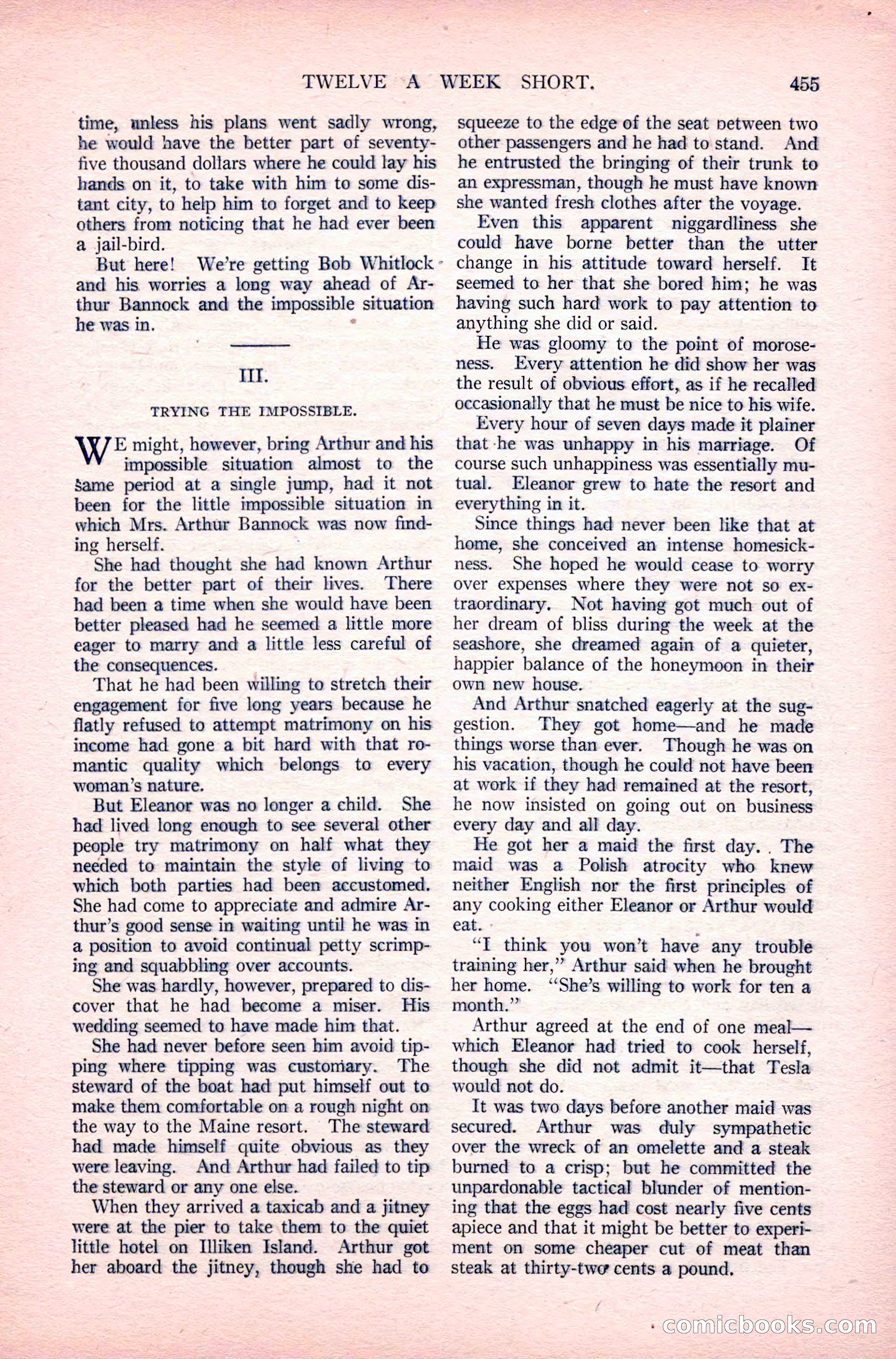
A restored page from Pulp Fiction, 1916. Page through the whole issue in the reader above.
📄 Transcribed text from this page (OCR, searchable)
Machine-transcribed from the original scan — historical spelling and the odd misread are preserved.
TWELVE time, unless his plans went sadly wrong, he would have the better part of seventy- five thousand dollars where he could lay his hands on it, to take with him to some dis- tant city, to help him to forget and to keep others from noticing that he had ever been a jail-bird. But here! and his worries a long way ahead of Ar- thur Bannock and the impossible situation he was in. Til. TRYING THE IMPOSSIBLE. WE might, however, bring Arthur and his impossible situation almost to the Same period at a single jump, had it not been for the little impossible situation in which Mrs. Arthur Bannock was now find- ing herself. She had thought she had known Arthur for the better part of their lives. There had been a time when she would have been better pleased had he seemed a little more eager to marry and a little less careful of the consequences. That he had been willing to stretch their engagement for five long years because he flatly refused to attempt matrimony on his income had gone a bit hard with that ro- mantic quality which belongs to every woman’s nature. But Eleanor was no longer a child. She had lived long enough to see several other people try matrimony on half what they needed to maintain the style of living to which both parties had been accustomed. She had come to appreciate and admire Ar- thur’s good sense in waiting until he was in a position to avoid continual petty scrimp- ing and squabbling over accounts. She was hardly, however, prepared to dis- cover that he had become a miser. His wedding seemed to have made him that. She had never before seen him avoid tip- ping where tipping was custoniary. The steward of the boat had put himself out to make them comfortable on a rough night on the way to the Maine resort. The steward had made himself quite obvious as they were leaving. And Arthur had failed to tip the steward or any one else. When they arrived a taxicab and a jitney were at the pier to take them to the quiet little hotel on Illiken Island. Arthur got her aboard the jitney, though she had to A WEEK SHORT. We're getting Bob Whitlock ° 455 squeeze to the edge of the seat petween two other passengers and he had to stand. And he entrusted the bringing of their trunk to an expressman, though he must have known she wanted fresh clothes after the voyage. Even this apparent niggardliness she could have borne better than the utter change in his attitude toward herself. It seemed to her that she bored him; he was having such hard work to pay attention to anything she did or said. He was gloomy to the point of morose- ness. Every attention he did show her was the result of obvious effort, as if he recalled occasionally that he must be nice to his wife. Every hour of seven days made it plainer that -he was unhappy in his marriage. Of course such unhappiness was essentially mu- tual. Eleanor grew to hate the resort and everything in it. Since things had never been like that at home, she conceived an intense homesick- ness. She hoped he would cease to worry Over expenses where they were not so ex- traordinary. Not having got much out of her dream of bliss during the week at the seashore, she dreamed again of a quieter, happier balance of the honeymoon in their own new house. And Arthur snatched eagerly at the sug- gestion. They got home—and he made things worse than ever. Though he was on his vacation, though he could not have been at work if they had remained at the resort, he now insisted on going out on business every day and all day. He got her a maid the first day. . The maid was a Polish atrocity who knew neither English nor the first principles of any cooking either Eleanor or Arthur would eat. “T think you won’t have any trouble training her,” Arthur said when he brought her home. “She’s willing to work for ten a month.” Arthur agreed at the end of one meal— which Eleanor had tried to cook herself, though she did not admit it—that Tesla would not do. It was two days before another maid was secured. Arthur was duly sympathetic over the wreck of an omelette and a steak burned to a crisp; but he committed the unpardonable tactical blunder of mention- ing that the eggs had cost nearly five cents apiece and that it might be better to experi- ment on some cheaper cut of meat than steak at thirty-twe cents a pound. ‘ CONNICLOOOLKKS (E@)