
Pulp Fiction, 1916 · page 80 of 212
The Argosy, Vol. 82, No. 3 — page 80: what you’re looking at
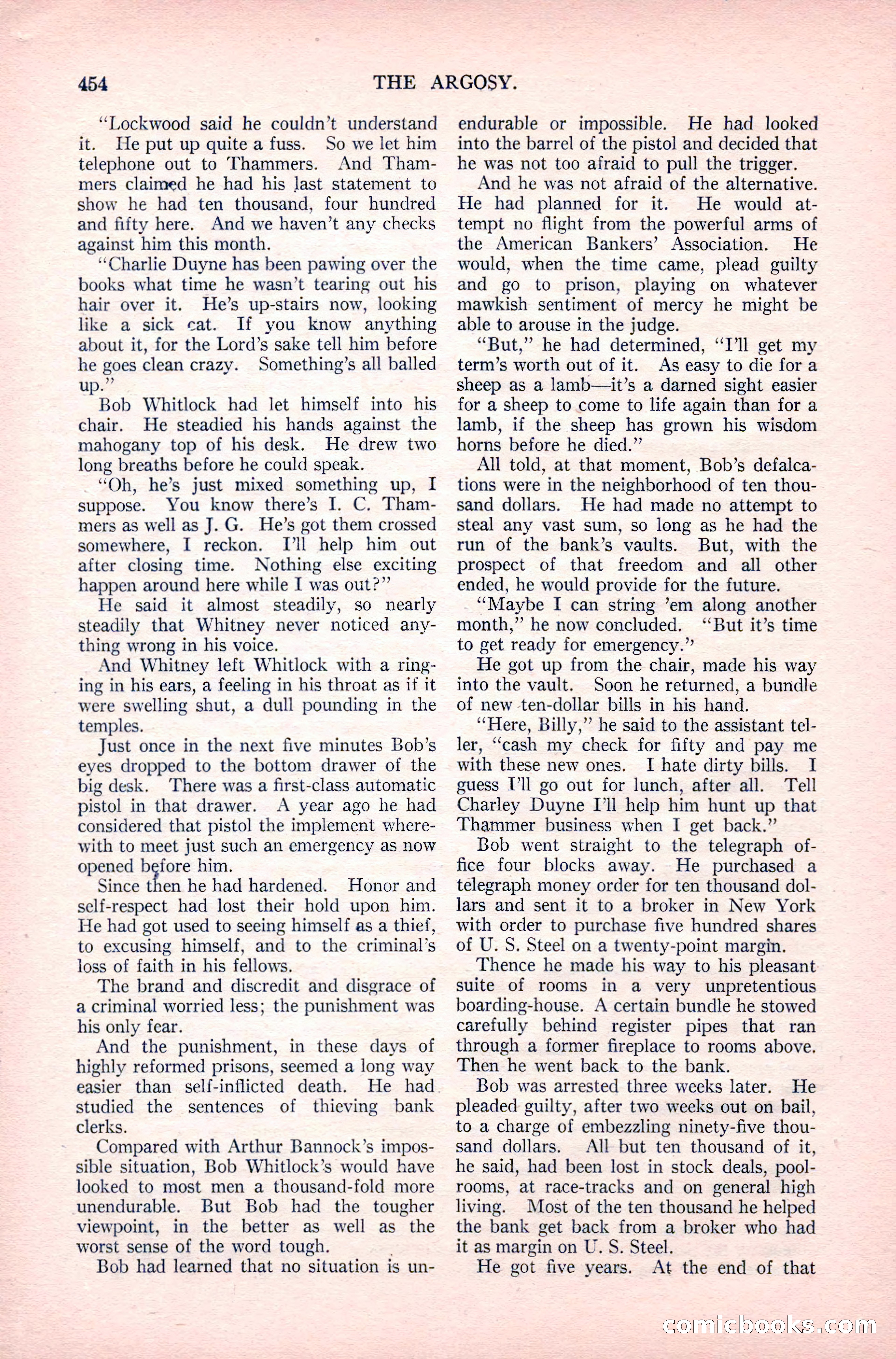
A restored page from Pulp Fiction, 1916. Page through the whole issue in the reader above.
📄 Transcribed text from this page (OCR, searchable)
Machine-transcribed from the original scan — historical spelling and the odd misread are preserved.
454 “Lockwood said he couldn’t understand it. He put up quite a fuss. So we let him telephone out to Thammers. And Tham- mers claimed he had his last statement to show he had ten thousand, four hundred and fifty here. And we haven’t any checks against him this month. ‘““Charlie Duyne has been pawing over the books what time he wasn’t tearing out his hair over it. He’s up-stairs now, looking like a sick cat. If you know anything about it, for the Lord’s sake tell him before he goes clean crazy. Something’s all balled Wipe Bob Whitlock had let himself into his chair. He steadied his hands against the mahogany top of his desk. He drew two long breaths before he could speak. “Oh, he’s just mixed something up, I suppose. You know there’s I. C. Tham- mers as well as J. G. He’s got them crossed somewhere, I reckon. I'll help him out after closing time. Nothing else exciting happen around here while I was out?” He said it almost steadily, so nearly steadily that Whitney never noticed any- thing wrong in his voice. And Whitney left Whitlock with a ring- ing in his ears, a feeling in his throat as if it were swelling shut, a dull pounding in the temples. Just once in the next five minutes Bob’s eyes dropped to the bottom drawer of the big desk. There was a first-class automatic pistol in that drawer. <A year ago he had considered that pistol the implement where- with to meet just such an emergency as now opened before him. Since then he had hardened. Honor and self-respect had lost their hold upon him. He had got used to seeing himself as a thief, to excusing himself, and to the criminal’s loss of faith in his fellows. The brand and discredit and disgrace of a criminal worried less; the punishment was his only fear. And the punishment, in these days of highly reformed prisons, seemed a long way easier than self-inflicted death. He had studied the sentences of thieving bank clerks. Compared with Arthur Bannock’s impos- sible situation, Bob Whitlock’s would have looked to most men a thousand-fold more unendurable. But Bob had the tougher viewpoint, in the better as well as the worst sense of the word tough. Bob had learned that no situation is un- THE ARGOSY. endurable or impossible. He had looked into the barrel of the pistol and decided that he was not too afraid to pull the trigger. And he was not afraid of the alternative. He had planned for it. He would at- tempt no flight from the powerful arms of the American Bankers’ Association. He would, when the time came, plead guilty and go to prison, playing on whatever mawkish sentiment of mercy he might be able to arouse in the judge. “But,” he had determined, “I'll get my term’s worth out of it. As easy to die for a sheep as a lamb—it’s a darned sight easier for a sheep to come to life again than for a lamb, if the sheep has grown his wisdom horns before he died.”’ All told, at that moment, Bob’s defalca- tions were in the neighborhood of ten thou- sand dollars. He had made no attempt to steal any vast sum, so long as he had the run of the bank’s vaults. But, with the prospect of that freedom and all other ended, he would provide for the future. ‘““Maybe I can string ’em along another month,” he now concluded. “But it’s time to get ready for emergency.” He got up from the chair, made his way into the vault. Soon he returned, a bundle of new ten-dollar bills in his hand. ‘Here, Billy,” he said to the assistant tel- ler, “cash my check for fifty and pay me with these new ones. I hate dirty bills. I guess I[’ll go out for lunch, after all. Tell Charley Duyne Ill help him hunt up that Thammer business when I get back.” Bob went straight to the telegraph of- fice four blocks away. He purchased a telegraph money order for ten thousand dol- lars and sent it to a broker in New York with order to purchase five hundred shares of U.S. Steel on a twenty-point margin. Thence he made his way to his pleasant suite of rooms in a very unpretentious boarding-house. A certain bundle he stowed carefully behind register pipes that ran through a former fireplace to rooms above. Then he went back to the bank. Bob was arrested three weeks later. He pleaded guilty, after two weeks out on bail, to a charge of embezzling ninety-five thou- sand dollars. All but ten thousand of it, he said, had been lost in stock deals, pool- rooms, at race-tracks and on general high living. Most of the ten thousand he helped the bank get back from a broker who had it as margin on U. S. Steel. He got five years. At the end of that COPMICLOOOKS (C@)