
Pulp Fiction, 1916 · page 82 of 212
The Argosy, Vol. 82, No. 3 — page 82: what you’re looking at
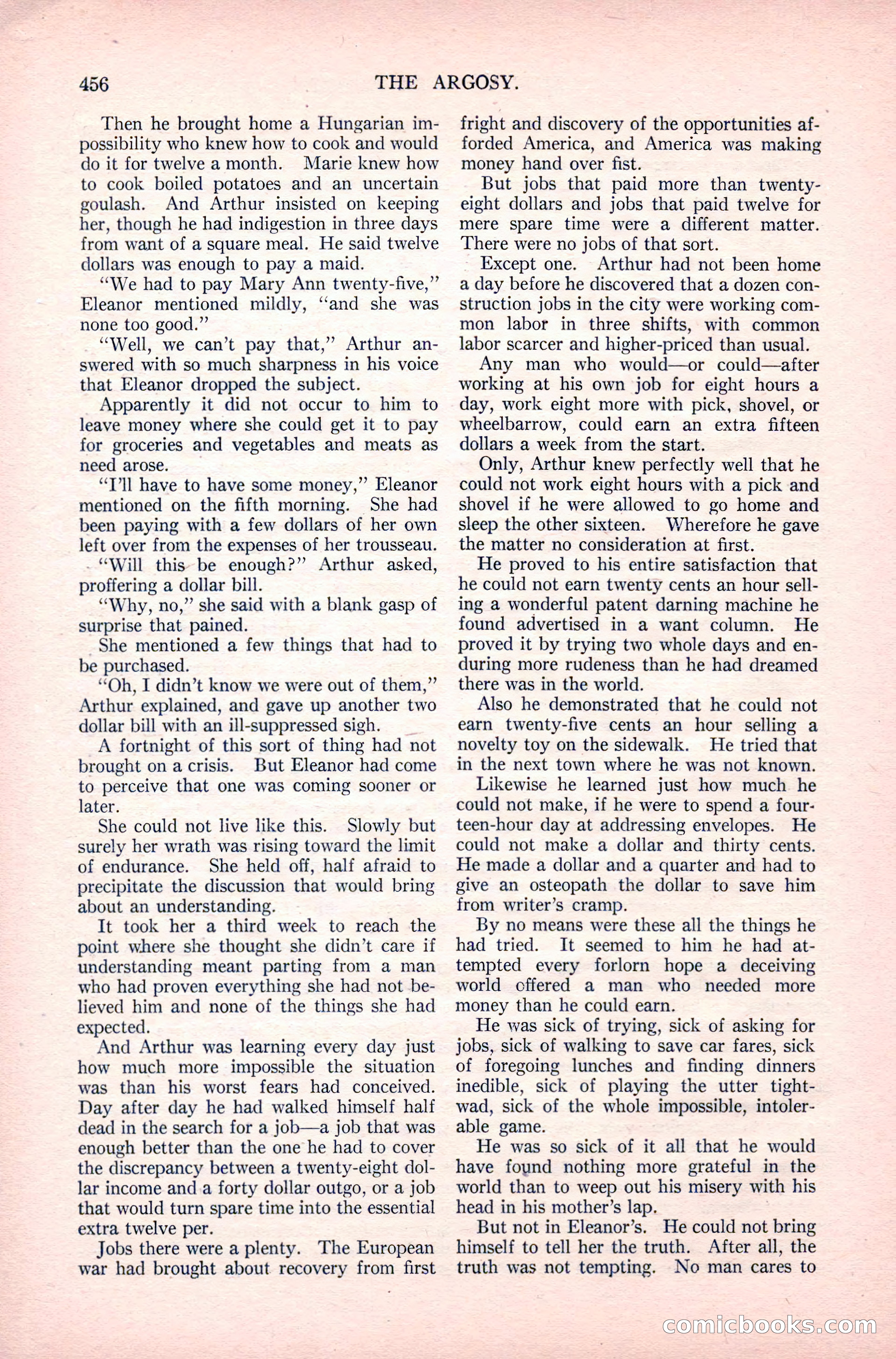
A restored page from Pulp Fiction, 1916. Page through the whole issue in the reader above.
📄 Transcribed text from this page (OCR, searchable)
Machine-transcribed from the original scan — historical spelling and the odd misread are preserved.
456 Then he brought home a Hungarian im- possibility who knew how to cook and would do it for twelve a month. Marie knew how to cook boiled potatoes and an uncertain goulash. And Arthur insisted on keeping her, though he had indigestion in three days from want of a square meal. He said twelve dollars was enough to pay a maid. “We had to pay Mary Ann twenty-five,” Eleanor mentioned mildly, ‘‘and she was none too good.” “Well, we can’t pay that,” Arthur an- swered with so much sharpness in his voice that Eleanor dropped the subject. Apparently it did not occur to him to leave money where she could get it to pay for groceries and vegetables and meats as need arose. “T’ll have to have some money,” Eleanor mentioned on the fifth morning. She had been paying with a few dollars of her own left over from the expenses of her trousseau. _ “Will this be enough?” Arthur asked, proffering a dollar bill. “Why, no,” she said with a blank gasp of surprise that pained. She mentioned a few things that had to be purchased. “Oh, I didn’t know we were out of them,” Arthur explained, and gave up another two dollar bill with an ill-suppressed sigh. A fortnight of this sort of thing had not brought on a crisis. But Eleanor had come to perceive that one was coming sooner or later. She could not live like this. Slowly but surely her wrath was rising toward the limit of endurance. She held off, half afraid to precipitate the discussion that would bring about an understanding. It took her a third week to reach the point where she thought she didn’t care if understanding meant parting from a man who had proven everything she had not be- lieved him and none of the things she had expected. And Arthur was learning every day just how much more impossible the situation was than his worst fears had conceived. Day after day he had walked himself half dead in the search for a job—a job that was enough better than the one he had to cover the discrepancy between a twenty-eight dol- lar income and a forty dollar outgo, or a job that would turn spare time into the essential extra twelve per. Jobs there were a plenty. The European war had brought about recovery from first THE ARGOSY. fright and discovery of the opportunities af- | forded America, and America was making money hand over fist. But jobs that paid more than twenty- eight dollars and jobs that paid twelve for mere spare time were a different matter. There were no jobs of that sort. Except one. Arthur had not been home a day before he discovered that a dozen con- struction jobs in the city were working com- mon labor in three shifts, with common labor scarcer and higher-priced than usual. Any man who would—or could—after working at his own job for eight hours a day, work eight more with pick, shovel, or wheelbarrow, could earn an extra fifteen dollars a week from the start. Only, Arthur knew perfectly well that he could not work eight hours with a pick and shovel if he were allowed to go home and sleep the other sixteen. Wherefore he gave the matter no consideration at first. He proved to his entire satisfaction that he could not earn twenty cents an hour sell- ing a wonderful patent darning machine he found advertised in a want column. He proved it by trying two whole days and en- during more rudeness than he had dreamed there was in the world. Also he demonstrated that he could not earn twenty-five cents an hour selling a novelty toy on the sidewalk. He tried that in the next town where he was not known. Likewise he learned just how much he could not make, if he were to spend a four- teen-hour day at addressing envelopes. He could not make a dollar and thirty cents. He made a dollar and a quarter and had to give an osteopath the dollar to save him from writer’s cramp. By no means were these all the things he had tried. It seemed to him he had at- tempted every forlorn hope a deceiving world cffered a man who needed more money than he could earn. He was sick of trying, sick of asking for jobs, sick of walking to save car fares, sick of foregoing lunches and finding dinners inedible, sick of playing the utter tight- wad, sick of the whole impossible, intoler- able game. He was so sick of it all that he would have found nothing more grateful in the world than to weep out his misery with his head in his mother’s lap. But not in Eleanor’s. He could not bring himself to tell her the truth. After all, the truth was not tempting. No man cares to Go VOOLKS mie (C@