
Pulp Fiction, 1916 · page 79 of 212
The Argosy, Vol. 82, No. 3 — page 79: what you’re looking at
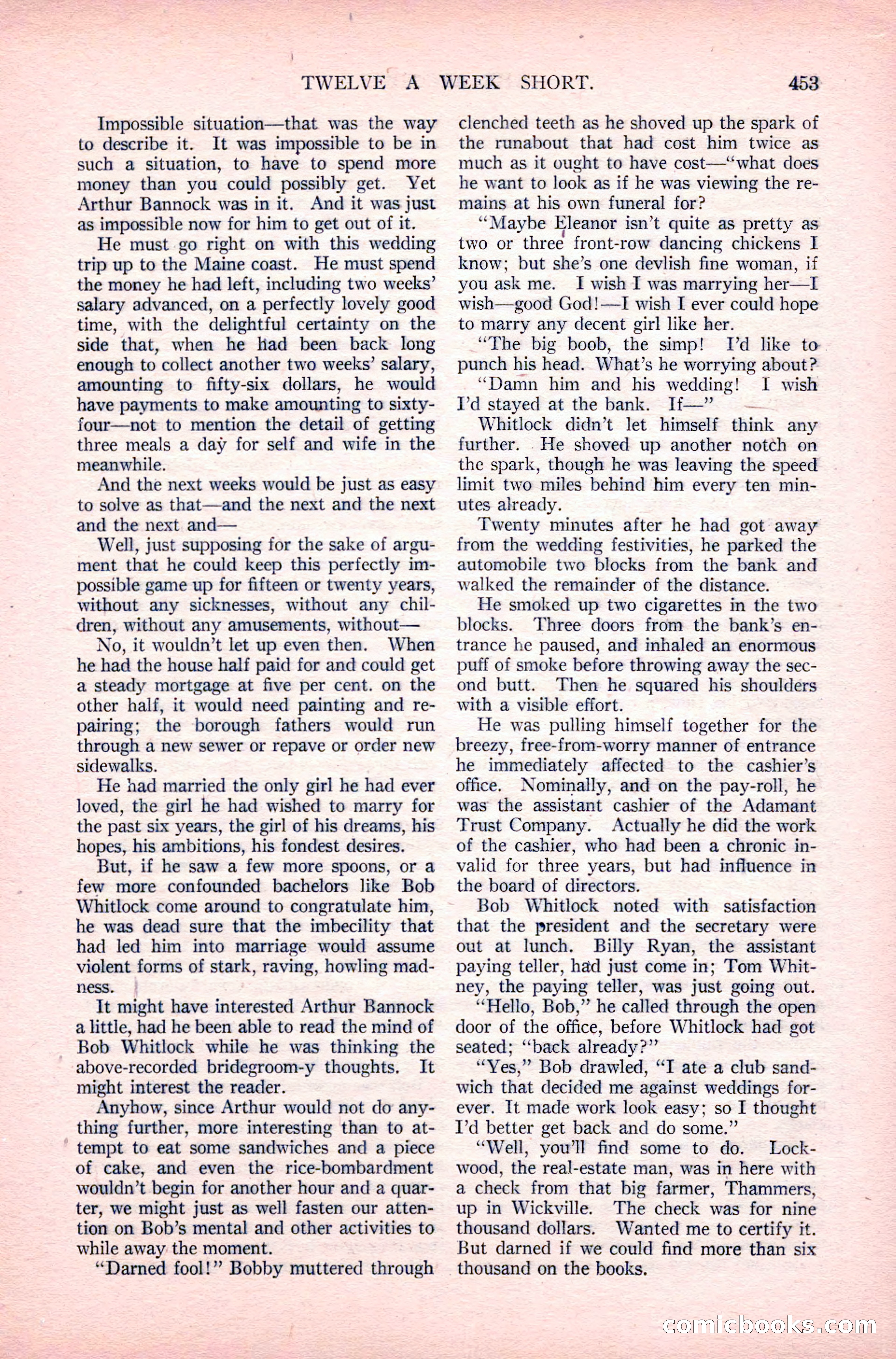
A restored page from Pulp Fiction, 1916. Page through the whole issue in the reader above.
📄 Transcribed text from this page (OCR, searchable)
Machine-transcribed from the original scan — historical spelling and the odd misread are preserved.
| TWELVE A WEEK SHORT. Impossible situation—that was the way to describe it. It was impossible to be in such a situation, to have to spend more money than you could possibly get. Yet Arthur Bannock was in it. And it was just as impossible now for him to get out of it. He must go right on with this wedding trip up to the Maine coast. He must spend the money he had left, including two weeks’ salary advanced, on a perfectly lovely good time, with the delightful certainty on the side that, when he Had been back long enough to collect another two weeks’ salary, amounting to fifty-six dollars, he would have payments to make amounting to sixty- four—not to mention the detail of getting three meals a day for self and wife in the meanwhile. And the next weeks would be just as easy to solve as that—and the next and the next and the next and— Well, just supposing for the sake of argu- ment that he could keep this perfectly im- possible game up for fifteen or twenty years, without any sicknesses, without any chil- dren, without any amusements, without— No, it wouldn’t let up even then. When he had the house half paid for and could get a steady mortgage at five per cent. on the other half, it would need painting and re- pairing; the borough fathers would run through a new sewer or repave or order new sidewalks. He had married the only girl he had ever loved, the girl he had wished to marry for the past six years, the girl of his dreams, his hopes, his ambitions, his fondest desires. But, if he saw a few more spoons, or a few more confounded bachelors like Bob Whitlock come around to congratulate him, he was dead sure that the imbecility that had led him into marriage would assume violent forms of stark, raving, howling mad- ness. It might have interested Arthur Bannock a little, had he been able to read the mind of Bob Whitlock while he was thinking the above-recorded bridegroom-y thoughts, It might interest the reader. Anyhow, since Arthur would not do any- thing further, more interesting than to at- tempt to eat some sandwiches and a piece of cake, and even the rice-bombardment wouldn’t begin for another hour and a quar- ter, we might just as well fasten our atten- tion on Bob’s mental and other activities to while away the moment. “Darned fool!” Bobby muttered through 453 clenched teeth as he shoved up the spark of the runabout that had cost him twice as much as it ought to have cost—‘‘what does he want to look as if he was viewing the re- mains at his own funeral for? “Maybe Eleanor isn’t quite as pretty as two or three front-row dancing chickens I know; but she’s one devlish fine woman, if you ask me. I wish I was marrying her—I wish—good God!—I wish I ever could hope to marry any decent girl like her. “The big boob, the simp! I’d like to punch his head. What’s he worrying about? “Damn him and his wedding! I wish I’d stayed at the bank. If—” ~— Whitlock didn’t let himself think any further. .He shoved up another notch on the spark, though he was leaving the speed limit two miles behind him every ten min- utes already. Twenty minutes after he had got away from the wedding festivities, he parked the automobile two blocks from the bank and walked the remainder of the distance. He smoked up two cigarettes in the two blocks. Three doors from the bank’s en- trance he paused, and inhaled an enormous puff of smoke before throwing away the sec- ond butt. Then he squared his shoulders with a visible effort. He was pulling himself together for the breezy, free-from-worry manner of entrance he immediately affected to the cashier’s office. Nominally, and on the pay-roll, he was the assistant cashier of the Adamant Trust Company. Actually he did the work of the cashier, who had been a chronic in- valid for three years, but had influence in the board of directors. Bob Whitlock noted with satisfaction that the president and the secretary were out at lunch. Billy Ryan, the assistant paying teller, had just come in; Tom Whit- ney, the paying teller, was just going out. “Hello, Bob,” he called through the open door of the office, before Whitlock had got seated; ‘back already?” “Ves,” Bob drawled, “I ate a club sand- wich that decided me against weddings for- ever. It made work look easy; so I thought I’d better get back and do some.” “Well, you'll find some to do. Lock- wood, the real-estate man, was in here with a check from that big farmer, Thammers, up in Wickville. The check was for nine thousand dollars. Wanted me to certify it. But darned if we could find more than six thousand on the books. COMMICLOOOKS (C@)