
Pulp Fiction, 1916 · page 145 of 212
The Argosy, Vol. 82, No. 3 — page 145: what you’re looking at
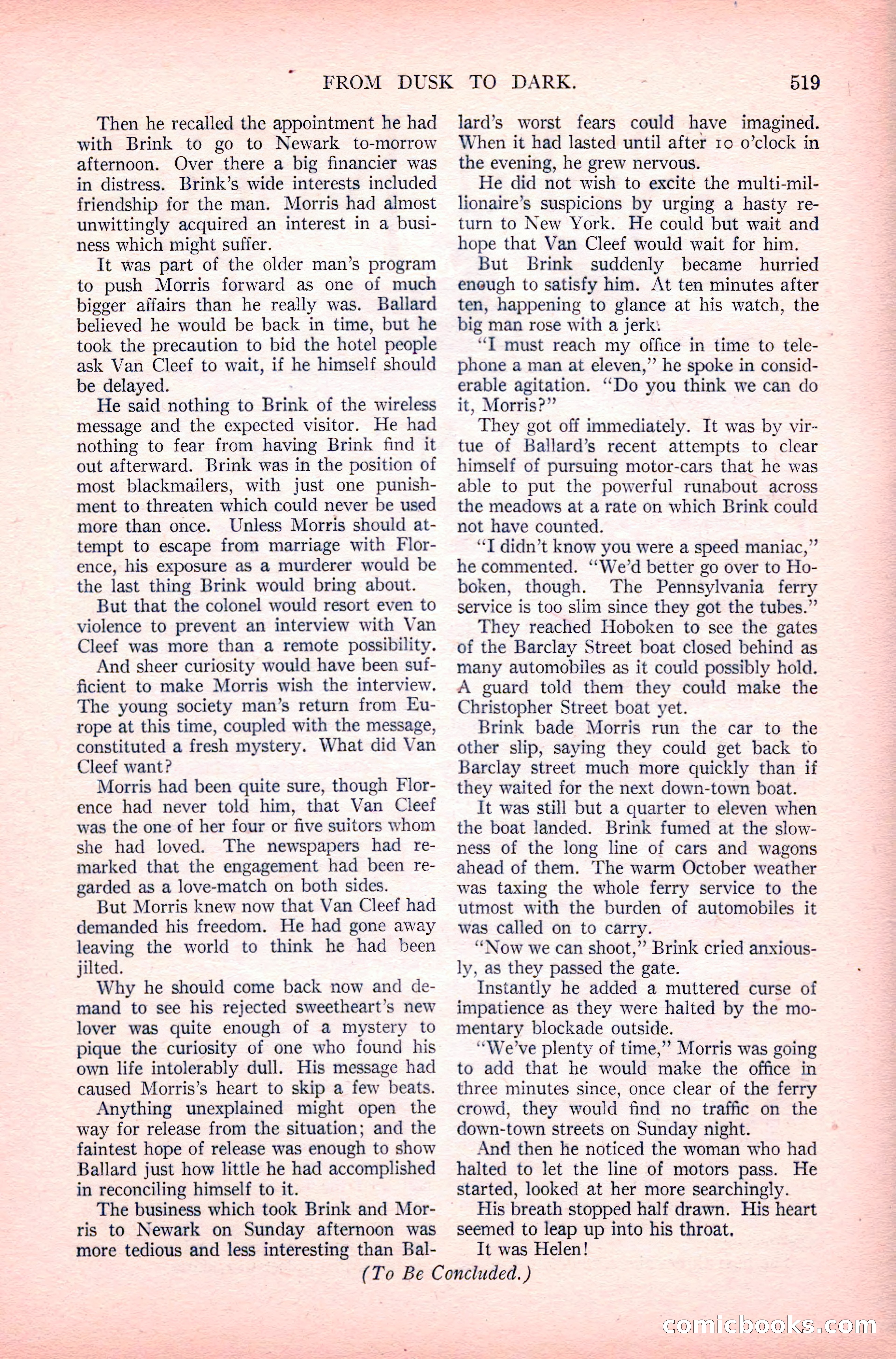
A restored page from Pulp Fiction, 1916. Page through the whole issue in the reader above.
📄 Transcribed text from this page (OCR, searchable)
Machine-transcribed from the original scan — historical spelling and the odd misread are preserved.
FROM DUSK TO DARK. Then he recalled the appointment he had with Brink to go to Newark to-morrow afternoon. Over there a big financier was in distress. Brink’s wide interests included friendship for the man. Morris had almost unwittingly acquired an interest in a busi- ness which might suffer. It was part of the older man’s program to push Morris forward as one of much bigger affairs than he really was. Ballard believed he would be back in time, but he took the precaution to bid the hotel people ask Van Cleef to wait, if he himself should be delayed. He said nothing to Brink of the wireless message and the expected visitor. He had nothing to fear from having Brink find it out afterward. Brink was in the position of most blackmailers, with just one punish- ment to threaten which could never be used more than once. Unless Morris should at- tempt to escape from marriage with Flor- ence, his exposure as a murderer would be the last thing Brink would bring about. But that the colonel would resort even to violence to prevent an interview with Van Cleef was more than a remote possibility. And sheer curiosity would have been suf- ficient to make Morris wish the interview. The young society man’s return from Eu- rope at this time, coupled with the message, constituted a fresh mystery. What did Van Cleef want? Morris had been quite sure, though Flor- ence had never told him, that Van Cleef was the one of her four or five suitors whom she had loved. The newspapers had re- marked that the engagement had been re- garded as a love-match on both sides. But Morris knew now that Van Cleef had demanded his freedom. He had gone away leaving the world to think he had been jilted. Why he should come back now and de- mand to see his rejected sweetheart’s new lover was quite enough of a mystery to pique the curiosity of one who found his own life intolerably dull. His message had caused Morris’s heart to skip a few beats. Anything unexplained might open the way for release from the situation; and the faintest hope of release was enough to show Ballard just how little he had accomplished in reconciling himself to it. The business which took Brink and Mor- ris to Newark on Sunday afternoon was more tedious and less interesting than Bal- 519 lard’s worst fears could have imagined. When it had lasted until after 10 o’clock in the evening, he grew nervous. He did not wish to excite the multi-mil- lionaire’s suspicions by urging a hasty re- turn to New York. He could but wait and hope that Van Cleef would wait for him. But Brink suddenly became hurried eneugh to satisfy him. At ten minutes after ten, happening to glance at his watch, the big man rose with a jerk: “T must reach my office in time to tele- phone a man at eleven,” he spoke in consid- erable agitation. “Do you think we can do it, Morris?” They got off immediately. It was by vir- tue of Ballard’s recent attempts to clear himself of pursuing motor-cars that he was able to put the powerful runabout across the meadows at a rate on which Brink could not have counted. “T didn’t know you were a speed maniac,” he commented. ‘“We’d better go over to Ho- boken, though. The Pennsylvania ferry service is too slim since they got the tubes.” They reached Hoboken to see the gates of the Barclay Street boat closed behind as many automobiles as it could possibly hold. A guard told them they could make the Christopher Street boat yet. Brink bade Morris run the car to the other slip, saying they could get back to Barclay street much more quickly than if they waited for the next down-town boat. it was still but a quarter to eleven when the boat landed. Brink fumed at the slow- ness of the long line of cars and wagons ahead of them. The warm October weather was taxing the whole ferry service to the utmost with the burden of automobiles it was called on to carry. “Now we can shoot,” Brink cried anxious- ly, as they passed the gate. Instantly he added a muttered curse of impatience as they were halted by the mo- mentary blockade outside. ‘“We’ve plenty of time,” Morris was going to add that he would make the office in three minutes since, once clear of the ferry crowd, they would find no traffic on the down-town streets on Sunday night. And then he noticed the woman who had halted to let the line of motors pass. He started, looked at her more searchingly. His breath stopped half drawn. His heart seemed to leap up into his throat. It was Helen! (To Be Concluded. ) Go NOOLKS (E@)