
Pulp Fiction, 1916 · page 146 of 212
The Argosy, Vol. 82, No. 3 — page 146: what you’re looking at
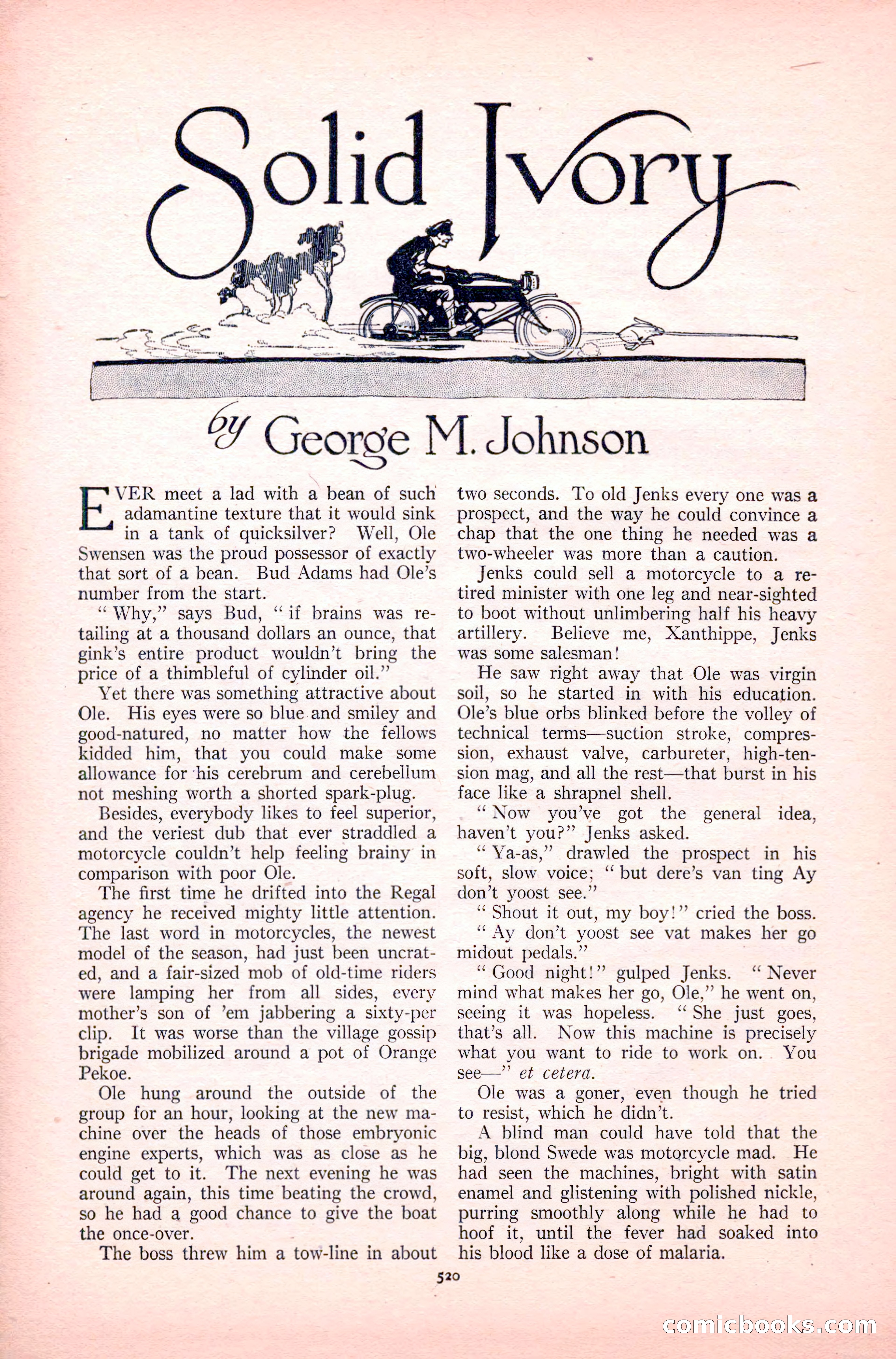
A restored page from Pulp Fiction, 1916. Page through the whole issue in the reader above.
📄 Transcribed text from this page (OCR, searchable)
Machine-transcribed from the original scan — historical spelling and the odd misread are preserved.
oY George M. Ichaaues adamantine texture that it would sink in a tank of quicksilver? Well, Ole Swensen was the proud possessor of exactly that sort of a bean. Bud Adams had Ole’s number from the start. “Why,” says Bud, “if brains was re- tailing at a thousand dollars an ounce, that gink’s entire product wouldn’t bring the price of a thimbleful of cylinder oil.” Yet there was something attractive about Ole. His eyes were so blue and smiley and good-natured, no matter how the fellows kidded him, that you could make some allowance for ‘his cerebrum and cerebellum not meshing worth a shorted spark-plug. Besides, everybody likes to feel superior, and the veriest dub that ever straddled a motorcycle couldn’t help feeling brainy in comparison with poor Ole. The first time he drifted into the Regal agency he received mighty little attention. The last word in motorcycles, the newest model of the season, had just been uncrat- ed, and a fair-sized mob of old-time riders were lamping her from all sides, every mother’s son of ’em jabbering a sixty-per clip. It was worse than the village gossip brigade mobilized around a pot of Orange Pekoe. Ole hung around the outside of the group for an hour, looking at the new ma- chine over the heads of those embryonic engine experts, which was as close as he could get to it. The next evening he was around again, this time beating the crowd, so he had a good chance to give the boat the once-over. 3 The boss threw him a tow-line in about b* ER meet a lad with a bean of such two seconds. To old Jenks every one was a prospect, and the way he could convince a chap that the one thing he needed was a two-wheeler was more than a caution. Jenks could sell a motorcycle to a re- tired minister with one leg and near-sighted to boot without unlimbering half his heavy artillery. Believe me, Xanthippe, Jenks was some salesman! He saw right away that Ole was virgin soil, so he started in with his education. Ole’s blue orbs blinked before the volley of technical terms—suction stroke, compres- sion, exhaust valve, carbureter, high-ten- sion mag, and all the rest—that burst in his face like a shrapnel shell. ‘““Now you’ve got the general idea, haven’t you?” Jenks asked. “Ya-as,” drawled the prospect in his soft, slow voice; “‘ but dere’s van ting Ay don’t yoost see.” ‘“ Shout it out, my boy!” cried the boss. ‘““Ay don’t yoost see vat makes her go midout pedals.” ‘Good night!” gulped Jenks. ‘‘ Never mind what makes her go, Ole,” he went on, seeing it was hopeless. “She just goes, that’s all. Now this machine is precisely what you want to ride to work on. You see—’’ et cetera. Ole was a goner, even though he tried to resist, which he didn’t. A blind man could have told that the big, blond Swede was motorcycle mad. He had seen the machines, bright with satin enamel and glistening with polished nickle, purring smoothly along while he had to hoof it, until the fever had soaked into his blood like a dose of malaria. 520 EOPMICLOOOLX< (C@)