
Pulp Fiction, 1916 · page 144 of 212
The Argosy, Vol. 82, No. 3 — page 144: what you’re looking at
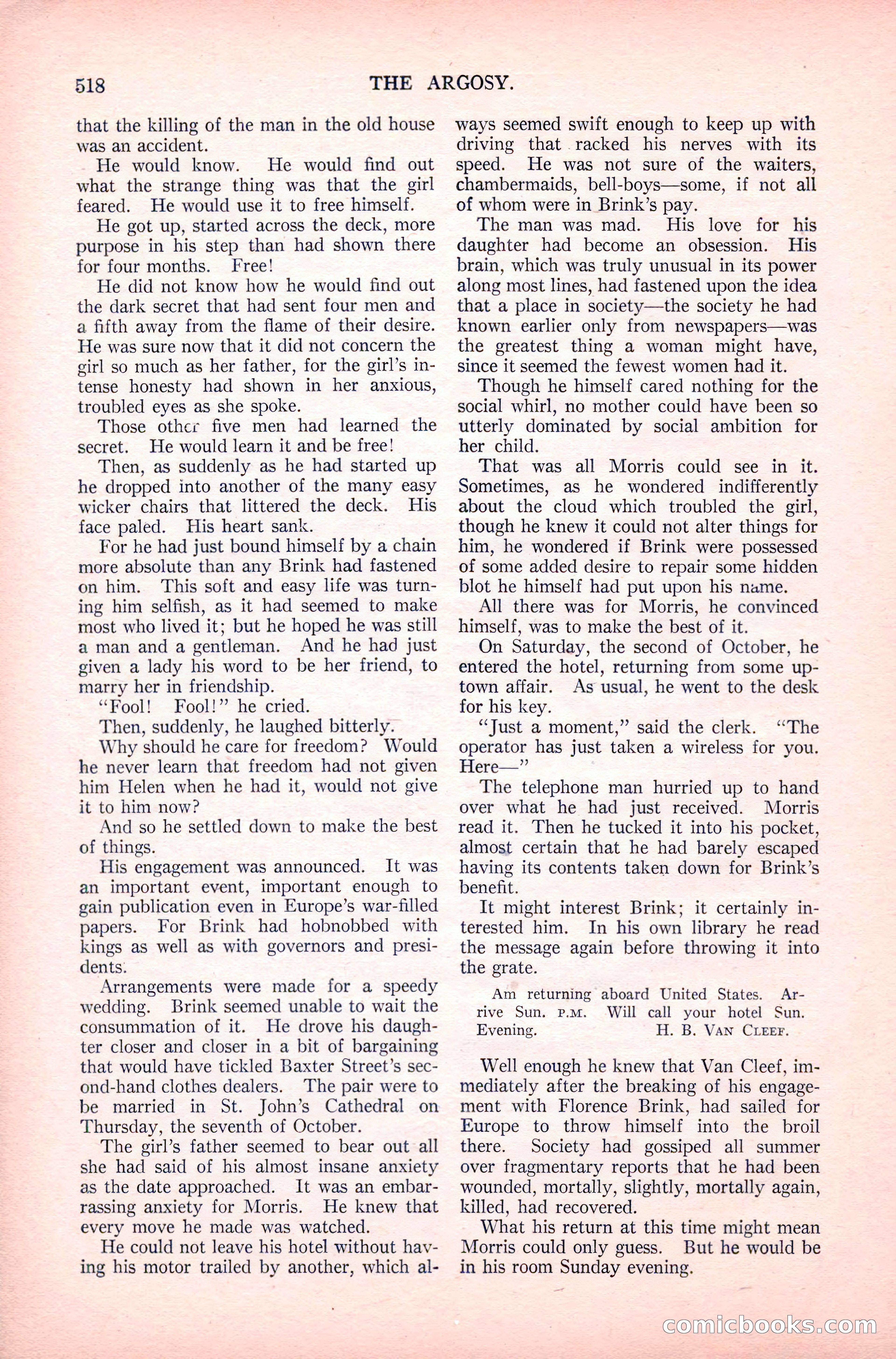
A restored page from Pulp Fiction, 1916. Page through the whole issue in the reader above.
📄 Transcribed text from this page (OCR, searchable)
Machine-transcribed from the original scan — historical spelling and the odd misread are preserved.
518 that the killing of the man in the old house was an accident. He would know. He would find out what the strange thing was that the girl feared. He would use it to free himself. He got up, started across the deck, more purpose in his step than had shown there for four months. Free! He did not know how he would find out the dark secret that had sent four men and a fifth away from the flame of their desire. He was sure now that it did not concern the girl so much as her father, for the girl’s in- tense honesty had shown in her anxious, troubled eyes as she spoke. Those othcr five men had learned the secret. He would learn it and be free! Then, as suddenly as he had started up he dropped into another of the many easy wicker chairs that littered the deck. His face paled. His heart sank. For he had just bound himself by a chain more absolute than any Brink had fastened on him. ‘This soft and easy life was turn- ing him selfish, as it had seemed to make most who lived it; but he hoped he was still a man and a gentleman. And he had just given a lady his word to be her friend, to marry her in friendship. “Fool! Fool!” he cried. Then, suddenly, he laughed bitterly. Why should he care for freedom? Would he never learn that freedom had not given him Helen when he had it, would not give it to him now? And so he settled down to make the best of things. His engagement was announced. It was an important event, important enough to gain publication even in Europe’s war-filled papers. For Brink had hobnobbed with kings as well as with governors and presi- dents. Arrangements were made for a speedy wedding. Brink seemed unable to wait the consummation of it. He drove his daugh- ter closer and closer in a bit of bargaining that would have tickled Baxter Street’s sec- ond-hand clothes dealers. The pair were to be married in St. John’s Cathedral on Thursday, the seventh of October. The girl’s father seemed to bear out all she had said of his almost insane anxiety as the date approached. It was an embar- rassing anxiety for Morris. He knew that every move he made was watched. He could not leave his hotel without hav- ing his motor trailed by another, which al- THE ARGOSY. ways seemed swift enough to keep up with driving that racked his nerves with its speed. He was not sure of the waiters, chambermaids, bell-boys—some, if not all of whom were in Brink’s pay. The man was mad. His love for his daughter had become an obsession. His brain, which was truly unusual in its power along most lines, had fastened upon the idea that a place in society—the society he had known earlier only from newspapers—was the greatest thing a woman might have, since it seemed the fewest women had it. Though he himself cared nothing for the social whirl, no mother could have been so utterly dominated by social ambition for her child. That was all Morris could see in it. Sometimes, as he wondered indifferently about the cloud which troubled the girl, though he knew it could not alter things for him, he wondered if Brink were possessed of some added desire to repair some hidden blot he himself had put upon his name. All there was for Morris, he convinced himself, was to make the best of it. On Saturday, the second of October, he entered the hotel, returning from some up- town affair. As usual, he went to the desk for his key. “Just a moment,” said the clerk. ‘‘The operator has just taken a wireless for you. Here—”’ The telephone man hurried up to hand over what he had just received. Morris read it. Then he tucked it into his pocket, almost certain that he had barely escaped having its contents taken down for Brink’s benefit. It might interest Brink; it certainly in- terested him. In his own library he read the message again before throwing it into the grate. Ar- Will call your hotel Sun. H. B. Van CLEEF. Am returning aboard United States. rive Sun. P.M. Evening. Well enough he knew that Van Cleef, im- mediately after the breaking of his engage- ment with Florence Brink, had sailed for Europe to throw himself into the broil there. Society had gossiped all summer over fragmentary reports that he had been wounded, mortally, slightly, mortally again, killed, had recovered. What his return at this time might mean Morris could only guess. But he would be in his room Sunday evening. (EO) oOOLK (C@)