
Pulp Fiction, 1916 · page 143 of 212
The Argosy, Vol. 82, No. 3 — page 143: what you’re looking at
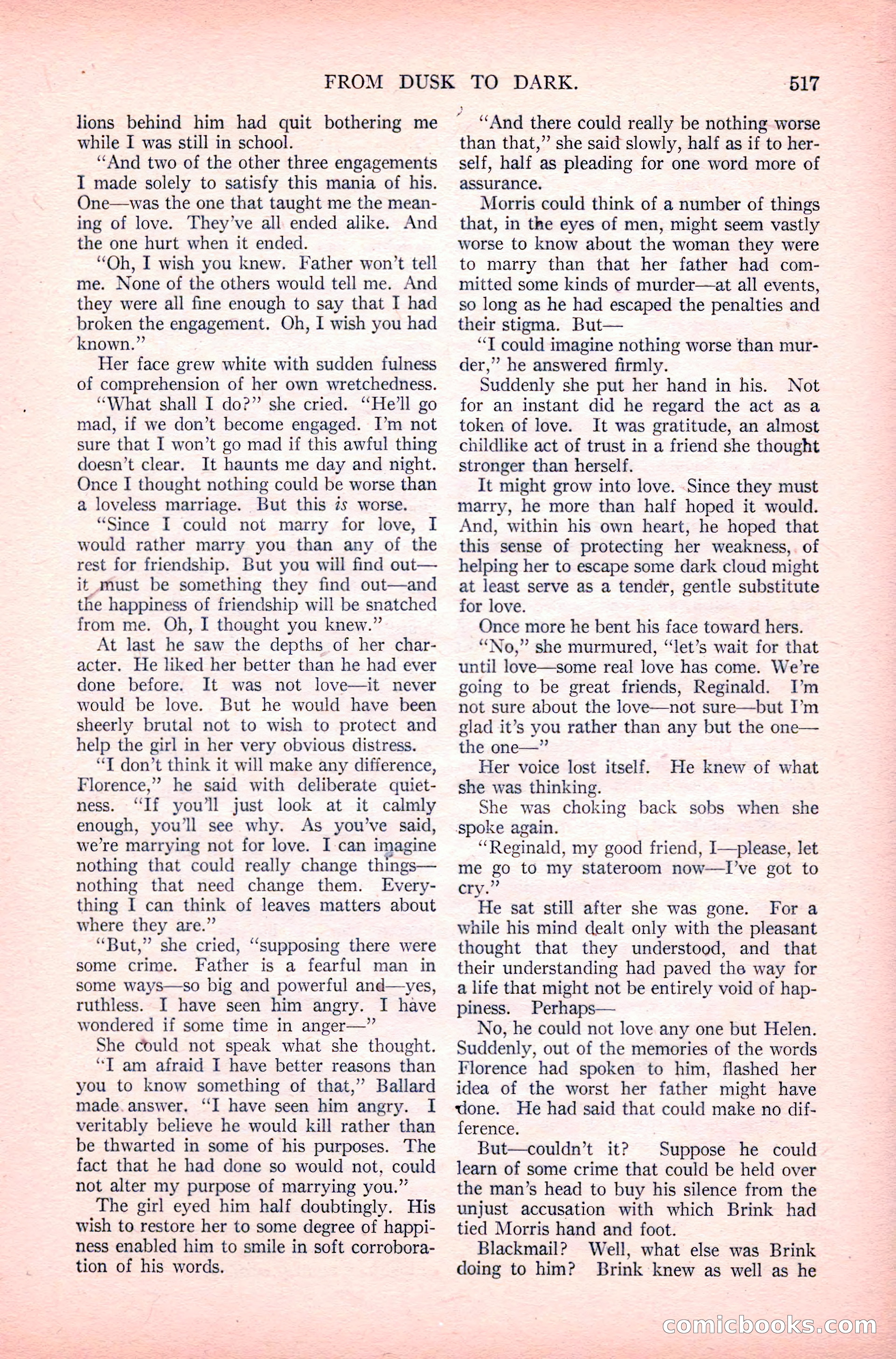
A restored page from Pulp Fiction, 1916. Page through the whole issue in the reader above.
📄 Transcribed text from this page (OCR, searchable)
Machine-transcribed from the original scan — historical spelling and the odd misread are preserved.
FROM DUSK TO DARK. lions behind him had quit bothering me while I was still in school. ‘“And two of the other three engagements I made solely to satisfy this mania of his. One—was the one that taught me the mean- ing of love. They’ve all ended alike. And the one hurt when it ended. “Oh, I wish you knew. Father won’t tell me. None of the others would tell me. And they were all fine enough to say that I had broken the engagement. Oh, I wish you had known.” Her face grew white with sudden fulness of comprehension of her own wretchedness. “What shall I do?” she cried. “He'll go mad, if we don’t become engaged. I’m not sure that I won’t go mad if this awful thing doesn’t clear. It haunts me day and night. Once I thought nothing could be worse than a loveless marriage. But this zs worse. “Since I could not marry for love, I would rather marry you than any of the rest for friendship. But you will find out— it must be something they find out—and the happiness of friendship will be snatched from me. Oh, I thought you knew.” At last he saw the depths of her char- acter. He liked her better than he had ever done before. It was not love—it never would be love. But he would have been sheerly brutal not to wish to protect and help the girl in her very obvious distress. “TY don’t think it will make any difference, Florence,” he said with deliberate quiet- ness. “If you'll just look at it calmly enough, you'll see why. As you’ve said, we're marrying not for love. I-can imagine nothing that could really change things— nothing that need change them. Every- thing I can think of leaves matters about where they are.” “But,” she cried, “supposing there were some crime. Father is a fearful man in some ways—so big and powerful and—yes, ruthless. I have seen him angry. I have wondered if some time in anger—” She could not speak what she thought. “ft am afraid I have better reasons than you to know something of that,” Ballard made. answer. “I have seen him angry. I veritably believe he would kill rather than be thwarted in some of his purposes. The fact that he had done so would not, could not alter my purpose of marrying you.” The girl eyed him half doubtingly. His wish to restore her to some degree of happi- ness enabled him to smile in soft corrobora- tion of his words. 517 ‘“And there could really be nothing worse than that,” she said slowly, half as if to her- self, half as pleading for one word more of assurance. Morris could think of a number of things that, in the eyes of men, might seem vastly worse to know about the woman they were to marry than that her father had com- mitted some kinds of murder—at all events, so long as he had escaped the penalties and their stigma. But— ‘“T could imagine nothing worse than mur- der,” he answered firmly. Suddenly she put her hand in his. Not for an instant did he regard the act as a token of love. It was gratitude, an almost childlike act of trust in a friend she thought stronger than herself. It might grow into love. Since they must marry, he more than half hoped it would. And, within his own heart, he hoped that this sense of protecting her weakness, of helping her to escape some dark cloud might at least serve as a tender, gentle substitute for love. Once more he bent his face toward hers. “No,” she murmured, “‘let’s wait for that until love—some real love has come. We’re going to be great friends, Reginald. I’m not sure about the love—not sure—but I’m glad it’s you rather than any but the one— the one—” Her voice lost itself. she was thinking. She was choking back sobs when she spoke again. ‘Reginald, my good friend, I—please, let me go to my stateroom now—l’ve got to cry.” He sat still after she was gone. For a while his mind dealt only with the pleasant thought that they understood, and that their understanding had paved the way for a life that might not be entirely void of hap- piness. Perhaps— No, he could not love any one but Helen. Suddenly, out of the memories of the words Florence had spoken to him, flashed her idea of the worst her father might have done. He had said that could make no dif- ference. But—couldn’t it? Suppose he could learn of some crime that could be held over the man’s head to buy his silence from the unjust accusation with which Brink had tied Morris hand and foot. Blackmail? Well, what else was Brink doing to him? Brink knew as well as he He knew of what CORNICGLOOOKS (C@)