
Pulp Fiction, 1916 · page 140 of 212
The Argosy, Vol. 82, No. 3 — page 140: what you’re looking at
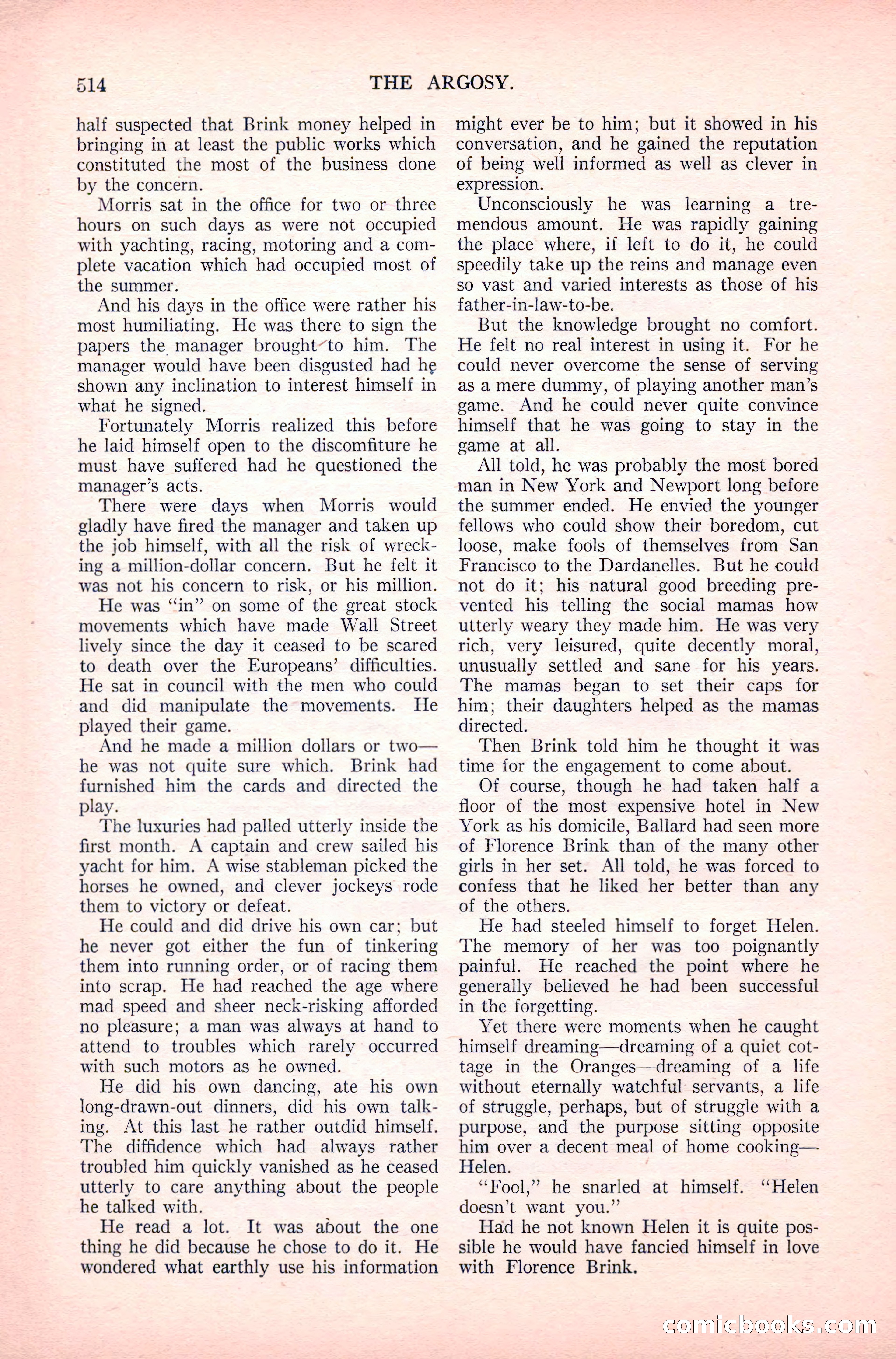
A restored page from Pulp Fiction, 1916. Page through the whole issue in the reader above.
📄 Transcribed text from this page (OCR, searchable)
Machine-transcribed from the original scan — historical spelling and the odd misread are preserved.
514 THE half suspected that Brink money helped in bringing in at least the public works which constituted the most of the business done by the concern. Morris sat in the office for two or three hours on such days as were not occupied with yachting, racing, motoring and a com- plete vacation which had occupied most of the summer. And his days in the office were rather his most humiliating. He was there to sign the papers the manager brought~to him. The manager would have been disgusted had he shown any inclination to interest himself in what he signed. Fortunately Morris realized this before he laid himself open to the discomfiture he must have suffered had he questioned the manager’s acts. There were days when Morris would gladly have fired the manager and taken up the job himself, with all the risk of wreck- ing a million-dollar concern. But he felt it was not his concern to risk, or his million. He was ‘“‘in” on some of the great stock movements which have made Wall Street lively since the day it ceased to be scared to death over the Europeans’ difficulties. He sat in council with the men who could and did manipulate the movements. He played their game. And he made a million dollars or two— he was not quite sure which. Brink had furnished him the cards and directed the play. The luxuries had palled utterly inside the first month. A captain and crew sailed his yacht for him. A wise stableman picked the horses he owned, and clever jockeys rode them to victory or defeat. He could and did drive his own car; but he never got either the fun of tinkering them into running order, or of racing them into scrap. He had reached the age where mad speed and sheer neck-risking afforded no pleasure; a man was always at hand to attend to troubles which rarely occurred with such motors as he owned. He did his own dancing, ate his own long-drawn-out dinners, did his own talk- ing. At this last he rather outdid himself. The diffidence which had always rather troubled him quickly vanished as he ceased utterly to care anything about the people he talked with. He read a lot. It was about the one thing he did because he chose to do it. He wondered what earthly use his information ARGOSY. might ever be to him; but it showed in his conversation, and he gained the reputation of being well informed as well as clever in expression. Unconsciously he was learning a tre- mendous amount. He was rapidly gaining the place where, if left to do it, he could speedily take up the reins and manage even so vast and varied interests as those of his father-in-law-to-be. But the knowledge brought no comfort. He felt no real interest in using it. For he could never overcome the sense of serving as a mere dummy, of playing another man’s game. And he could never quite convince himself that he was going to stay in the game at all. All told, he was probably the most bored man in New York and Newport long before the summer ended. He envied the younger fellows who could show their boredom, cut loose, make fools of themselves from San Francisco to the Dardanelles. But he could not do it; his natural good breeding pre- vented his telling the social mamas how utterly weary they made him. He was very rich, very leisured, quite decently moral, unusually settled and sane for his years. The mamas began to set their caps for him; their daughters helped as the mamas directed. Then Brink told him he thought it was time for the engagement to come about. Of course, though he had taken half a floor of the most expensive hotel in New York as his domicile, Ballard had seen more of Florence Brink than of the many other girls in her set. All told, he was forced to confess that he liked her better than any of the others. He had steeled himself to forget Helen. The memory of her was too poignantly painful. He reached the point where he generally believed he had been successful in the forgetting. Yet there were moments when he caught himself dreaming—dreaming of a quiet cot- tage in the Oranges—dreaming of a life without eternally watchful servants, a life of struggle, perhaps, but of struggle with a purpose, and the purpose sitting opposite him over a decent meal of home cooking— Helen. “Fool,” he snarled at himself. doesn’t want you.” Had he not known Helen it is quite pos- sible he would have fancied himself in love with Florence Brink. ‘Helen (EO) oOOLK (C@)