
Pulp Fiction, 1916 · page 141 of 212
The Argosy, Vol. 82, No. 3 — page 141: what you’re looking at
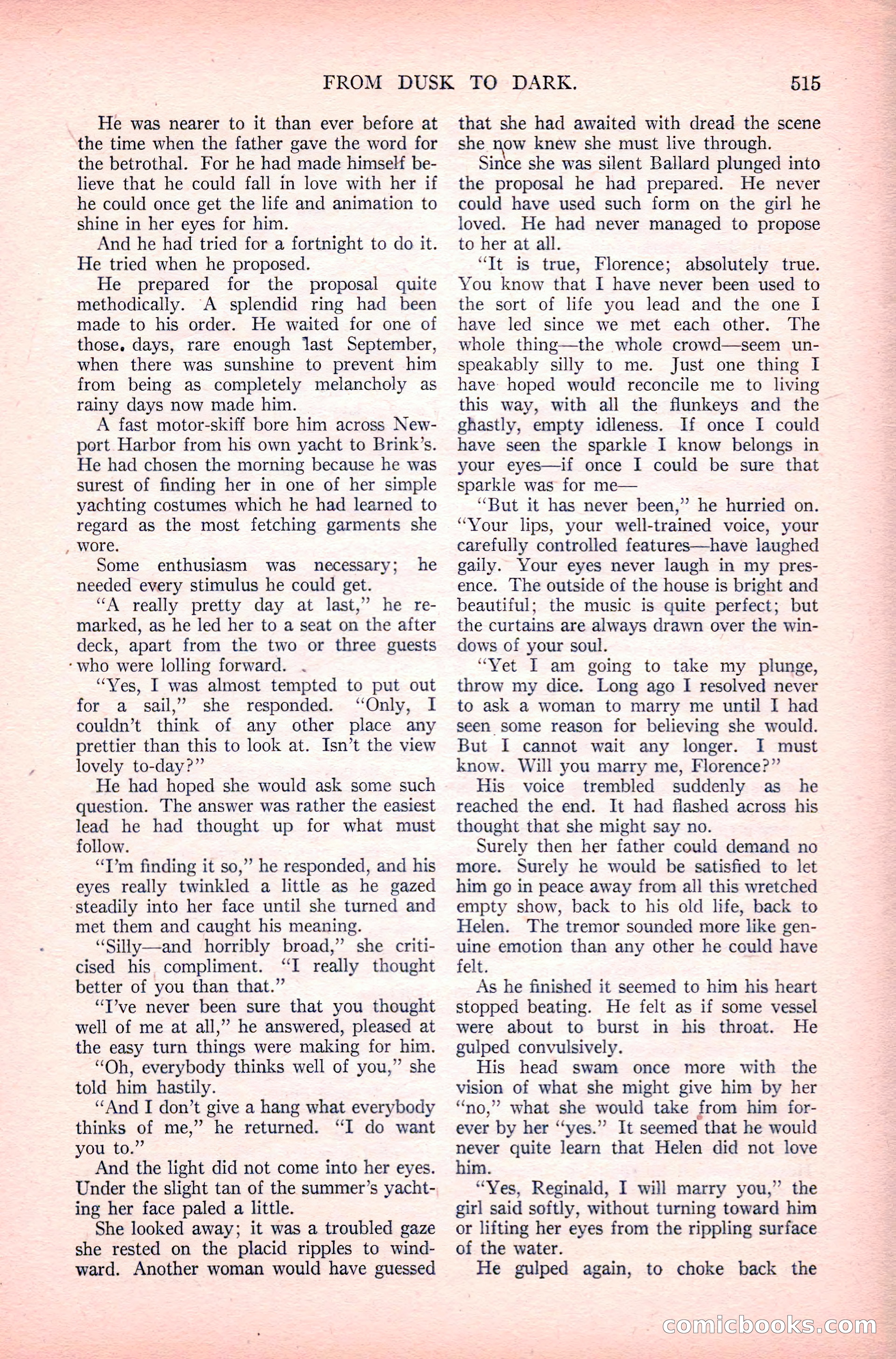
A restored page from Pulp Fiction, 1916. Page through the whole issue in the reader above.
📄 Transcribed text from this page (OCR, searchable)
Machine-transcribed from the original scan — historical spelling and the odd misread are preserved.
FROM DUSK TO DARK. He was nearer to it than ever before at the time when the father gave the word for the betrothal. For he had made himself be- lieve that he could fall in love with her if he could once get the life and animation to shine in her eyes for him. And he had tried for a fortnight to do it. He tried when he proposed. He prepared for the proposal quite methodically. A splendid ring had been made to his order. He waited for one of those. days, rare enough last September, when there was sunshine to prevent him from being as completely melancholy as rainy days now made him. A fast motor-skiff bore him across New- port Harbor from his own yacht to Brink’s. He had chosen the morning because he was surest of finding her in one of her simple yachting costumes which he had learned to regard as the most fetching garments she , wore. Some enthusiasm was _ necessary; needed every stimulus he could get. “A really pretty day at last,” he re- marked, as he led her to a seat on the after deck, apart from the two or three guests ‘who were lolling forward. “Ves, I was almost tempted to put out for a sail,” she responded. “Only, I couldn’t think of any other place any prettier than this to look at. Isn’t the view lovely to-day?” He had hoped she would ask some such question. The answer was rather the easiest lead he had thought up for what must follow. “I’m finding it so,” he responded, and his eyes really twinkled a little as he gazed steadily into her face until she turned and met them and caught his meaning. ‘“Silly—and horribly broad,” she criti- cised his compliment. “I really thought better of you than that.” “T’ve never been sure that you thought well of me at all,” he answered, pleased at the easy turn things were making for him. “Oh, everybody thinks well of you,” she told him hastily. ‘And I don’t give a hang what everybody thinks of me,” he returned. “I do want you to.” And the light did not come into her eyes. Under the slight tan of the summer’s yacht- ing her face paled a little. She looked away; it was a troubled gaze she rested on the placid ripples to wind- ward. Another woman would have guessed he 515 that she had awaited with dread the scene she now knew she must live through. Since she was silent Ballard plunged into the proposal he had prepared. He never could have used such form on the girl he loved. He had never managed to propose to her at all. “It is true, Florence; absolutely true. You know that I have never been used to the sort of life you lead and the one I have led since we met each other. The whole thing—the whole crowd—seem un- speakably silly to me. Just one thing I have hoped would reconcile me to living this way, with all the flunkeys and the ghastly, empty idleness. If once I could have seen the sparkle I know belongs in your eyes—if once I could be sure that sparkle was for me— “But it has never been,” he hurried on. “Your lips, your well-trained voice, your carefully controlled features—have laughed gaily. Your eyes never laugh in my pres- ence. The outside of the house is bright and beautiful; the music is quite perfect; but the curtains are always drawn over the win- dows of your soul. “Yet I am going to take my plunge, throw my dice. Long ago I resolved never to ask a woman to marry me until I had seen some reason for believing she would. But I cannot wait any longer. I must know. Will you marry me, Florence?” His voice trembled suddenly as _ he reached the end. It had flashed across his thought that she might say no. Surely then her father could demand no more. Surely he would be satisfied to let him go in peace away from all this wretched empty show, back to his old life, back to Helen. The tremor sounded more like gen- uine emotion than any other he could have felt. As he finished it seemed to him his heart stopped beating. He felt as if some vessel were about to burst in his throat. He gulped convulsively. His head swam once more with the vision of what she might give him by her “no,” what she would take from him for- ever by her “‘yes.”” It seemed that he would never quite learn that Helen did not love him. “Yes, Reginald, I will marry you,” the girl said softly, without turning toward him or lifting her eyes from the rippling surface of the water. He gulped again, to choke back the CORMICGLOOOKS (C@)