
Pulp Fiction, 1916 · page 139 of 212
The Argosy, Vol. 82, No. 3 — page 139: what you’re looking at
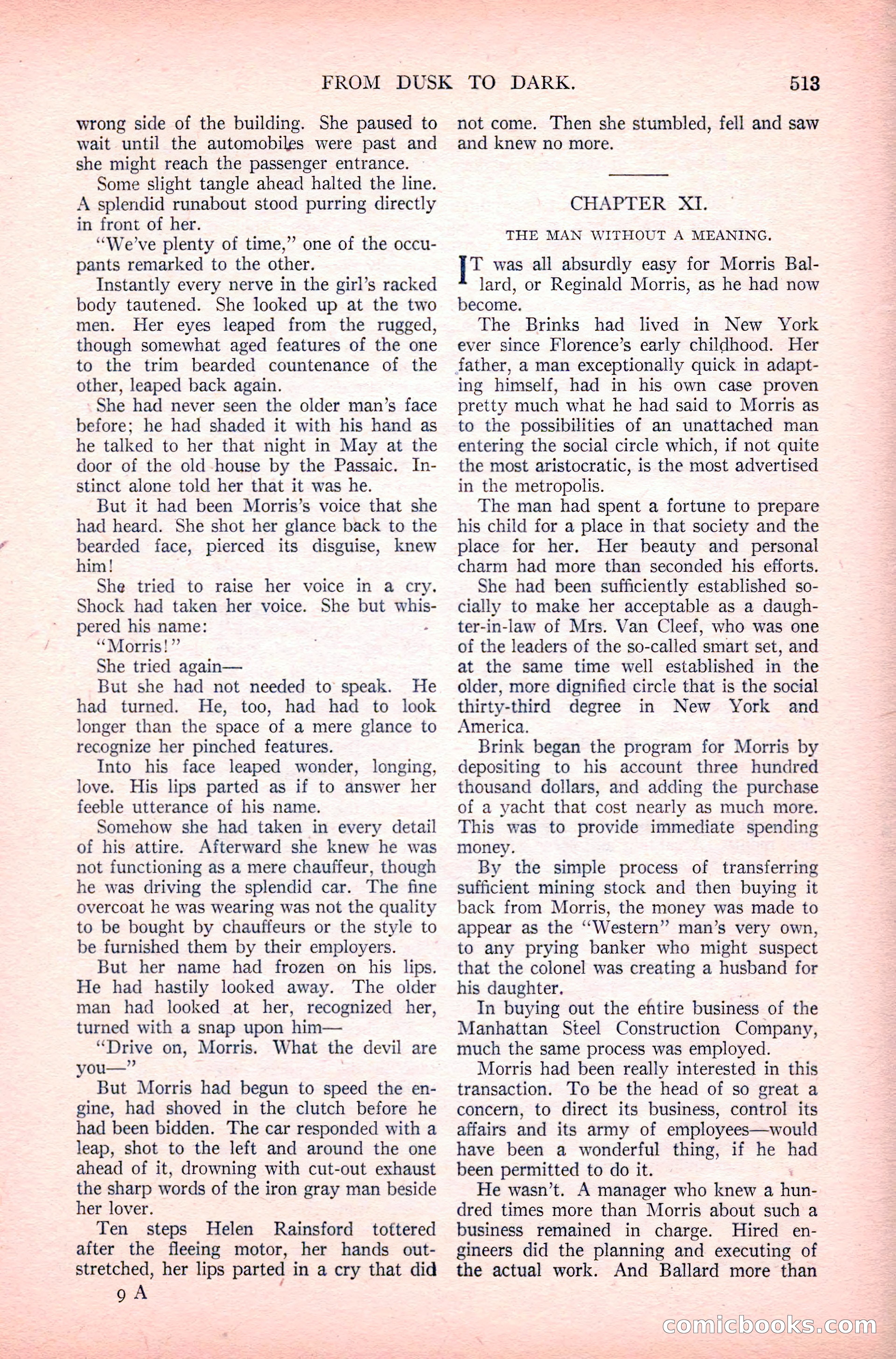
A restored page from Pulp Fiction, 1916. Page through the whole issue in the reader above.
📄 Transcribed text from this page (OCR, searchable)
Machine-transcribed from the original scan — historical spelling and the odd misread are preserved.
FROM DUSK TO DARK. wrong side of the building. She paused to wait until the automobiles were past and she might reach the passenger entrance. Some slight tangle ahead halted the line. A splendid runabout stood purring directly in front of her. ‘““We’ve plenty of time,” one of the occu- pants remarked to the other. Instantly every nerve in the girl’s racked body tautened. She looked up at the two men. Her eyes leaped from the rugged, though somewhat aged features of the one to the trim bearded countenance of the other, leaped back again. She had never seen the older man’s face before; he had shaded it with his hand as he talked to her that night in May at the door of the old house by the Passaic. In- stinct alone told her that it was he. But it had been Morris’s voice that she had heard. She shot her glance back to the bearded face, pierced its disguise, knew him! She tried to raise her voice in a cry. Shock had taken her voice. She but whis- pered his name: ‘Morris!’ She tried again— But she had not needed to speak. He had turned. He, too, had had to look longer than the space of a mere glance to recognize her pinched features. Into his face leaped wonder, longing, love. His lips parted as if to answer her feeble utterance of his name. Somehow she had taken in every detail of his attire. Afterward she knew he was not functioning as a mere chauffeur, though he was driving the splendid car. The fine overcoat he was wearing was not the quality to be bought by chauffeurs or the style to be furnished them by their employers. But her name had frozen on his lips. He had hastily looked away. The older man had looked at her, recognized her, turned with a snap upon him— “Drive on, Morris. What the devil are you—” But Morris had begun to speed the en- gine, had shoved in the clutch before he had been bidden. The car responded with a leap, shot to the left and around the one ahead of it, drowning with cut-out exhaust the sharp words of the iron gray man beside her lover. Ten steps Helen Rainsford toftered after the fleeing motor, her hands out- stretched, her lips parted in a cry that did oA 513 not come. Then she stumbled, fell and saw and knew no more. CHAPTER XI. THE MAN WITHOUT A MEANING. [* was all absurdly easy for Morris Bal- lard, or Reginald Morris, as he had now become. The Brinks had lived in New York ever since Florence’s early childhood. Her father, a man exceptionally quick in adapt- ing himself, had in his own case proven pretty much what he had said to Morris as to the possibilities of an unattached man entering the social circle which, if not quite the most aristocratic, is the most advertised in the metropolis. The man had spent a fortune to prepare his child for a place in that society and the place for her. Her beauty and _ personal charm had more than seconded his efforts. She had been sufficiently established so- cially to make her acceptable as a daugh- ter-in-law of Mrs. Van Cleef, who was one of the leaders of the so-called smart set, and at the same time well established in the older, more dignified circle that is the social thirty-third degree in New York and America. Brink began the program for Morris by depositing to his account three hundred thousand dollars, and adding the purchase of a yacht that cost nearly as much more. This was to provide immediate spending money. By the simple process of transferring sufficient mining stock and then buying it back from Morris, the money was made to appear as the ‘‘Western” man’s very own, to any prying banker who might suspect that the colonel was creating a husband for his daughter. In buying out the ehtire business of the Manhattan Steel Construction Company, much the same process was employed. Morris had been really interested in this transaction. To be the head of so great a concern, to direct its business, control its affairs and its army of employees—would have been a wonderful thing, if he had been permitted to do it. He wasn’t. A manager who knew a hun- dred times more than Morris about such a business remained in charge. Hired en- gineers did the planning and executing of the actual work. And Ballard more than (EO) VNOO|KS AUG (C@)