
Pulp Fiction, 1916 · page 138 of 212
The Argosy, Vol. 82, No. 3 — page 138: what you’re looking at
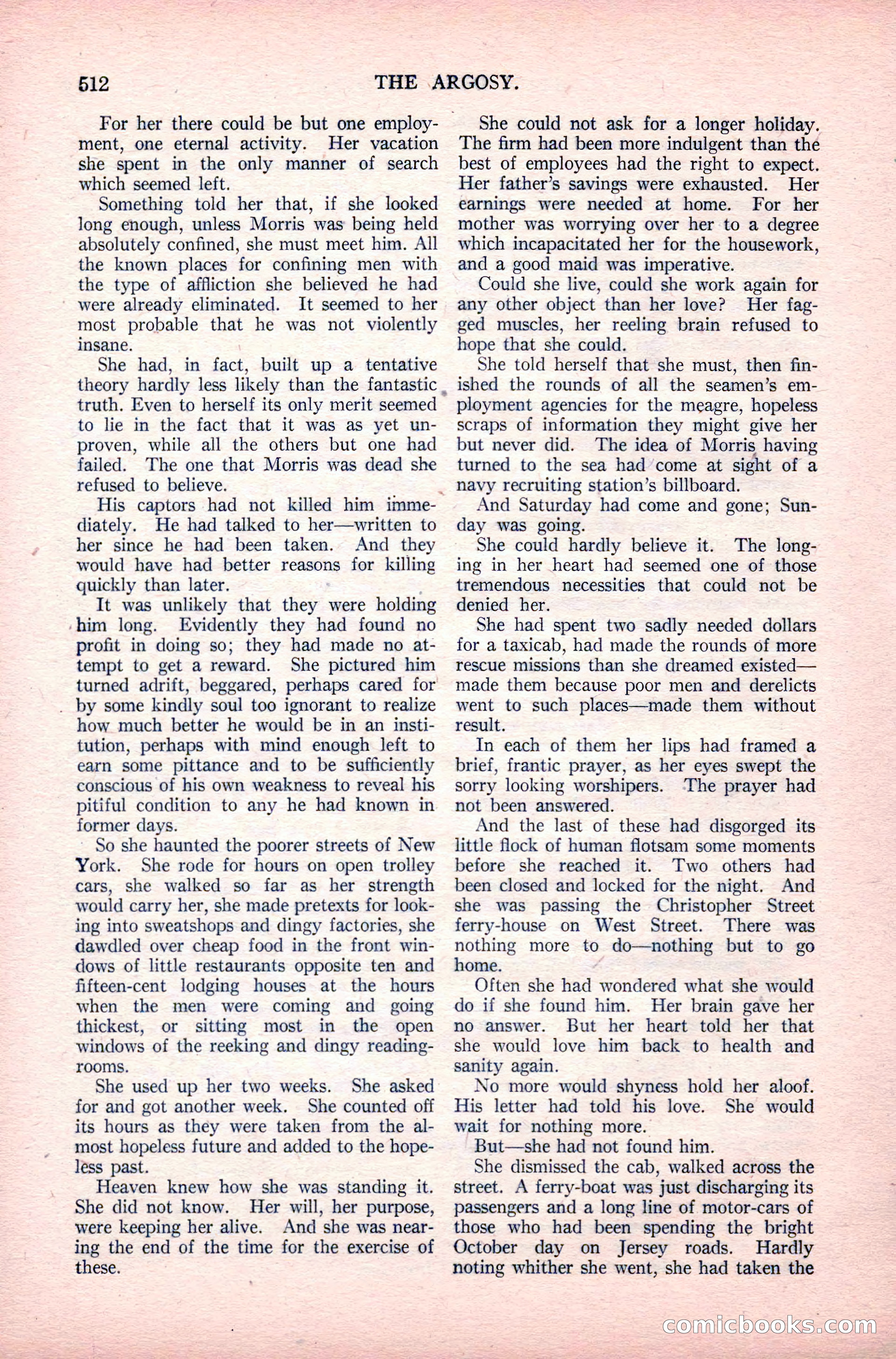
A restored page from Pulp Fiction, 1916. Page through the whole issue in the reader above.
📄 Transcribed text from this page (OCR, searchable)
Machine-transcribed from the original scan — historical spelling and the odd misread are preserved.
512 For her there could be but one employ- ment, one eternal activity. Her vacation she spent in the only manner of search which seemed left. Something told her that, if she looked long enough, unless Morris was being held absolutely confined, she must meet him. All the known places for confining men with the type of affliction she believed he had were already eliminated. It seemed to her most probable that he was not violently insane. She had, in fact, built up a tentative theory hardly less likely than the fantastic _ truth. Even to herself its only merit seemed to lie in the fact that it was as yet un- proven, while all the others but one had failed. The one that Morris was dead she refused to believe. His captors had not killed him imme- diately. He had talked to her—written to her since he had been taken. And they would have had better reasons for killing quickly than later. | It was unlikely that they were holding ‘him long. Evidently they had found no profit in doing so; they had made no at- tempt to get a reward. She pictured him turned adrift, beggared, perhaps cared for _ by some kindly soul too ignorant to realize how much better he would be in an insti- tution, perhaps with mind enough left to earn some pittance and to be sufficiently conscious of his own weakness to reveal his pitiful condition to any he had known in former days. - So she haunted the poorer streets of New York. She rode for hours on open trolley cars, she walked so far as her strength would carry her, she made pretexts for look- ing into sweatshops and dingy factories, she dawdled over cheap food in the front win- dows of little restaurants opposite ten and fifteen-cent lodging houses at the hours when the men were coming and going thickest, or sitting most in the open windows of the reeking and dingy reading- rooms. She used up her two weeks. She asked for and got another week. She counted off its hours as they were taken from the al- most hopeless future and added to the hope- less past. Heaven knew how she was standing it. She did not know. Her will, her purpose, were keeping her alive. And she was near- ing the end of the time for the exercise of these. THE ARGOSY. She could not ask for a longer holiday. The firm had been more indulgent than the best of employees had the right to expect. Her father’s savings were exhausted. Her earnings were needed at home. For her mother was worrying over her to a degree which incapacitated her for the housework, and a good maid was imperative. Could she live, could she work again for any other object than her love? Her fag- ged muscles, her reeling brain refused to hope that she could. She told herself that she must, then fin- ished the rounds of all the seamen’s em- ployment agencies for the meagre, hopeless scraps of information they might give her but never did. The idea of Morris having turned to the sea had come at sight of a navy recruiting station’s billboard. And Saturday had come and gone; Sun- day was going. She could hardly believe it. The long- ing in her heart had seemed one of those tremendous necessities that could not be denied her. She had spent two sadly needed dollars for a taxicab, had made the rounds of more rescue missions than she dreamed existed— made them because poor men and derelicts went to such places—made them without result. In each of them her lips had framed a brief, frantic prayer, as her eyes swept the sorry looking worshipers. ‘The prayer had not been answered. And the last of these had disgorged its little flock of human flotsam some moments before she reached it. Two others had been closed and locked for the night. And she was passing the Christopher Street ferry-house on West Street. There was nothing more to do—nothing but to go home. Often she had wondered what she would do if she found him. Her brain gave her no answer. But her heart told her that she would love him back to health and sanity again. No more would shyness hold her aloof. His letter had told his love. She would wait for nothing more. But—she had not found him. She dismissed the cab, walked across the street. A ferry-boat was just discharging its passengers and a long line of motor-cars of those who had been spending the bright October day on Jersey roads. Hardly noting whither she went, she had taken the COMIC VOOKS, (E@)