
Pulp Fiction, 1916 · page 137 of 212
The Argosy, Vol. 82, No. 3 — page 137: what you’re looking at
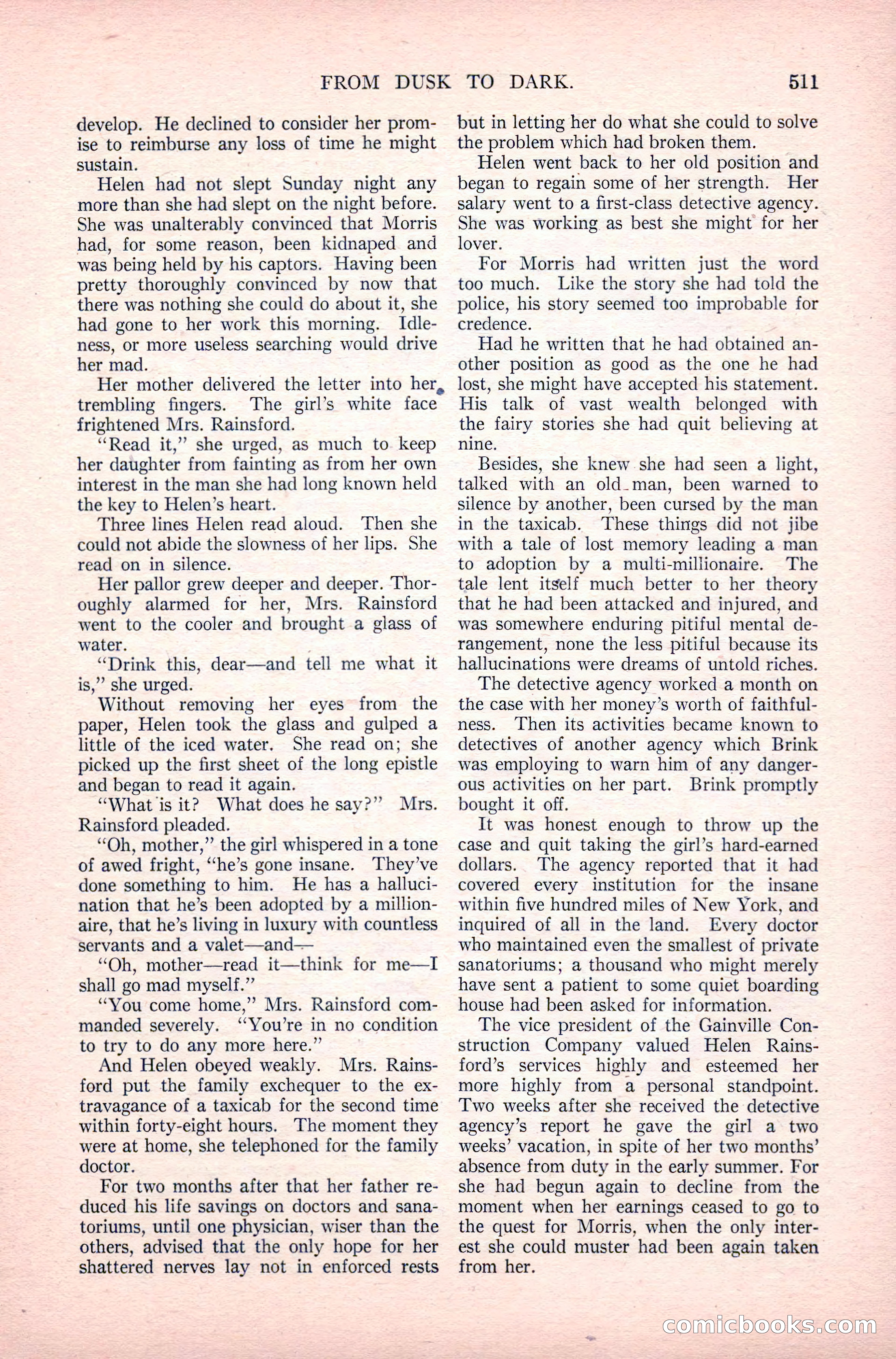
A restored page from Pulp Fiction, 1916. Page through the whole issue in the reader above.
📄 Transcribed text from this page (OCR, searchable)
Machine-transcribed from the original scan — historical spelling and the odd misread are preserved.
FROM DUSK TO DARK. develop. He declined to consider her prom- ise to reimburse any loss of time he might sustain. Helen had not slept Sunday night any more than she had slept on the night before. She was unalterably convinced that Morris had, for some reason, been kidnaped and was being held by his captors. Having been pretty thoroughly convinced by now that there was nothing she could do about it, she had gone to her work this morning. Idle- ness, or more useless searching would drive her mad. Her mother delivered the letter into her, trembling fingers. The girl’s white face frightened Mrs. Rainsford. “Read it,” she urged, as much to keep her daughter from fainting as from her own interest in the man she had long known held the key to Helen’s heart. Three lines Helen read aloud. Then she could not abide the slowness of her lips. She read on in silence. Her pallor grew deeper and deeper. Thor- oughly alarmed for her, Mrs. Rainsford went to the cooler and brought a glass of water. “Drink this, dear—and tell me what it is,” she urged. Without removing her eyes from the paper, Helen took the glass and gulped a little of the iced water. She read on; she picked up the first sheet of the long epistle and began to read it again. “What is it? What does he say?” Rainsford pleaded. “Oh, mother,” the girl whispered in a tone of awed fright, “he’s gone insane. They’ve done something to him. He has a halluci- nation that he’s been adopted by a million- aire, that he’s living in luxury with countless servants and a valet-—and— “Oh, mother—read it—think for me—I shall go mad myself.” “Vou come home,” Mrs. Rainsford com- manded severely. ‘‘You’re in no condition to try to do any more here.” And Helen obeyed weakly. Mrs. Rains- ford put the family exchequer to the ex- travagance of a taxicab for the second time within forty-eight hours. The moment they were at home, she telephoned for the family doctor. For two months after that her father re- duced his life savings on doctors and sana- toriums, until one physician, wiser than the others, advised that the only hope for her shattered nerves lay not in enforced rests Mrs. 511 but in letting her do what she could to solve the problem which had broken them. Helen went back to her old position and began to regain some of her strength. Her salary went to a first-class detective agency. She was working as best she might for her lover. For Morris had written just the word too much. Like the story she had told the police, his story seemed too improbable for credence. Had he written that he had obtained an- other position as good as the one he had lost, she might have accepted his statement. His talk of vast wealth belonged with the fairy stories she had quit believing at nine. Besides, she knew she had seen a light, talked with an old_man, been warned to silence by another, been cursed by the man in the taxicab. ‘These things did not jibe with a tale of lost memory leading a man to adoption by a multi-millionaire. The tale lent itself much better to her theory that he had been attacked and injured, and was somewhere enduring pitiful mental de- rangement, none the less pitiful because its hallucinations were dreams of untold riches. The detective agency worked a month on the case with her money’s worth of faithful- ness. Then its activities became known to detectives of another agency which Brink was employing to warn him of any danger- ous activities on her part. Brink promptly bought it off. It was honest enough to throw up the case and quit taking the girl’s hard-earned dollars. The agency reported that it had covered every institution for the insane within five hundred miles of New York, and inquired of all in the land. Every doctor who maintained even the smallest of private sanatoriums; a thousand who might merely have sent a patient to some quiet boarding house had been asked for information. The vice president of the Gainville Con- struction Company valued Helen Rains- ford’s services highly and esteemed her more highly from a personal standpoint. Two weeks after she received the detective agency’s report he gave the girl a two weeks’ vacation, in spite of her two months’ absence from duty in the early summer. For she had begun again to decline from the moment when her earnings ceased to go to the quest for Morris, when the only inter- est she could muster had been again taken from her. (EO) NOOK (E@)