
Pulp Fiction, 1916 · page 131 of 212
The Argosy, Vol. 82, No. 3 — page 131: what you’re looking at
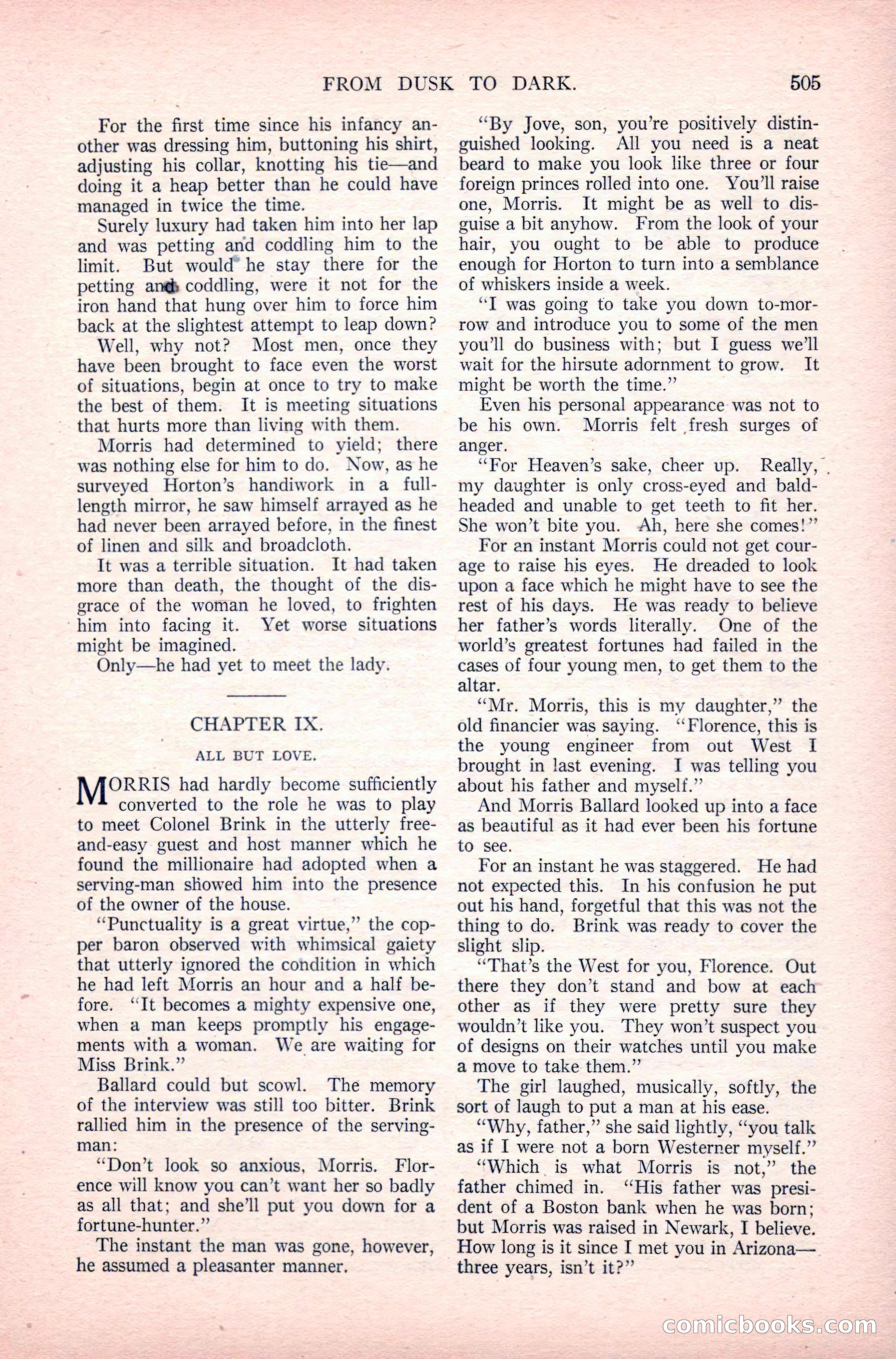
A restored page from Pulp Fiction, 1916. Page through the whole issue in the reader above.
📄 Transcribed text from this page (OCR, searchable)
Machine-transcribed from the original scan — historical spelling and the odd misread are preserved.
FROM DUSK TO DARK. For the first time since his infancy an- other was dressing him, buttoning his shirt, adjusting his collar, knotting his tie—and doing it a heap better than he could have managed in twice the time. Surely luxury had taken him into her lap and was petting and coddling him to the limit. But would’ he stay there for the petting ang coddling, were it not for the iron hand that hung over him to force him back at the slightest attempt to leap down? Well, why not? Most men, once they have been brought to face even the worst of situations, begin at once to try to make the best of them. It is meeting situations that hurts more than living with them. Morris had determined to yield; there was nothing else for him to do. Now, as he surveyed Horton’s handiwork in a full- length mirror, he saw himself arrayed as he had never been arrayed before, in the finest of linen and silk and broadcloth. It was a terrible situation. It had taken more than death, the thought of the dis- grace of the woman he loved, to frighten ‘him into facing it. Yet worse situations might be imagined. Only—he had yet to meet the lady. CHAPTER IX, ALL BUT LOVE. Me&88Is had hardly become sufficiently converted to the role he was to play to meet Colonel Brink in the utterly free- and-easy guest and host manner which he found the millionaire had adopted when a serving-man showed him into the presence of the owner of the house. “Punctuality is a great virtue,” the cop- per baron observed with whimsical gaiety that utterly ignored the condition in which he had left Morris an hour and a half be- fore. “It becomes a mighty expensive one, when a man keeps promptly his engage- ments with a woman. We are waiting for Miss Brink.” Ballard could but scowl. The memory of the interview was still too bitter. Brink rallied him in the presence of the serving- man: “Don’t look so anxious, Morris. Flor- ence will know you can’t want her so badly as all that; and she’ll put you down for a fortune-hunter.”’ The instant the man was gone, however, he assumed a pleasanter manner. 505 “By Jove, son, you’re positively distin- guished looking. All you need is a neat beard to make you look like three or four foreign princes rolled into one. You'll raise one, Morris. It might be as well to dis- guise a bit anyhow. From the look of your hair, you ought to be able to produce enough for Horton to turn into a semblance of whiskers inside a week. “T was going to take you down to-mor- row and introduce you to some of the men you'll do business with; but I guess we'll wait for the hirsute adornment to grow. It might be worth the time.” Even his personal appearance was not to be his own. Morris felt fresh surges of anger. 3 “For Heaven’s sake, cheer up. Really, . my daughter is only cross-eyed and bald- headed and unable to get teeth to fit her. She won’t bite you. Ah, here she comes!”’ For an instant Morris could not get cour- age to raise his eyes. He dreaded to look upon a face which he might have to see the rest of his days. He was ready to believe her father’s words literally. One of the world’s greatest fortunes had failed in the cases of four young men, to get them to the altar. “Mr. Morris, this is my daughter,” the old financier was saying. ‘Florence, this is the young engineer from out West I brought in last evening. I was telling you about his father and myself.” And Morris Ballard looked up into a face as beautiful as it had ever been his fortune to see. For an instant he was staggered. He had not expected this. In his confusion he put out his hand, forgetful that this was not the thing to do. Brink was ready to cover the slight slip. : “That’s the West for you, Florence. Out there they don’t stand and bow at each other as if they were pretty sure they wouldn’t like you. They won’t suspect you of designs on their watches until you make a move to take them.” The girl laughed, musically, softly, the sort of laugh to put a man at his ease. “Why, father,” she said lightly, “you talk as if I were not a born Westerner myself.” “Which is what Morris is not,” the father chimed in. “His father was presi- dent of a Boston bank when he was born; but Morris was raised in Newark, I believe. How long is it since I met you in Arizona— three years, isn’t it?” COMMUC VOOLKS (C@)