
Pulp Fiction, 1916 · page 130 of 212
The Argosy, Vol. 82, No. 3 — page 130: what you’re looking at
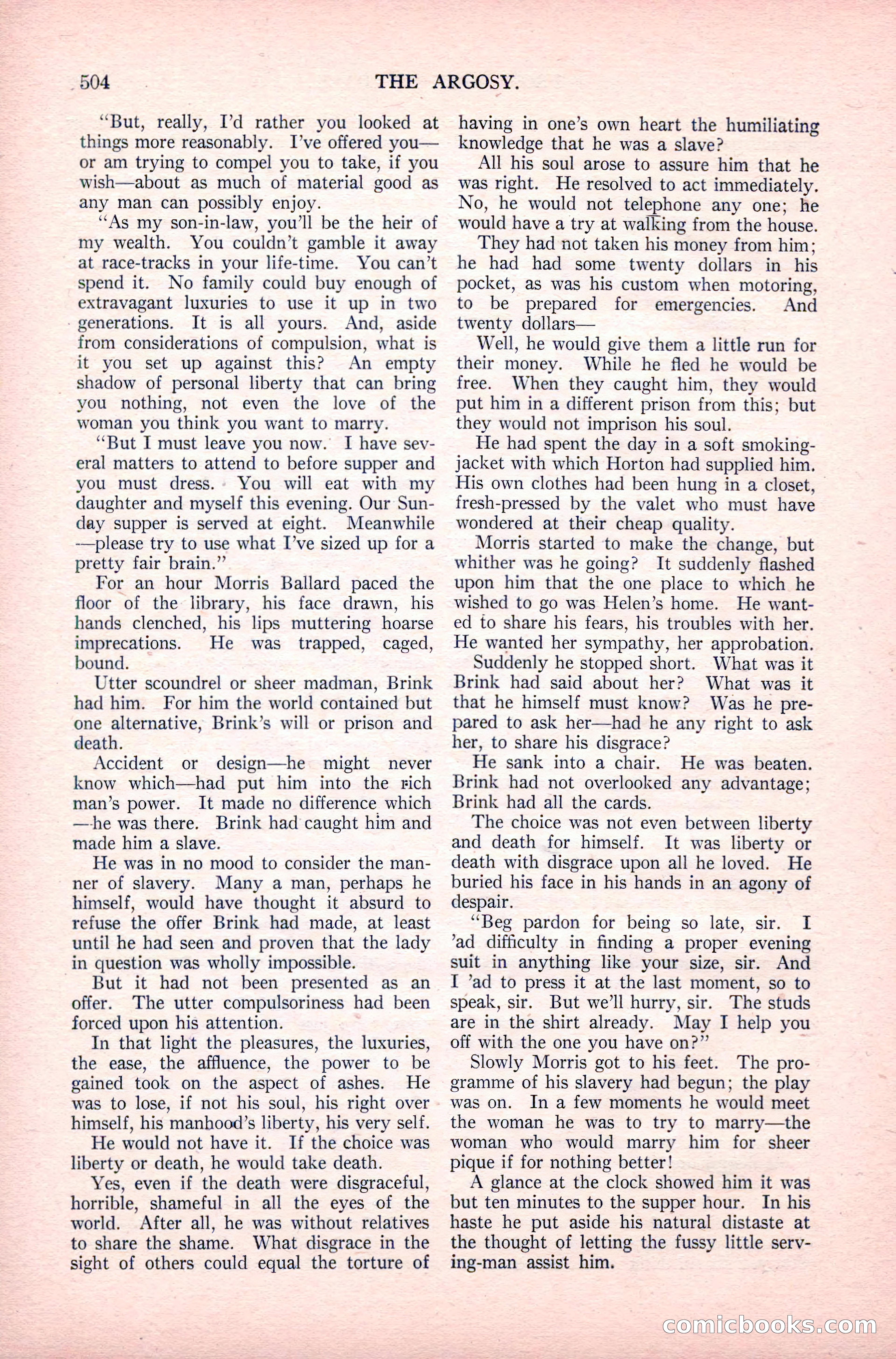
A restored page from Pulp Fiction, 1916. Page through the whole issue in the reader above.
📄 Transcribed text from this page (OCR, searchable)
Machine-transcribed from the original scan — historical spelling and the odd misread are preserved.
504 “But, really, I'd rather you looked at things more reasonably. I’ve offered you— or am trying to compel you to take, if you wish—about as much of material good as any man can possibly enjoy. ‘““As my son-in-law, you'll be the heir of my wealth. You couldn’t gamble it away at race-tracks in your life-time. You can’t spend it. No family could buy enough of extravagant luxuries to use it up in two -generations. It is all yours. And, aside from considerations of compulsion, what is it you set up against this? An empty shadow of personal liberty that can bring you nothing, not even the love of the woman you think you want to marry. ‘But I must leave you now. I have sev- eral matters to attend to before supper and you must dress.- You will eat with my daughter and myself this evening. Our Sun- day supper is served at eight. Meanwhile -—please try to use what I’ve sized up for a pretty fair brain.” For an hour Morris Ballard paced the floor of the library, his face drawn, his hands clenched, his lips muttering hoarse imprecations. He was trapped, caged, bound. Utter scoundrel or sheer madman, Brink had him. For him the world contained but one alternative, Brink’s will or prison and death. Accident or design—he might never know which—had put him into the rich man’s power. It made no difference which —he was there. Brink had caught him and made him a slave. He was in no mood to consider the man- ner of slavery. Many a man, perhaps he himself, would have thought it absurd to refuse the offer Brink had made, at least until he had seen and proven that the lady in question was wholly impossible. But it had not been presented as an offer. The utter compulsoriness had been forced upon his attention. In that light the pleasures, the luxuries, the ease, the affluence, the power to be gained took on the aspect of ashes. He was to lose, if not his soul, his right over himself, his manhood’s liberty, his very self. He would not have it. If the choice was liberty or death, he would take death. Yes, even if the death were disgraceful, horrible, shameful in all the eyes of the world. After all, he was without relatives to share the shame. What disgrace in the sight of others could equal the torture of THE ARGOSY. having in one’s own heart the humiliating knowledge that he was a slave? All his soul arose to assure him that he was right. He resolved to act immediately. No, he would not telephone any one; he would have a try at walking from the house. They had not taken his money from him; he had had some twenty dollars in his pocket, as was his custom when motoring, to be prepared for emergencies. And twenty dollars— Well, he would give them a little run for their money. While he fled he would be free. When they caught him, they would put him in a different prison from this; but they would not imprison his soul. He had spent the day in a soft smoking- jacket with which Horton had supplied him. His own clothes had been hung in a closet, fresh-pressed by the valet who must have wondered at their cheap quality. Morris started to make the change, but whither was he going? It suddenly flashed upon him that the one place to which he wished to go was Helen’s home. He want- ed to share his fears, his troubles with her. He wanted her sympathy, her approbation. Suddenly he stopped short. What was it Brink had said about her? What was it that he himself must know? Was he pre- pared to ask her—had he any right to ask her, to share his disgrace? He sank into a chair. He was beaten. Brink had not overlooked any advantage; Brink had all the cards. The choice was not even between liberty and death for himself. It was liberty or death with disgrace upon all he loved. He buried his face in his hands in an agony of despair. ‘Beg pardon for being so late, sir. I ‘ad difficulty in finding a proper evening suit in anything like your size, sir. And I ’ad to press it at the last moment, so to speak, sir. But we’ll hurry, sir. The studs are in the shirt already. May I help you off with the one you have on?” Slowly Morris got to his feet. The pro- gramme of his slavery had begun; the play was on. In a few moments he would meet the woman he was to try to marry—the woman who would marry him for sheer pique if for nothing better! A glance at the clock showed him it was but ten minutes to the supper hour. In his haste he put aside his natural distaste at the thought of letting the fussy little serv- ing-man assist him. COPMICLOOOLK< (E@)