
Pulp Fiction, 1916 · page 132 of 212
The Argosy, Vol. 82, No. 3 — page 132: what you’re looking at
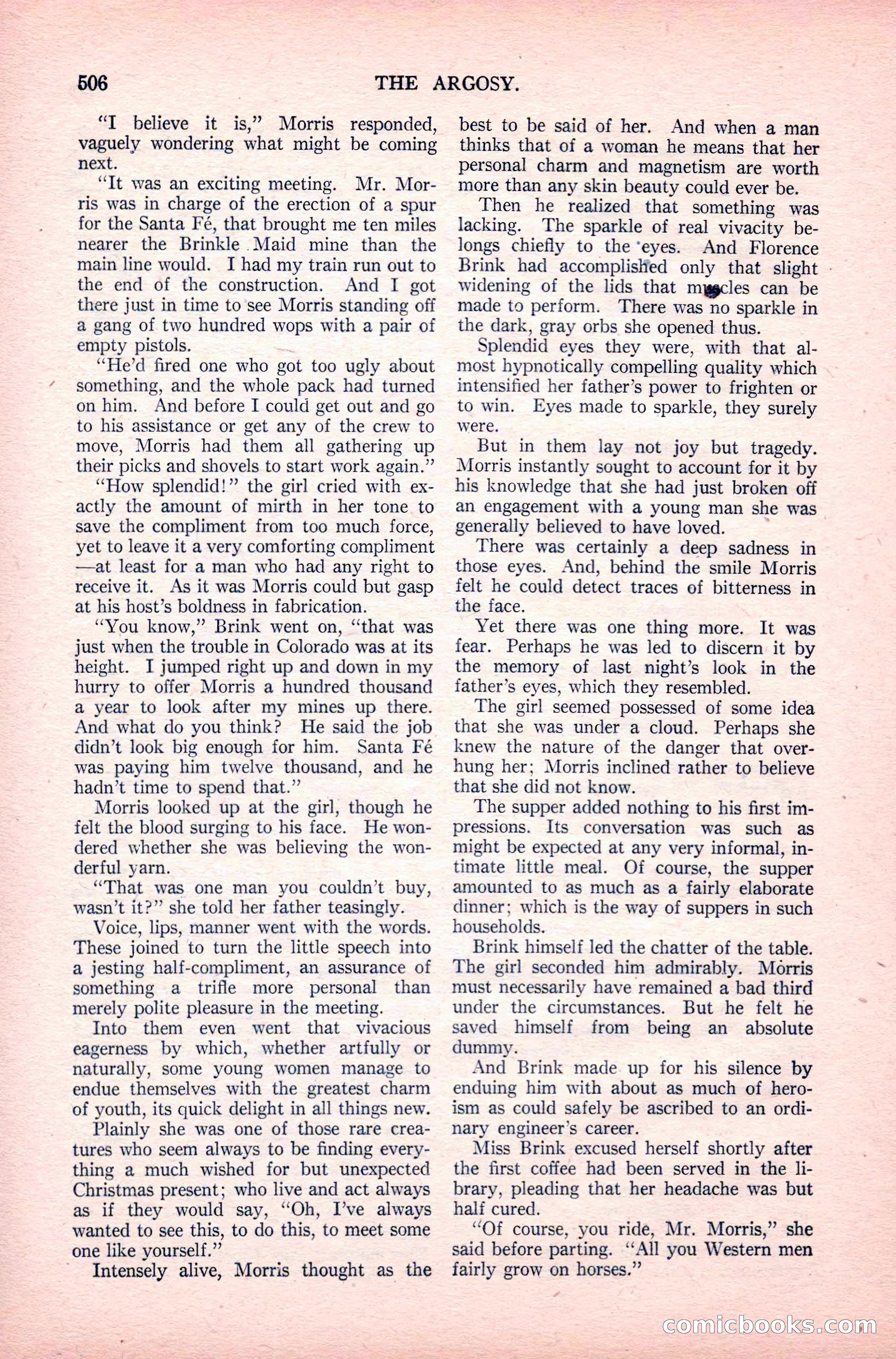
A restored page from Pulp Fiction, 1916. Page through the whole issue in the reader above.
📄 Transcribed text from this page (OCR, searchable)
Machine-transcribed from the original scan — historical spelling and the odd misread are preserved.
506 “I believe it is,” Morris responded, vaguely wondering what might be coming next. “It was an exciting meeting. Mr. Mor- ris was in charge of the erection of a spur for the Santa Fé, that brought me ten miles nearer the Brinkle Maid mine than the main line would. I had my train run out to the end of the construction. And I got there just in time to see Morris standing off a gang of two hundred wops with a pair of empty pistols. ‘““He’d fired one who got too ugly about something, and the whole pack had turned on him. And before I could get out and go to his assistance or get any of the crew to move, Morris had them all gathering up their picks and shovels to start work again.” “How splendid!” the girl cried with ex- actly the amount of mirth in her tone to save the compliment from too much force, yet to leave it a very comforting compliment —at least for a man who had any right to receive it. As it was Morris could but gasp at his host’s boldness in fabrication. “You know,” Brink went on, “that was just when the trouble in Colorado was at its height. I jumped right up and down in my hurry to offer Morris a hundred thousand a year to look after my mines up there. And what do you think? He said the job didn’t look big enough for him. Santa Fé was paying him twelve thousand, and he hadn’t time to spend that.” Morris looked up at the girl, though he felt the blood surging to his face. He won- dered whether she was believing the won- derful yarn. “That was one man you couldn’t buy, wasn’t it?” she told her father teasingly. Voice, lips, manner went with the words. These joined to turn the little speech into a jesting half-compliment, an assurance of something a trifle more personal than merely polite pleasure in the meeting. Into them even went that vivacious eagerness by which, whether artfully or naturally, some young women manage to endue themselves with the greatest charm of youth, its quick delight in all things new. Plainly she was one of those rare crea- tures who seem always to be finding every- thing a much wished for but unexpected Christmas present; who live and act always as if they would say, ‘Oh, I’ve always wanted to see this, to do this, to meet some one like yourself.” Intensely alive, Morris thought as the THE ARGOSY. best to be said of her. And when a man thinks that of a woman he means that her personal charm and magnetism are worth more than any skin beauty could ever be. Then he realized that something was lacking. The sparkle of real vivacity be- longs chiefly to the ‘eyes. And Florence Brink had accomplisHed only that slight - widening of the lids that mygcles can be made to perform. There was no sparkle in the dark, gray orbs she opened thus. Splendid eyes they were, with that al- most hypnotically compelling quality which intensified her father’s power to frighten or to win. Eyes made to sparkle, they surely were. But in them lay not joy but tragedy. Morris instantly sought to account for it by his knowledge that she had just broken off an engagement with a young man she was generally believed to have loved. | There was certainly a deep sadness in those eyes. And, behind the smile Morris felt he could detect traces of bitterness in the face. Yet there was one thing more. It was fear. Perhaps he was led to discern it by the memory of last night’s look in the father’s eyes, which they resembled. The girl seemed possessed of some idea that she was under a cloud. Perhaps she knew the nature of the danger that over- hung her; Morris inclined rather to believe that she did not know. The supper added nothing to his first im- pressions. Its conversation was such as might be expected at any very informal, in- timate little meal. Of course, the supper amounted to as much as a fairly elaborate dinner; which is the way of suppers in such households. Brink himself led the chatter of the table. The girl seconded him admirably. Morris must necessarily have remained a bad third under the circumstances. But he felt he saved himself from being an absolute dummy. And Brink made. up for his silence by enduing him with about as much of hero- ism as could safely be ascribed to an ordi- nary engineer’s career. Miss Brink excused herself shortly after the first coffee had been served in the li- brary, pleading that her headache was but half cured. “Of course, you ride, Mr. Morris,” she said before parting. ‘“‘All you Western men fairly grow on horses.” COPMICLOOOKS (C©)