
Pulp Fiction, 1916 · page 129 of 212
The Argosy, Vol. 82, No. 3 — page 129: what you’re looking at
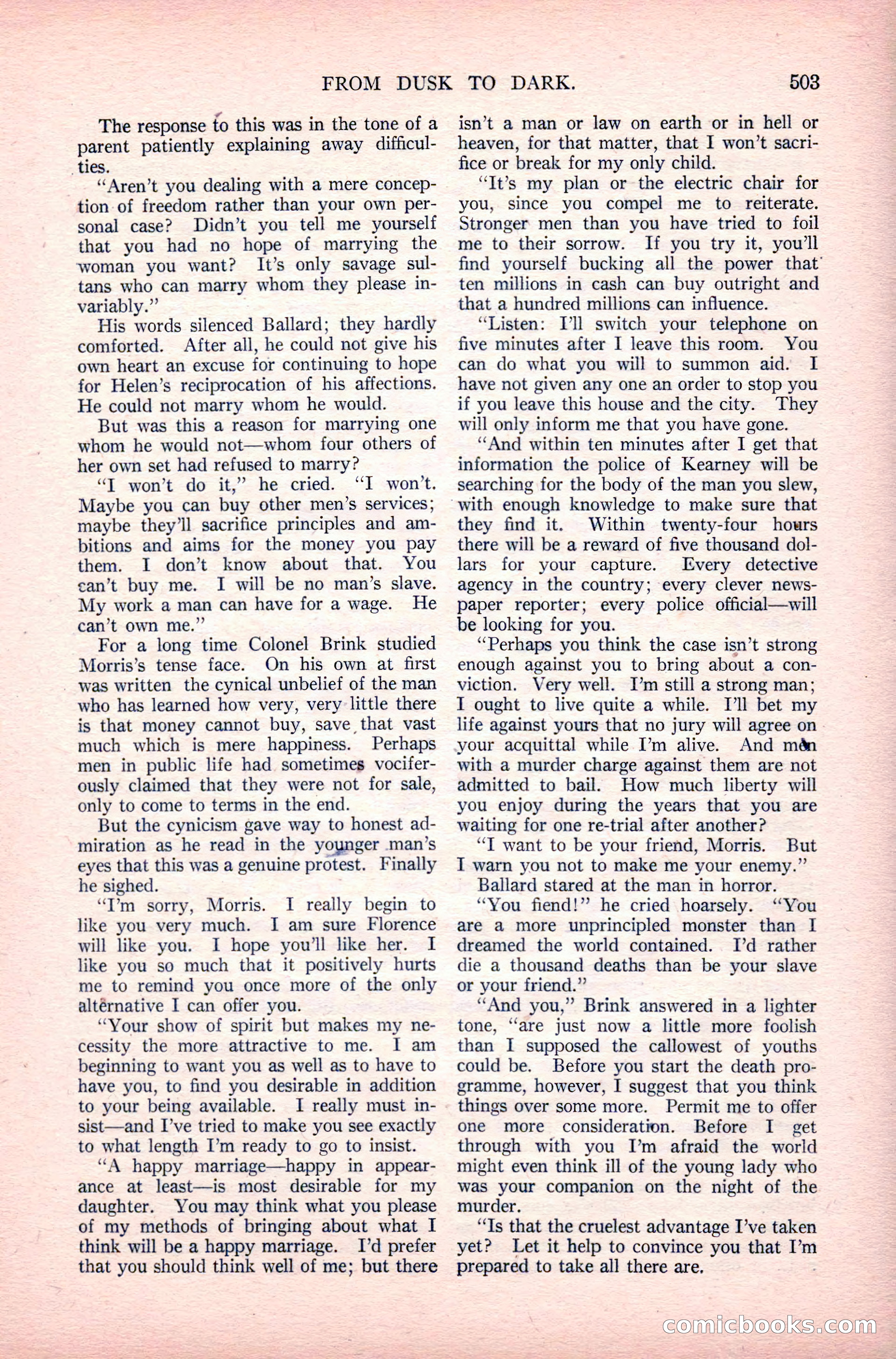
A restored page from Pulp Fiction, 1916. Page through the whole issue in the reader above.
📄 Transcribed text from this page (OCR, searchable)
Machine-transcribed from the original scan — historical spelling and the odd misread are preserved.
FROM The response to this was in the tone of a parent patiently explaining away difficul- ties. “Aren’t you dealing with a mere concep- tion of freedom rather than your own per- sonal case? Didn’t you tell me yourself that you had no hope of marrying the woman you want? It’s only savage sul- tans who can marry whom they please in- variably.” His words silenced Ballard; they hardly comforted. After all, he could not give his own heart an excuse for continuing to hope for Helen’s reciprocation of his affections. He could not marry whom he would. But was this a reason for marrying one whom he would not—whom four others of her own set had refused to marry? “T won’t do it,” he cried. ‘I won't. Maybe you can buy other men’s services; maybe they’ll sacrifice principles and am- bitions and aims for the money you pay them. I don’t know about that. You can’t buy me. I will be no man’s slave. My work a man can have for a wage. He can’t own me.” For a long time Colonel Brink studied Morris’s tense face. On his own at first - was written the cynical unbelief of the man who has learned how very, very little there is that money cannot buy, save that vast much which is mere happiness. Perhaps men in public life had sometimes vocifer- ously claimed that they were not for sale, only to come to terms in the end. But the cynicism gave way to honest ad- miration as he read in the younger man’s eyes that this was a genuine protest. Finally he sighed. ‘“T’m sorry, Morris. I really begin to like you very much. I am sure Florence will like you. I hope you'll like her. I like you so much that it positively hurts me to remind you once more of the only altérnative I can offer you. “Vour show of spirit but makes my ne- cessity the more attractive to me. I am beginning to want you as well as to have to have you, to find you desirable in addition to your being available. I really must in- sist—and I’ve tried to make you see exactly to what length I’m ready to go to insist. “A happy marriage—happy in appear- ance at least—is most desirable for my daughter. You may think what you please of my methods of bringing about what I think will be a happy marriage. I’d prefer that you should think well of me; but there DUSK TO DARK. 503 isn’t a man or law on earth or in hell or heaven, for that matter, that I won’t sacri- fice or break for my only child. “Tt’s my plan or the electric chair for you, since you compel me to reiterate. Stronger men than you have tried to foil me to their sorrow. If you try it, you'll find yourself bucking all the power that’ ten millions in cash can buy outright and that a hundred millions can influence. “Listen: Ill switch your telephone on five minutes after I leave this room. You can do what you will to summon aid. I have not given any one an order to stop you if you leave this house and the city. They will only inform me that you have gone. ‘““And within ten minutes after I get that information the police of Kearney will be searching for the body of the man you slew, with enough knowledge to make sure that they find it. Within twenty-four hours there will be a reward of five thousand dol- lars for your capture. Every detective agency in the country; every clever news- paper reporter; every police official—will be looking for you. ‘Perhaps you think the case isn’t strong enough against you to bring about a con- viction. Very well. I’m still a strong man; I ought to live quite a while. I’ll bet my life against yours that no jury will agree on your acquittal while I’m alive. And mén with a murder charge against them are not admitted to bail. How much liberty will you enjoy during the years that you are waiting for one re-trial after another? “T want to be your friend, Morris. But I warn you not to make me your enemy.” Ballard stared at the man in horror. “You fiend!” he cried hoarsely. “You are a more unprincipled monster than I dreamed the world contained. Id rather die a thousand deaths than be your slave or your friend.” “And you,” Brink answered in a lighter tone, “are just now a little more foolish than I supposed the callowest of youths could be. Before you start the death pro- gramme, however, I suggest that you think things over some more. Permit me to offer one more consideration. Before I get through with you I’m afraid the world might even think ill of the young lady who was your companion on the night of the murder. ‘Ts that the cruelest advantage I’ve taken yet? Let it help to convince you that I’m prepared to take all there are. EO OOK AIG (E@