
Pulp Fiction, 1916 · page 128 of 212
The Argosy, Vol. 82, No. 3 — page 128: what you’re looking at
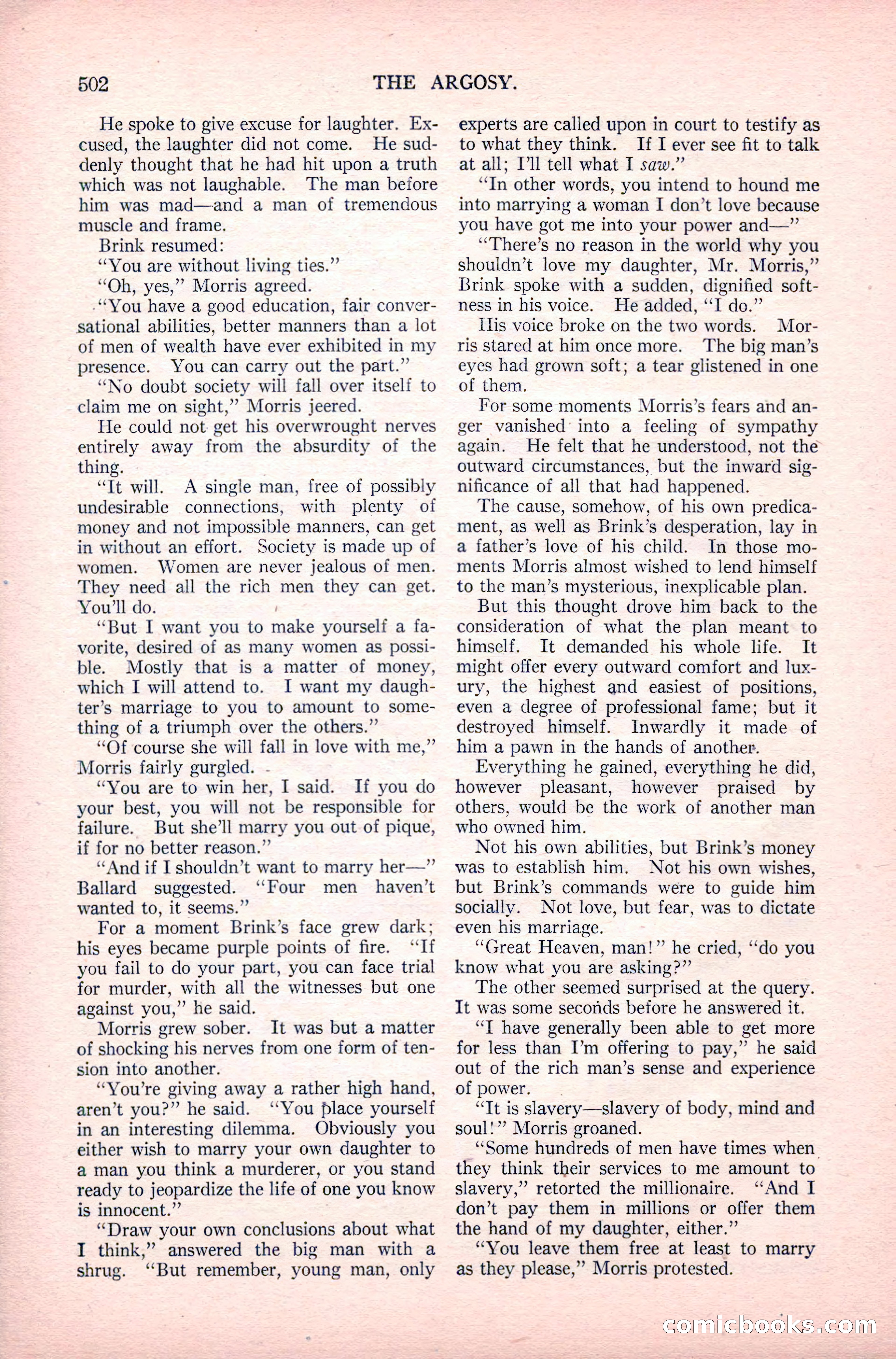
A restored page from Pulp Fiction, 1916. Page through the whole issue in the reader above.
📄 Transcribed text from this page (OCR, searchable)
Machine-transcribed from the original scan — historical spelling and the odd misread are preserved.
502 He spoke to give excuse for laughter. Ex- cused, the laughter did not come. He sud- denly thought that he had hit upon a truth which was not laughable. ‘The man before him was mad—and a man of tremendous muscle and frame. Brink resumed: “Vou are without living ties.” “Oh, yes,” Morris agreed. “You have a good education, fair conver- sational abilities, better manners than a lot of men of wealth have ever exhibited in my presence. You can carry out the part.” “No doubt society will fall over itself to claim me on sight,’”’ Morris jeered. He could not get his overwrought nerves entirely away from the absurdity of the thing. “Tt will. A single man, free of possibly undesirable connections, with plenty of money and not impossible manners, can get in without an effort. Society is made up of women. Women are never jealous of men. They need all the rich men they can get. You'll do. “But I want you to make yourself a fa- vorite, desired of as many women as possi- ble. Mostly that is a matter of money, which I will attend to. I want my daugh- ter’s marriage to you to amount to some- thing of a triumph over the others.” “Of course she will fall in love with me,” Morris fairly gurgled. - “Vou are to win her, I said. If you do your best, you will not be responsible for failure. But she’ll marry you out of pique, if for no better reason.” ‘And if I shouldn’t want to marry her—” Ballard suggested. ‘‘Four men _ haven’t wanted to, it seems.”’ For a moment Brink’s face grew dark; his eyes became purple points of fire. “If you fail to do your part, you can face trial for murder, with all the witnesses but one against you,” he said. Morris grew sober. It was but a matter of shocking his nerves from one form of ten- sion into another. “Vou’re giving away a rather high hand, aren’t you?” he said. ‘‘You place yourself in an interesting dilemma. Obviously you either wish to marry your own daughter to a man you think a murderer, or you stand ready to jeopardize the life of one you know is innocent.” “Draw your own conclusions about what I think,” answered the big man with a shrug. ‘But remember, young man, only THE ARGOSY. experts are called upon in court to testify as to what they think. If I ever see fit to talk at all; I'll tell what I saw.” “In other words, you intend to hound me into marrying a woman I don’t love because you have got me into your power and—”’ ‘“There’s no reason in the world why you shouldn’t love my daughter, Mr. Morris,” Brink spoke with a sudden, dignified soft- ness in his voice. He added, ‘‘I do.” His voice broke on the two words. Mor- ris stared at him once more. The big man’s eyes had grown soft; a tear glistened in one of them. lor some moments Morris’s fears and an- ger vanished’ into a feeling of sympathy again. He felt that he understood, not the outward circumstances, but the inward sig- nificance of all that had happened. The cause, somehow, of his own predica- ment, as well as Brink’s desperation, lay in a father’s love of his child. In those mo- ments Morris almost wished to lend himself to the man’s mysterious, inexplicable plan. But this thought drove him back to the consideration of what the plan meant to himself. It demanded his whole life. It might offer every outward comfort and lux- ury, the highest and easiest of positions, even a degree of professional fame; but it destroyed himself. Inwardly it made of him a pawn in the hands of another. Everything he gained, everything he did, however pleasant, however praised by others, would be the work of another man who owned him. Not his own abilities, but Brink’s money was to establish him. Not his own wishes, but Brink’s commands were to guide him socially. Not love, but fear, was to dictate even his marriage. “Great Heaven, man!” he cried, “‘do you know what you are asking?” The other seemed surprised at the query. It was some seconds before he answered it. “T have generally been able to get more for less than I’m offering to pay,” he said out of the rich man’s sense and experience of power. “Tt is slavery—slavery of body, mind and soul!” Morris groaned. “Some hundreds of men have times when they think their services to me amount to slavery,” retorted the millionaire. ‘‘And I don’t pay them in millions or offer them the hand of my daughter, either.” “Vou leave them free at least to marry as they please,” Morris protested. HVOOKS COWMUCG (E@)