
Pulp Fiction, 1916 · page 127 of 212
The Argosy, Vol. 82, No. 3 — page 127: what you’re looking at
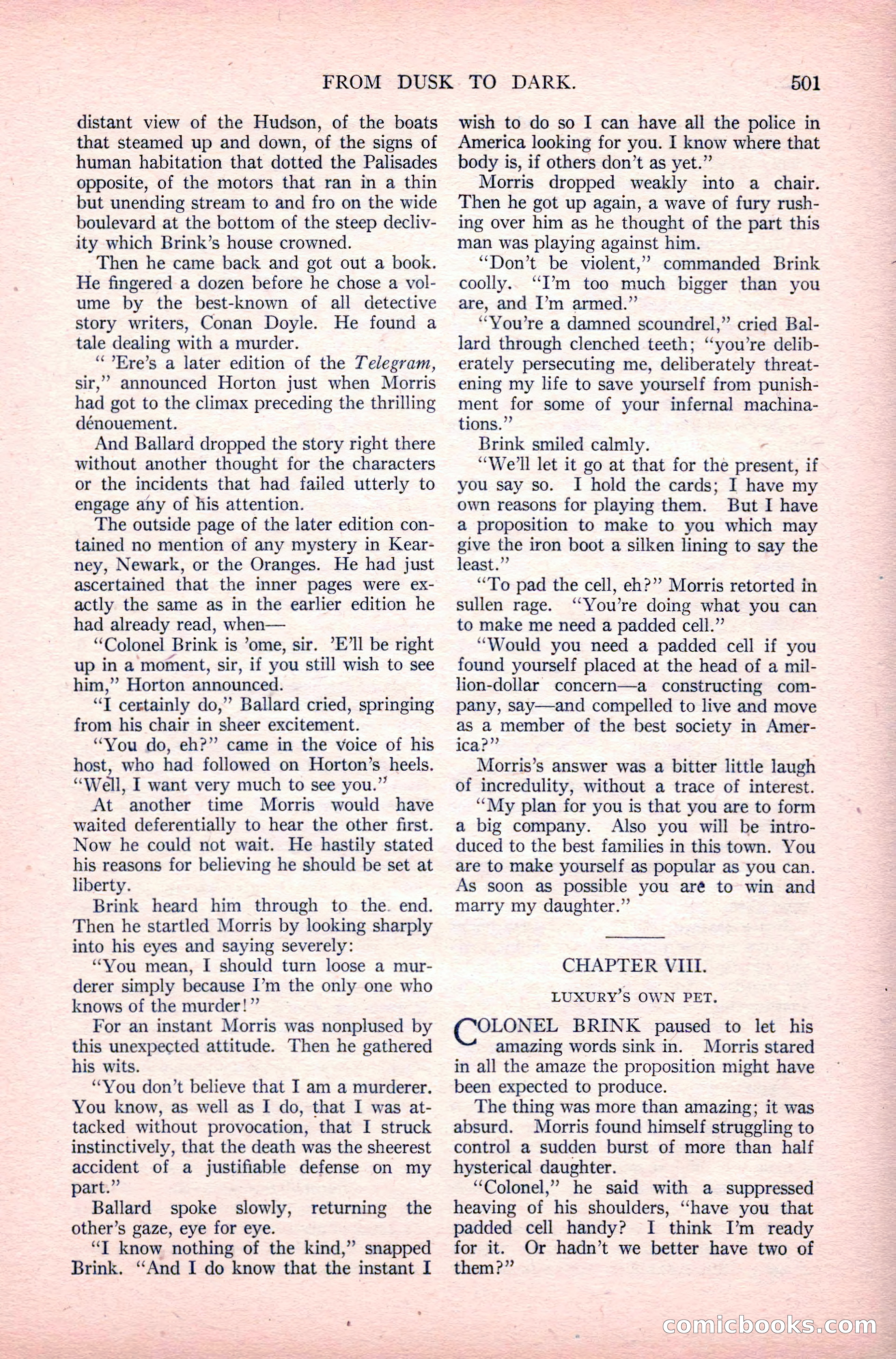
A restored page from Pulp Fiction, 1916. Page through the whole issue in the reader above.
📄 Transcribed text from this page (OCR, searchable)
Machine-transcribed from the original scan — historical spelling and the odd misread are preserved.
FROM DUSK TO DARK. distant view of the Hudson, of the boats that steamed up and down, of the signs of human habitation that dotted the Palisades opposite, of the motors that ran in a thin but unending stream to and fro on the wide boulevard at the bottom of the steep decliv- ity which Brink’s house crowned. Then he came back and got out a book. He fingered a dozen before he chose a vol- ume by the best-known of all detective story writers, Conan Doyle. He found a tale dealing with a murder. ‘“°Ere’s a later edition of the Telegram, sir,’ announced Horton just when Morris had got to the climax preceding the thrilling dénouement. And Ballard dropped the story right there without another thought for the characters or the incidents that had failed utterly to engage any of his attention. The outside page of the later edition con- tained no mention of any mystery in Kear- ney, Newark, or the Oranges. He had just ascertained that the inner pages were ex- actly the same as in the earlier edition he had already read, when— “Colonel Brink is ’ome, sir. ’E’ll be right up in a moment, sir, if you still wish to see him,” Horton announced. “T certainly do,” Ballard cried, springing from his chair in sheer excitement. “Vou do, eh?” came in the voice of his host, who had followed on Horton’s heels. “Well, I want very much to see you.” At another time Morris would have waited deferentially to hear the other first. Now he could not wait. He hastily stated his reasons for believing he should be set at liberty. Brink heard him through to the. end. Then he startled Morris by looking sharply into his eyes and saying severely: “You mean, I should turn loose a mur- derer simply because I’m the only one who knows of the murder!” For an instant Morris was nonplused by this unexpected attitude. Then he gathered his wits. “You don’t believe that I am a murderer. You know, as well as I do, that I was at- tacked without provocation, that I struck instinctively, that the death was the sheerest accident of a justifiable defense on my part.” Ballard spoke slowly, other’s gaze, eye for eye. “J know nothing of the kind,” snapped Brink. ‘And I do know that the instant I returning the 501 wish to do so I can have all the police in America looking for you. I know where that body is, if others don’t as yet.” Morris dropped weakly into a chair. Then he got up again, a wave of fury rush- ing over him as he thought of the part this man was playing against him. ‘Don’t be violent,” commanded Brink coolly.. “I’m too much bigger than you are, and I’m armed.” ‘““You’re a damned scoundrel,” cried Bal- lard through clenched teeth; “you’re delib- erately persecuting me, deliberately threat- ening my life to save yourself from punish- ment for some of your infernal machina- tions.” Brink smiled calmly. “We'll let it go at that for the piesa if you say so. I hold the cards; I have my own reasons for playing them. But I have a proposition to make to you which may give the iron boot a silken lining to say the least.” “To pad the cell, eh?” Morris retorted in sullen rage. ‘“‘You’re doing what you can to make me need a padded cell.”’ ‘Would you need a padded cell if you found yourself placed at the head of a mil- lion-dollar concern—a constructing com- pany, say—and compelled to live and move as a member of the best society in Amer- ica?” Morris’s answer was a bitter little laugh of incredulity, without a trace of interest. ‘My plan for you is that you are to form a big company. Also you will be intro- duced to the best families in this town. You are to make yourself as popular as you can. As soon as possible you aré to win and marry my daughter.” CHAPTER VIII. LUXURY’S OWN PET. COLON EL BRINK paused to let his amazing words sink in. Morris stared in all the amaze the proposition might have been expected to produce. The thing was more than amazing; it was absurd. Morris found himself struggling to control a sudden burst of more than half hysterical daughter. “Colonel,” he said with a suppressed heaving of his shoulders, ‘have you that padded cell handy? I think I’m ready for it. Or hadn’t we better have two of them?” COPNICGLOOOKS (E@)