
Pulp Fiction, 1916 · page 126 of 212
The Argosy, Vol. 82, No. 3 — page 126: what you’re looking at
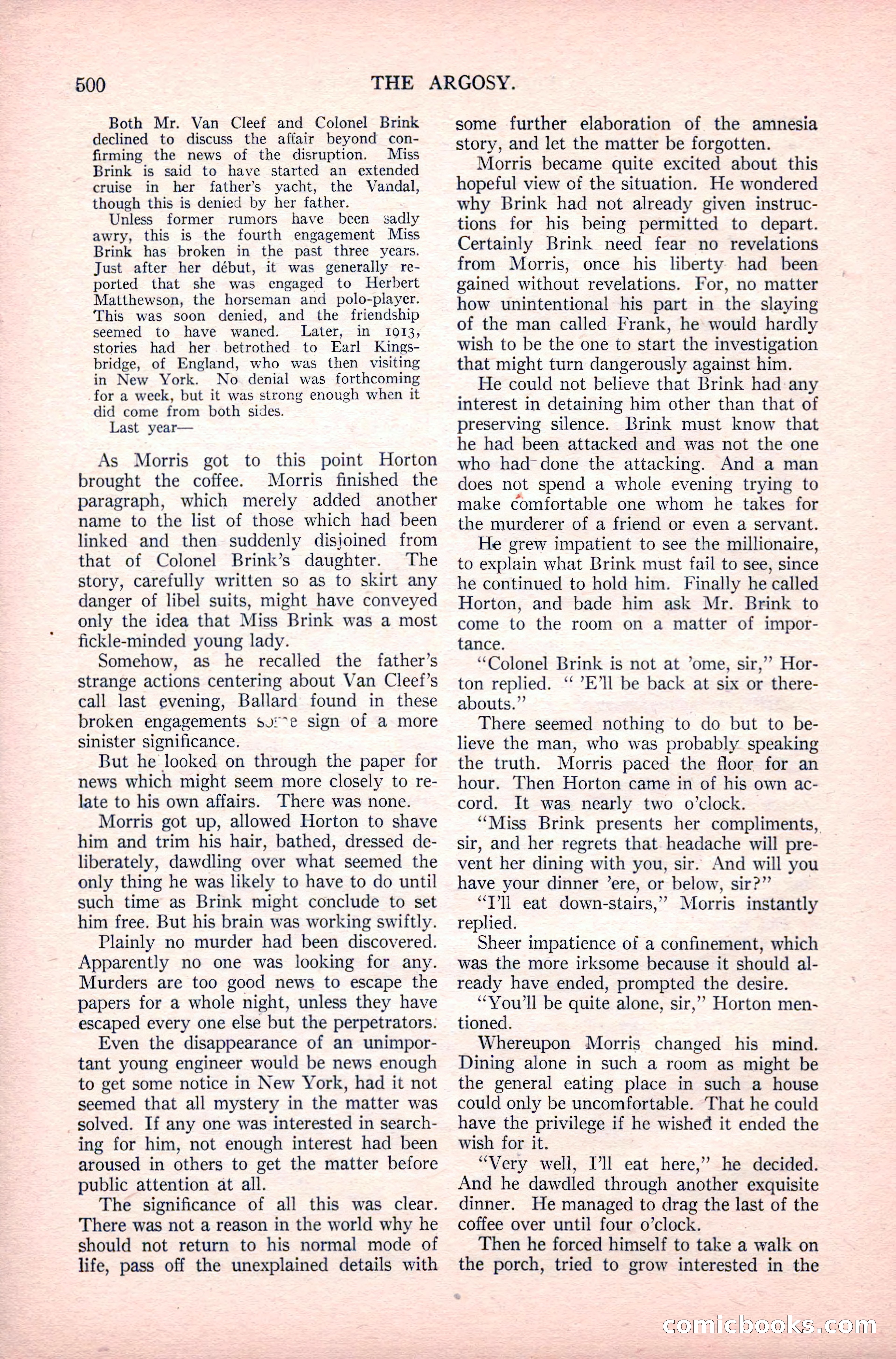
A restored page from Pulp Fiction, 1916. Page through the whole issue in the reader above.
📄 Transcribed text from this page (OCR, searchable)
Machine-transcribed from the original scan — historical spelling and the odd misread are preserved.
500 THE Both Mr. Van Cleef and Colonel Brink declined to discuss the affair beyond con- firming the news of the disruption. Miss Brink is said to have started an extended cruise in her father’s yacht, the Vandal, though this is denied by her father. Unless former rumors have been sadly awry, this is the fourth engagement Miss Brink has broken in the past three years. Just after her début, it was generally re- ported that she was engaged to Herbert Matthewson, the horseman and polo-player. This was soon denied, and the friendship seemed to have waned. Later, in 1013, stories had her betrothed to Earl Kings- bridge, of England, who was then visiting in New York. No denial was forthcoming for a week, but it was strong enough when it did come from both sides. Last year— As Morris got to this point Horton brought the coffee. Morris finished the paragraph, which merely added another name to the list of those which had been linked and then suddenly disjoined from that of Colonel Brink’s daughter. The story, carefully written so as to skirt any danger of libel suits, might have conveyed only the idea that Miss Brink was a most fickle-minded young lady. Somehow, as he recalled the father’s strange actions centering about Van Cleef’s call last evening, Ballard found in these broken engagements sor-e sign of a more sinister significance. But he looked on through the paper for news which might seem more closely to re- late to his own affairs. There was none. Morris got up, allowed Horton to shave him and trim his hair, bathed, dressed de- liberately, dawdling over what seemed the only thing he was likely to have to do until such time as Brink might conclude to set him free. But his brain was working swiftly. Plainly no murder had been discovered. Apparently no one was looking for any. Murders are too good news to escape the papers for a whole night, unless they have escaped every one else but the perpetrators. Even the disappearance of an unimpor- tant young engineer would be news enough to get some notice in New York, had it not seemed that all mystery in the matter was solved. If any one was interested in search- ing for him, not enough interest had been aroused in others to get the matter before public attention at all. The significance of all this was clear. There was not a reason in the world why he should not return to his normal mode of life, pass off the unexplained details with ARGOSY. some further elaboration of the amnesia story, and let the matter be forgotten. Morris became quite excited about this hopeful view of the situation. He wondered why Brink had not already given instruc- tions for his being permitted to depart. Certainly Brink need fear no revelations from Morris, once his liberty had been gained without revelations. For, no matter how unintentional his part in the slaying of the man called Frank, he would hardly wish to be the one to start the investigation that might turn dangerously against him. He could not believe that Brink had any interest in detaining him other than that of preserving silence. Brink must know that he had been attacked and was not the one who had done the attacking. And a man does not spend a whole evening trying to make comfortable one whom he takes for the murderer of a friend or even a servant. He grew impatient to see the millionaire, to explain what Brink must fail to see, since he continued to hold him. Finally he called Horton, and bade him ask Mr. Brink to come to the room on a matter of impor- tance. “Colonel Brink is not at ’ome, sir,” Hor- ton replied. “‘ ’E’ll be back at six or there- abouts.” There seemed nothing to do but to be- lieve the man, who was probably speaking the truth. Morris paced the floor for an hour. Then Horton came in of his own ac- cord. It was nearly two o’clock. ‘Miss Brink presents her compliments, sir, and her regrets that headache will pre- vent her dining with you, sir. And will you have your dinner ’ere, or below, sir?” “Tl eat down-stairs,” Morris instantly replied. Sheer impatience of a confinement, which was the more irksome because it should al- ready have ended, prompted the desire. “You'll be quite alone, sir,’ Horton men- tioned. Whereupon Morris changed his mind. Dining alone in such a room as might be the general eating place in such a house could only be uncomfortable. That he could have the privilege if he wished it ended the wish for it. “Very well, [ll eat here,” he decided. And he dawdled through another exquisite dinner. He managed to drag the last of the coffee over until four o’clock. Then he forced himself to take a walk on the porch, tried to grow interested in the EOPMICLOOC (C cS (©)