
Pulp Fiction, 1916 · page 123 of 212
The Argosy, Vol. 82, No. 3 — page 123: what you’re looking at
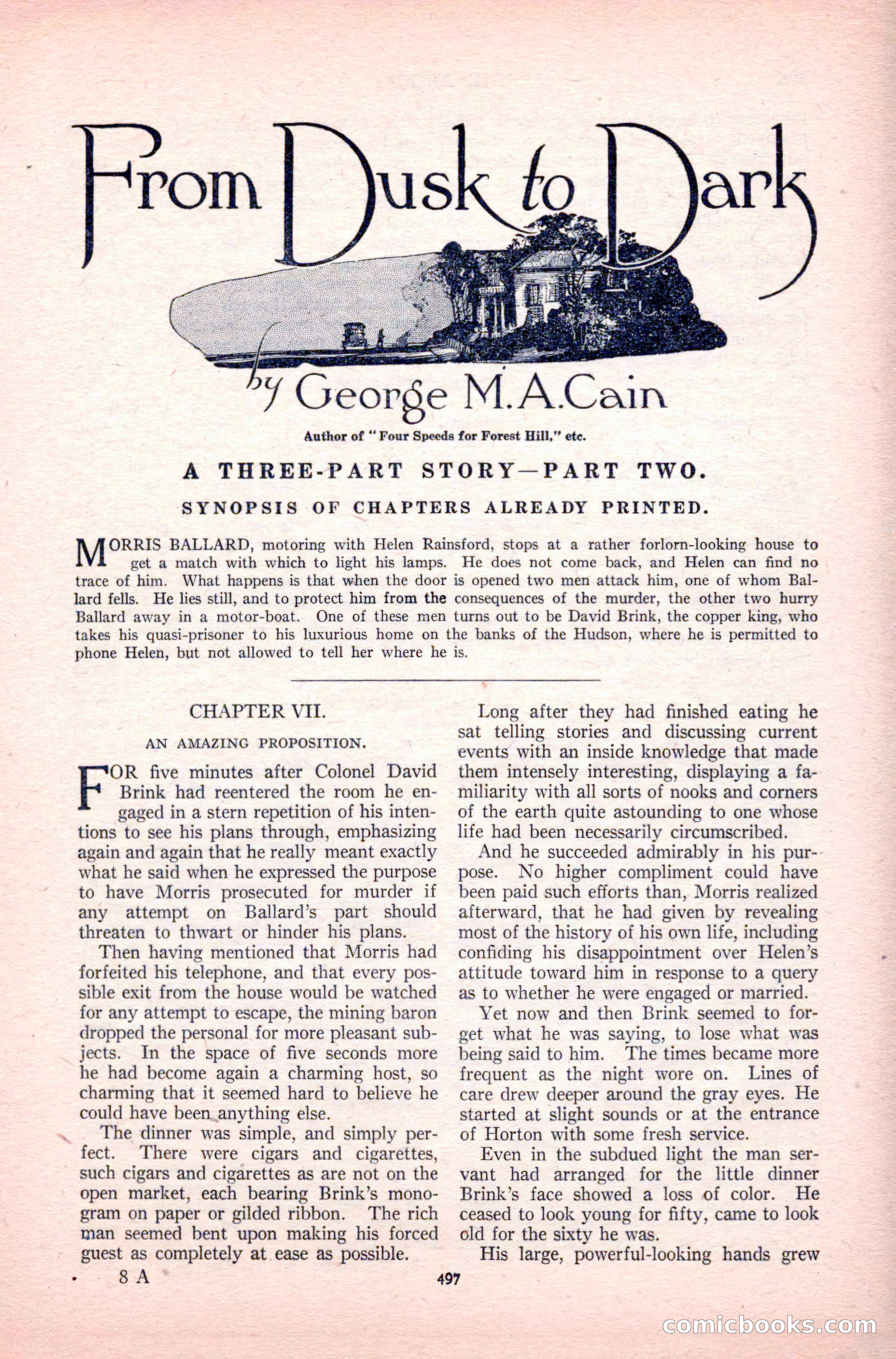
A restored page from Pulp Fiction, 1916. Page through the whole issue in the reader above.
📄 Transcribed text from this page (OCR, searchable)
Machine-transcribed from the original scan — historical spelling and the odd misread are preserved.
¥ George M.ACain Author of “‘ Four Speeds for Forest Hill,” ete. A THREE-PART STORY—PART TWO. SYNOPSIS OF CHAPTERS ALREADY PRINTED. ORRIS BALLARD, motoring with Helen Rainsford, stops at a rather forlorn-looking house to get a match with which to light his lamps. He does not come back, and Helen can find no trace of him. What happens is that when the door is opened two men attack him, one of whom Bal- lard fells. He lies still, and to protect him from the consequences of the murder, the other two hurry Ballard away in a motor-boat. One of these men turns out to be David Brink, the copper king, who takes his quasi-prisoner to his luxurious home on the banks of the Hudson, where he is permitted to phone Helen, but not allowed to tell her where he is. CHAPTER VII. AN AMAZING PROPOSITION. OR five minutes after Colonel David Brink had reentered the room he en- gaged in a stern repetition of his inten- tions to see his plans through, emphasizing again and again that he really meant exactly what he said when he expressed the purpose to have Morris prosecuted for murder if any attempt on Ballard’s part should threaten to thwart or hinder his plans. Then having mentioned that Morris had forfeited his telephone, and that every pos- sible exit from the house would be watched for any attempt to escape, the mining baron dropped the personal for more pleasant sub- jects. In the space of five seconds more he had become again a charming host, so charming that it seemed hard to believe he could have been.anything else. The dinner was simple, and simply per- fect. There were cigars and cigarettes, such cigars and cigarettes as are not on the open market, each bearing Brink’s mono- gram on paper or gilded ribbon. The rich man seemed bent upon making his forced guest as completely at.ease as possible. . 8A Long after they had finished eating he sat telling stories and discussing current events with an inside knowledge that made them intensely interesting, displaying a fa- miliarity with all sorts of nooks and corners of the earth quite astounding to one whose life had been necessarily circumscribed. And he succeeded admirably in his pur-- pose. No higher compliment could have been paid such efforts than, Morris realized afterward, that he had given by revealing most of the history of his own life, including confiding his disappointment over Helen’s attitude toward him in response to a query as to whether he were engaged or married. Yet now and then Brink seemed to for- get what he was saying, to lose what was being said to him. The times became more frequent as the night wore on. Lines of care drew deeper around the gray eyes. He started at slight sounds or at the entrance of Horton with some fresh service. Even in the subdued light the man ser- vant had arranged for the little dinner Brink’s face showed a loss of color. He ceased to look young for fifty, came to look old for the sixty he was. His large, powerful-looking hands grew 497 .OO (C@) cS) (E@)