
Pulp Fiction, 1916 · page 122 of 212
The Argosy, Vol. 82, No. 3 — page 122: what you’re looking at
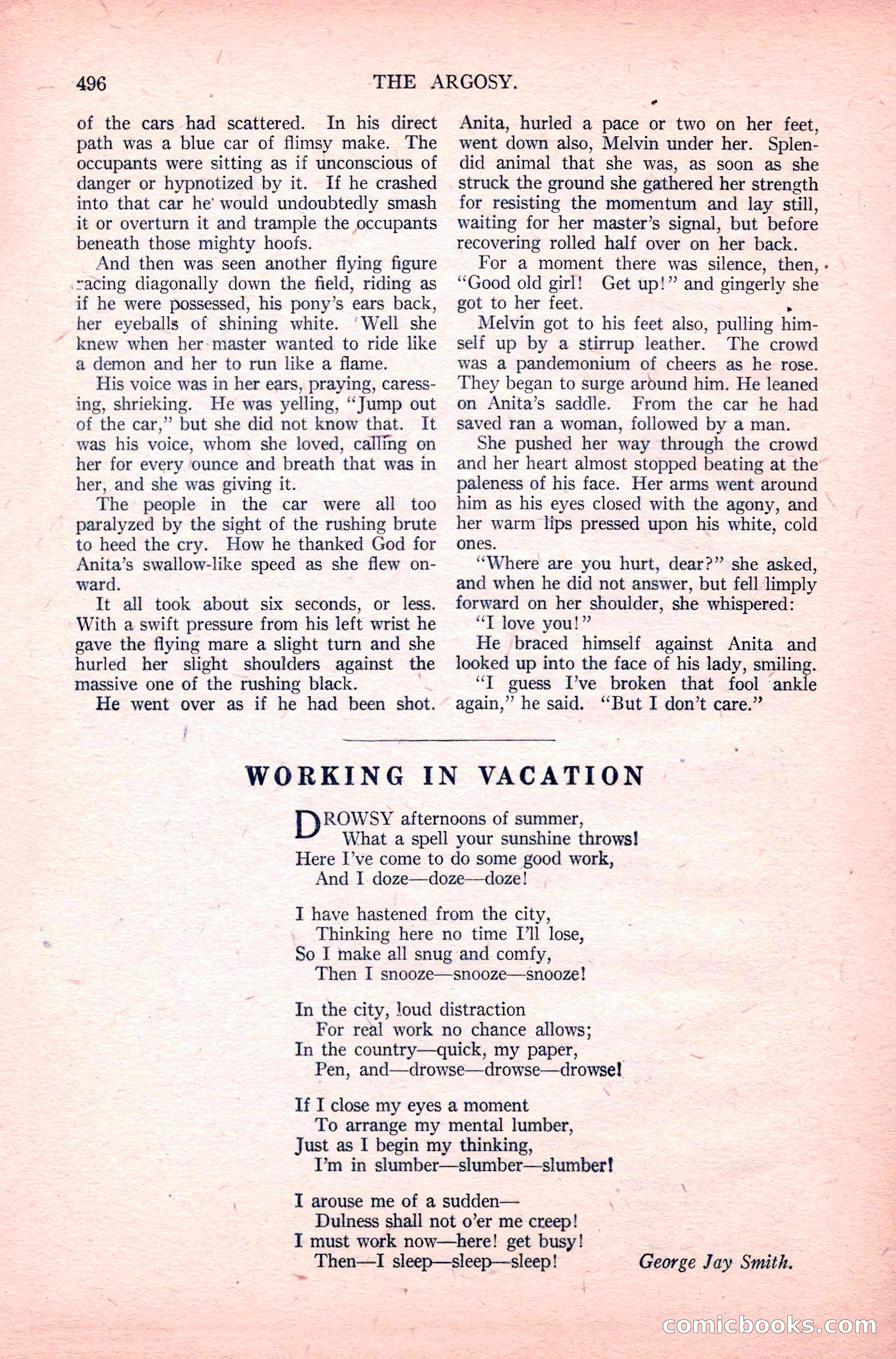
A restored page from Pulp Fiction, 1916. Page through the whole issue in the reader above.
📄 Transcribed text from this page (OCR, searchable)
Machine-transcribed from the original scan — historical spelling and the odd misread are preserved.
496 of the cars had scattered. In his direct path was a blue car of flimsy make. The occupants were sitting as if unconscious of danger or hypnotized by it. If he crashed into that car he’ would undoubtedly smash it or overturn it and trample the occupants beneath those mighty hoofs. And then was seen another flying figure “acing diagonally down the field, riding as if he were possessed, his pony’s ears back, her eyeballs of shining white. ‘Well she knew when her- master wanted to ride like a demon and her to run like a flame. His voice was in her ears, praying, caress- ing, shrieking. He was yelling, “Jump out of the car,” but she did not know that. It was his voice, whom she loved, calling on her for every ounce and breath that was in her, and she was giving it. The people in the car were all too paralyzed by the sight of the rushing brute to heed the cry. How he thanked God for Anita’s swallow-like speed as she flew on- ward. It all took about six seconds, or less. With a swift pressure from his left wrist he gave the flying mare a slight turn and she hurled her slight shoulders against the massive one of the rushing black. He went over as if he had been shot. THE ARGOSY. Cd Anita, hurled a pace or two on her feet, went down also, Melvin under her. Splen- did animal that she was, as soon as she struck the ground she gathered her strength for resisting the momentum and lay still, waiting for her master’s signal, but before recovering rolled half over on her back. For a moment there was silence, then, - “Good old girl! Get up!” and gingerly she got to her feet. J Melvin got to his feet also, pulling him- self up by a stirrup leather. The crowd was a pandemonium of cheers as he rose. They began to surge around him. He leaned on Anita’s saddle. From the car he had saved ran a woman, followed by a man. She pushed her way through the crowd and her heart almost stopped beating at the paleness of his face. Her arms went around him as his eyes closed with the agony, and her warm lips pressed upon his white, cold ones. ‘Where are you hurt, dear?” she asked, and when he did not answer, but fell limply forward on her shoulder, she whispered: “T love you!” He braced himself against Anita and looked up into the face of his lady, smiling. “T guess I’ve broken that fool ankle again,” he said. “But I don’t care.” WORKING IN VACATION ROWSY afternoons of summer, What a spell your sunshine throws! Here I’ve come to do some good work, And I doze—doze—doze! I have hastened from the city, Thinking here no time I'll lose, So I make all snug and comfy, Then I snooze—snooze—snooze! In the city, loud distraction For real work no chance allows; In the country—quick, my paper, Pen, and—drowse—drowse—drowse! If I close my eyes a moment To arrange my mental lumber, Just as I begin my thinking, I’m in slumber—slumber—slumber! I arouse me of a sudden— Dulness shall not o’er me creep! _ I must work now—here! get busy! Then—I sleep—sleep—sleep! George Jay Smith. EOPMICLOOOKS (E@)