
Pulp Fiction, 1916 · page 124 of 212
The Argosy, Vol. 82, No. 3 — page 124: what you’re looking at
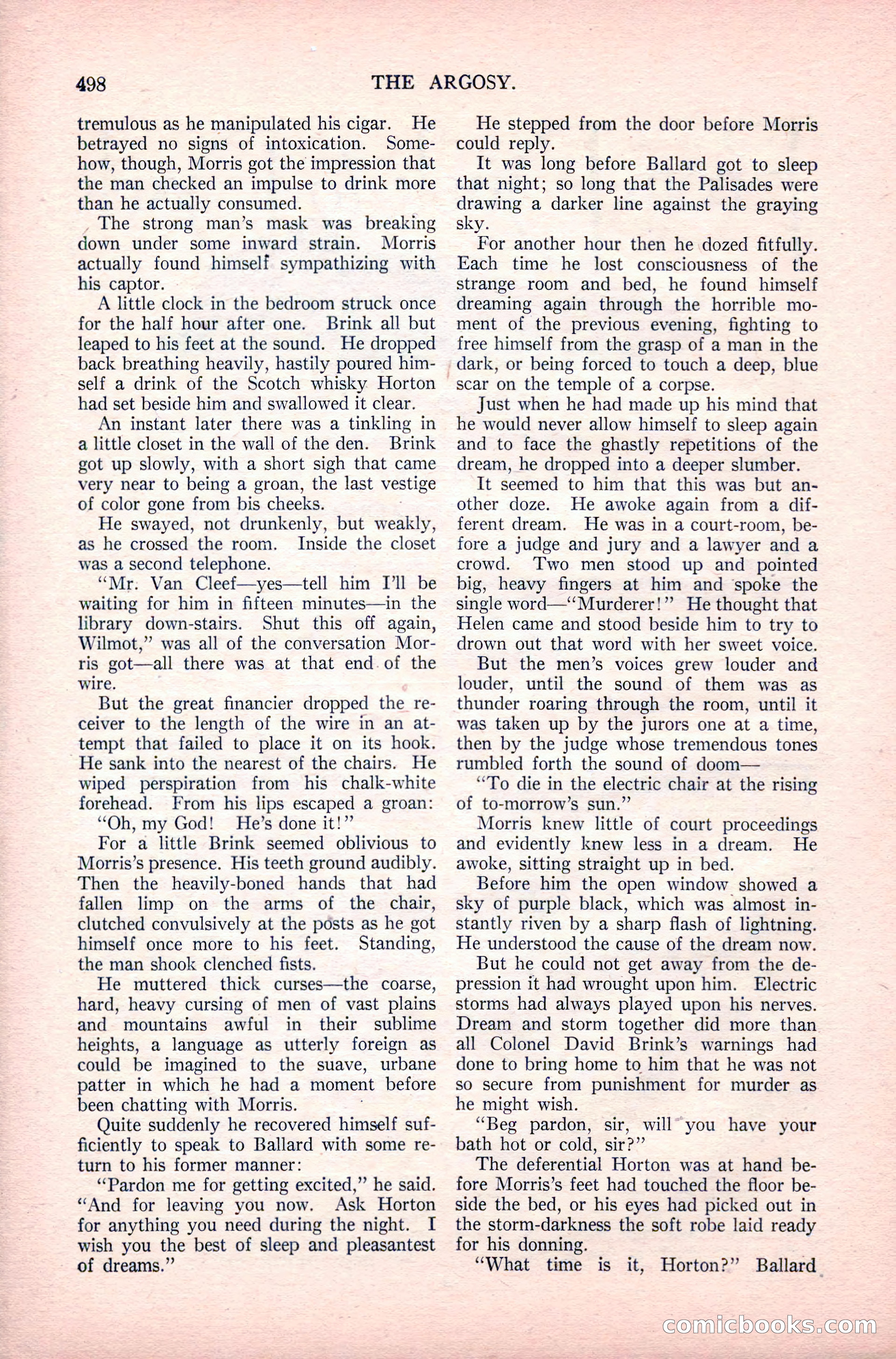
A restored page from Pulp Fiction, 1916. Page through the whole issue in the reader above.
📄 Transcribed text from this page (OCR, searchable)
Machine-transcribed from the original scan — historical spelling and the odd misread are preserved.
498 THE tremulous as he manipulated his cigar. He betrayed no signs of intoxication. Some- how, though, Morris got the impression that the man checked an impulse to drink more than he actually consumed. _ The strong man’s mask was breaking down under some inward strain. Morris actually found himself sympathizing with his captor. A little clock in the bedroom struck once for the half hour after one. Brink all but leaped to his feet at the sound. He dropped back breathing heavily, hastily poured him- self a drink of the Scotch whisky Horton had set beside him and swallowed it clear. An instant later there was a tinkling in a little closet in the wall of the den. Brink got up slowly, with a short sigh that came very near to being a groan, the last vestige of color gone from bis cheeks. He swayed, not drunkenly, but wendy, as he crossed the room. Inside the closet was a second telephone. “Mr. Van Cleef—yes—tell him [’ll be waiting for him in fifteen minutes—in the library down-stairs. Shut this off again, Wilmot,” was all of the conversation Mor- ris got—all there was at that end. of the wire. But the great financier dropped the re- ceiver to the length of the wire in an at- tempt that failed to place it on its hook. He sank into the nearest of the chairs. He wiped perspiration from his chalk-white forehead. From his lips escaped a groan: “Oh, my God! He’s done it!” For a little Brink seemed oblivious to Morris’s presence. His teeth ground audibly. Then the heavily-boned hands that had fallen limp on the arms of the chair, clutched convulsively at the posts as he got himself once more to his feet. Standing, the man shook clenched fists. He muttered thick curses—the coarse, hard, heavy cursing of men of vast plains and mountains awful in their sublime heights, a language as utterly foreign as could be imagined to the suave, urbane patter in which he had a moment before been chatting with Morris. Quite suddenly he recovered himself suf- ficiently to speak to Ballard with some re- turn to his former manner: ‘Pardon me for getting excited,” he said. “And for leaving you now. Ask Horton for anything you need during the night. I wish you the best of sleep and pleasantest of dreams.” ARGOSY. He stepped from the door before Morris could reply. It was long before Ballard got to sleep that night; so long that the Palisades were drawing a darker line against the graying sky. For another hour then he dozed fitfully. Each time he lost consciousness of the strange room and bed, he found himself dreaming again through the horrible mo- ment of the previous evening, fighting to free himself from the grasp of a man in the dark, or being forced to touch a deep, blue scar on the temple of a corpse. Just when he had made up his mind that he would never allow himself to sleep again and to face the ghastly repetitions of the dream, he dropped into a deeper slumber. It seemed to him that this was but an- other doze. He awoke again from a dif- ferent dream. He was in a court-room, be- fore a judge and jury and a lawyer and a crowd. Two men stood up and pointed big, heavy fingers at him and spoke the single word—‘‘Murderer!” He thought that Helen came and stood beside him to try to drown out that word with her sweet voice. But the men’s voices grew louder and louder, until the sound of them was as thunder roaring through the room, until it was taken up by the jurors one at a time, then by the judge whose tremendous tones rumbled forth the sound of doom— ‘To die in the electric chair at the rising of to-morrow’s sun.” Morris knew little of court proceedings and evidently knew less in a dream. He awoke, sitting straight up in bed. Before him the open window showed a sky of purple black, which was almost in- stantly riven by a sharp flash of lightning. He understood the cause of the dream now. But he could not get away from the de- pression it had wrought upon him. Electric storms had always played upon his nerves. Dream and storm together did more than all Colonel David Brink’s warnings had done to bring home to him that he was not so secure from punishment for murder as he might wish. “Beg pardon, sir, will you have your bath hot or cold, sir?” The deferential Horton was at hand be- fore Morris’s feet had touched the floor be- side the bed, or his eyes had picked out in the storm-darkness the soft robe laid ready for his donning. “What time is it, Horton?” (€(0) TOO AMUN S Ballard | (S@)