
Pulp Fiction, 1916 · page 118 of 212
The Argosy, Vol. 82, No. 3 — page 118: what you’re looking at
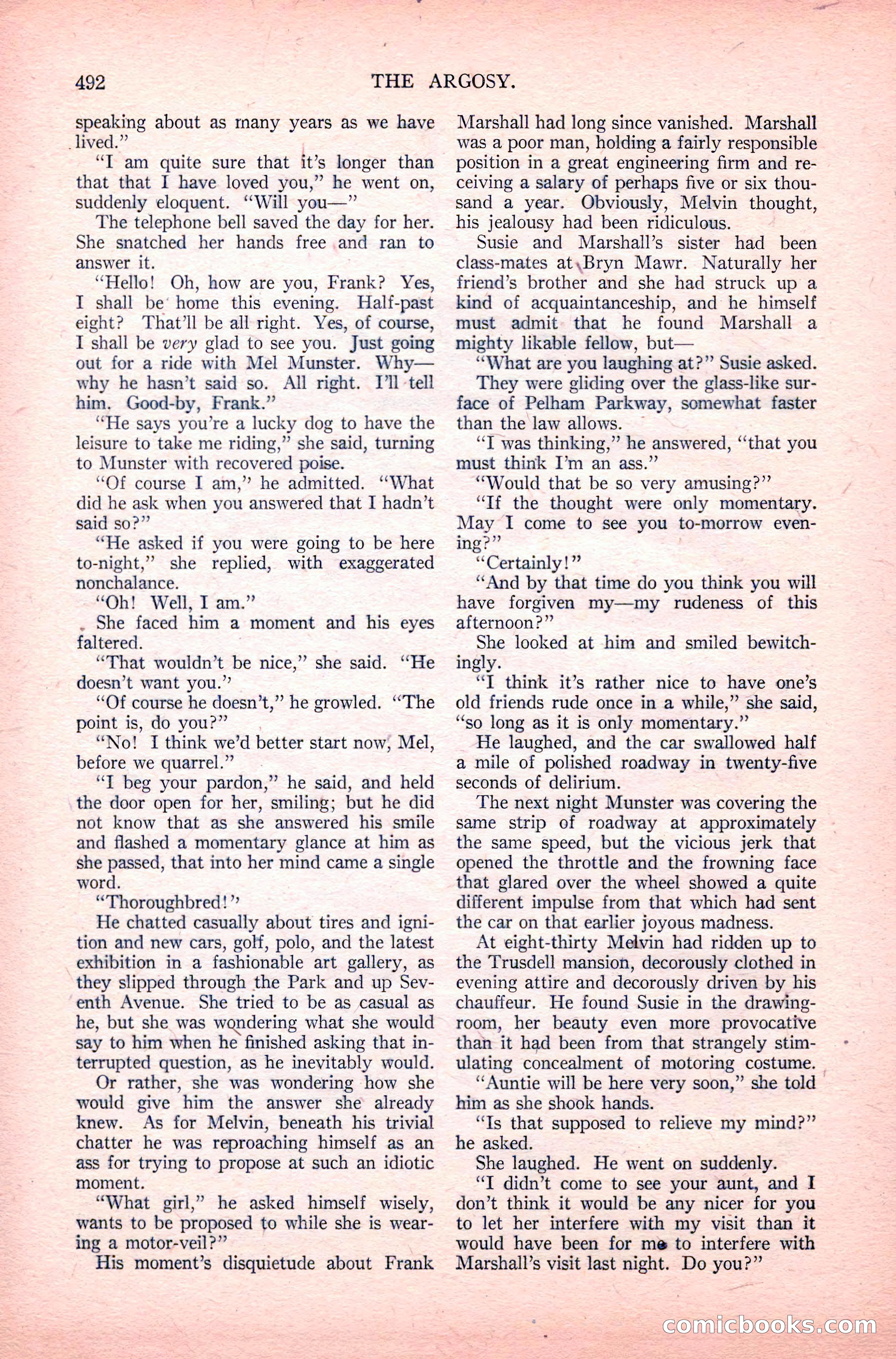
A restored page from Pulp Fiction, 1916. Page through the whole issue in the reader above.
📄 Transcribed text from this page (OCR, searchable)
Machine-transcribed from the original scan — historical spelling and the odd misread are preserved.
492 speaking about as tnany years as we have _lived.” “T am quite sure that it’s longer than that that I have loved you,” he went on, suddenly eloquent. ‘‘Will you—” The telephone bell saved the day for her. She snatched her hands free and ran to answer it. ‘Hello! Oh, how are you, Frank? Yes, I shall be’ home this evening. Half-past eight? That’ll be all right. Yes, of course, I shall be very glad to see you. Just going out for a ride with Mel Munster. Why— why he hasn’t said so. All right. I'll tell him. Good-by, Frank.” ‘“He says you’re a lucky dog to have the leisure to take me riding,” she said, turning to Munster with recovered poise. “Of course I am,” he admitted. ‘‘What did he ask when you answered that I hadn’t said so?” “He asked if you were going to be here to-night,” she replied, with exaggerated nonchalance. “Oh! Well, I am.” . She faced him a moment and his eyes faltered. “That wouldn’t be nice,” she said. ‘‘He doesn’t want you.” “Of course he doesn’t,” he growled. ‘“The point is, do you?” “No! I think we’d better start now, Mel, before we quarrel.” “YT beg your pardon,” he said, and held the door open for her, smiling; but he did not know that as she answered his smile and flashed a momentary glance at him as she passed, that into her mind came a single word. “Thoroughbred! ” He chatted casually about tires and igni- tion and new cars, golf, polo, and the latest exhibition in a fashionable art gallery, as they slipped through the Park and up Sev- enth Avenue. She tried to be as casual as he, but she was wondering what she would say to him when he finished asking that in- terrupted question, as he inevitably would. Or rather, she was wondering how she would give him the answer she already knew. As for Melvin, beneath his trivial chatter he was reproaching himself as an ass for trying to propose at such an idiotic moment. “What girl,” he asked himself wisely, wants to be proposed to while she is wear- ing a motor-veil?” His moment’s disquietude about Frank THE ARGOSY. Marshall had long since vanished. Marshall was a poor man, holding a fairly responsible position in a great engineering firm and re- ceiving a salary of perhaps five or six thou- sand a year. Obviously, Melvin thought, his jealousy had been ridiculous. Susie and Marshall’s sister had been class-mates at,Bryn Mawr. Naturally her friend’s brother and she had struck up a kind of acquaintanceship, and he himself must admit that he found Marshall a mighty likable fellow, but— “What are you laughing at?” Susie asked. They were gliding over the glass-like sur- face of Pelham Parkway, somewhat faster than the law allows. ~ “T was thinking,” he answered, “‘that you must think I’m an ass.” “Would that be so very amusing?” “Tf the thought were only momentary. May I come to see you to-morrow even- ing?” “Certainly!” “And by that time do you think you will have forgiven my—my rudeness of this afternoon?” She looked at him and smiled bewitch- ingly. “T think it’s rather nice to have one’s old friends rude once in a while,” she said, ‘so long as it is only momentary.” He laughed, and the car swallowed half a mile of polished roadway in twenty-five seconds of delirium. The next night Munster was covering the same strip of roadway at approximately the same speed, but the vicious jerk that opened the throttle and the frowning face that glared over the wheel showed a quite different impulse from that which had sent the car on that earlier joyous madness. At eight-thirty Melvin had ridden up to the Trusdell mansion, decorously clothed in evening attire and decorously driven by his chauffeur. He found Susie in the drawing- room, her beauty even more provocative than it had been from that strangely stim- ulating concealment of motoring costume. ‘“‘Auntie will be here very soon,” she told him as she shook hands. “Ts that supposed to relieve my mind?” he asked. She laughed. He went on suddenly. “T didn’t come to see your aunt, and I don’t think it would be any nicer for you to let her interfere with my visit than it would have been for me to interfere with Marshall’s visit last night. Do you?” GEomichbooks (E)