
Pulp Fiction, 1916 · page 119 of 212
The Argosy, Vol. 82, No. 3 — page 119: what you’re looking at
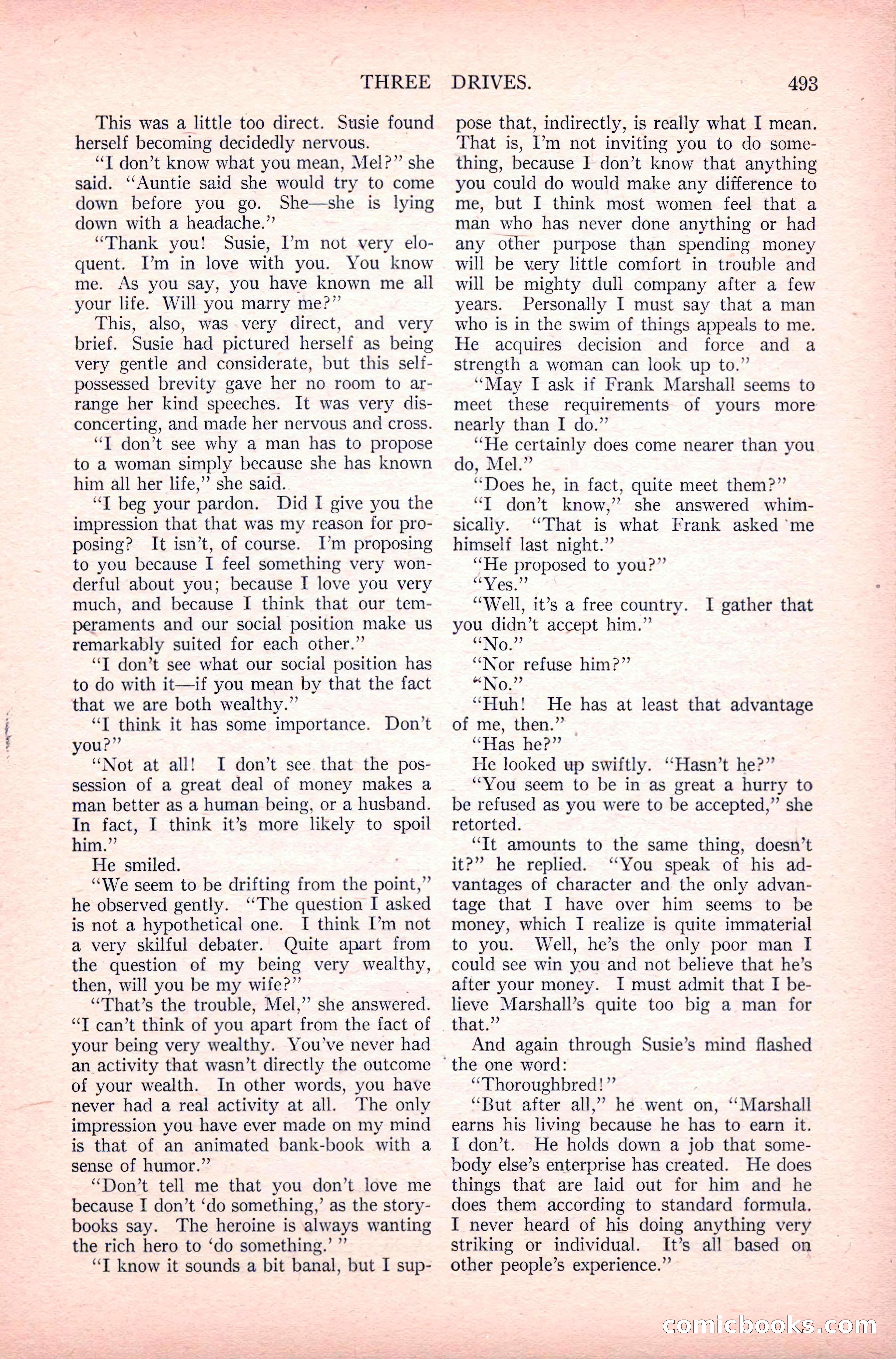
A restored page from Pulp Fiction, 1916. Page through the whole issue in the reader above.
📄 Transcribed text from this page (OCR, searchable)
Machine-transcribed from the original scan — historical spelling and the odd misread are preserved.
THREE This was a little too direct. Susie found herself becoming decidedly nervous. “T don’t know what you mean, Mel?” she said. “Auntie said she would try to come down before you go. She—she is lying down with a headache.” “Thank you! Susie, I’m not very elo- quent. I’m in love with you. You know me. As you say, you have known me all your life. Will you marry me?” This, also, was very direct, and very brief. Susie had pictured herself as being very gentle and considerate, but this self- possessed brevity gave her no room to ar- range her kind speeches. It was very dis- concerting, and made her nervous and cross. “T don’t see why a man has to propose to a woman simply because she has known him all her life,’”’ she said. “Tt beg your pardon. Did I give you the impression that that was my reason for pro- posing? It isn’t, of course. I’m proposing to you because I feel something very won- derful about you; because I love you very much, and because I think that our tem- peraments and our social position make us remarkably suited for each other.”’ “T don’t see what our social position has to do with it—if you mean by that the fact that we are both wealthy.”’ “T think it has some importance. Don’t ou?” “Not at all! I don’t see that the pos- session of a great deal of money makes a man better as a human being, or a husband. In fact, I think it’s more likely to spoil him.” He smiled. “We seem to be drifting from the point,” he observed gently. ‘‘The question I asked is not a hypothetical one. I think I’m not a very skilful debater. Quite apart from the question of my being very wealthy, then, will you be my wife?” . “'That’s the trouble, Mel,’ she answered. “T can’t think of you apart from the fact of your being very wealthy. You’ve never had an activity that wasn’t directly the outcome of your wealth. In other words, you have never had a real activity at all. The only impression you have ever made on my mind is that of an animated bank-book with a sense of humor.” “Don’t tell me that you don’t love me because I don’t ‘do something,’ as the story- books say. The heroine is always wanting the rich hero to ‘do something.’ ” “T know it sounds a bit banal, but I sup- DRIVES. 493 pose that, indirectly, is really what I mean. That is, ’m not inviting you to do some- thing, because I don’t know that anything you could do would make any difference to me, but I think most women feel that a man who has never done anything or had any other purpose than spending money will be very little comfort in trouble and will be mighty dull company after a few years. Personally I must say that a man who is in the swim of things appeals to me. He acquires decision and force and a strength a woman can look up to.” “May I ask if Frank Marshall seems to meet these requirements of yours more nearly than I do.” “He certainly does come nearer than you do, Mel.” “Does he, in fact, quite meet them?” “T don’t know,” she answered whim- sically. ‘That is what Frank asked ‘me himself last night.” “He proposed to you?” co p77 “Well, it’s a free country. you didn’t accept him.” “NiG.”? “Nor refuse him?” “Nig “Huh! He has at least that advantage of me, then.” “Has he?” He looked up swiftly. ‘‘Hasn’t he?” “You seem to be in as great a hurry to be refused as you were to be accepted,” she retorted. ‘Tt amounts to the same thing, doesn’t it?” he replied. “You speak of his ad- vantages of character and the only advan- tage that I have over him seems to be money, which I realize is quite immaterial to you. Well, he’s the only poor man I could see win you and not believe that he’s after your money. I must admit that I be- lieve Marshall’s quite too big a man for that.” And again through Susie’s mind flashed I gather that ‘the one word: “Thoroughbred!” “But after all,” he went on, ‘Marshall earns his living because he has to earn it. I don’t. He holds down a job that some- body else’s enterprise has created. He does things that are laid out for him and he does them according to standard formula. I never heard of his doing anything very striking or individual. It’s all based on other people’s experience.” (C@) NOOLKS (E@)