
Pulp Fiction, 1916 · page 117 of 212
The Argosy, Vol. 82, No. 3 — page 117: what you’re looking at
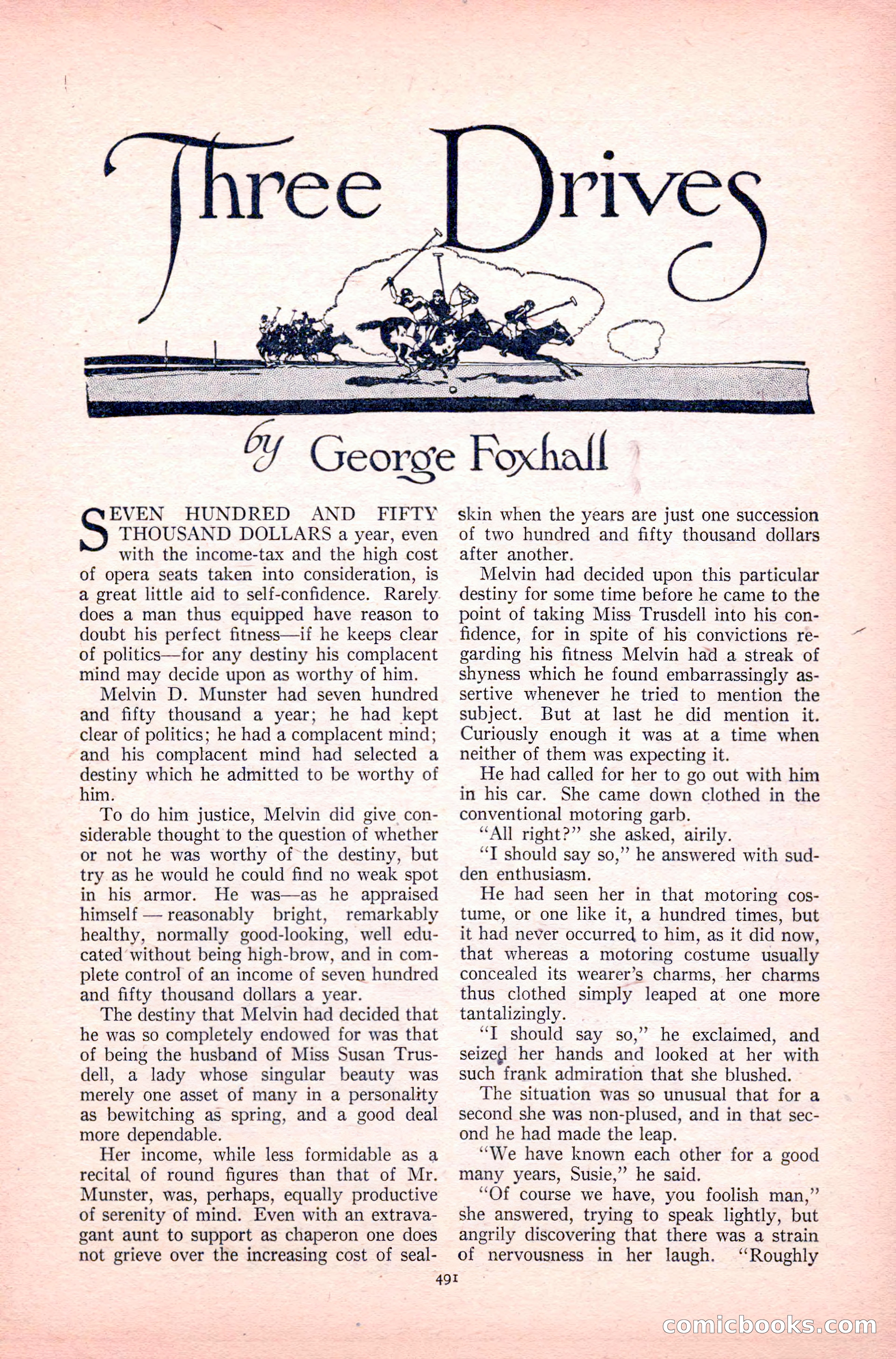
A restored page from Pulp Fiction, 1916. Page through the whole issue in the reader above.
📄 Transcribed text from this page (OCR, searchable)
Machine-transcribed from the original scan — historical spelling and the odd misread are preserved.
Sgt Ze eo eS age ~ ee George Foxhall EVEN HUNDRED AND FIFTY S THOUSAND DOLLARS a year, even with the income-tax and the high cost of opera seats taken into consideration, is a great little aid to self-confidence. Rarely. does a man thus equipped have reason to doubt his perfect fitness—if he keeps clear of politics—for any destiny his complacent mind may decide upon as worthy of him. Melvin D. Munster had seven hundred and fifty thousand a year; he had kept clear of politics; he had a complacent mind; and his complacent mind had selected a destiny which he admitted to be worthy of him. To do him justice, Melvin did give con- siderable thought to the question of whether or not he was worthy of the destiny, but try as he would he could find no weak spot in his armor. He was—as he appraised himself — reasonably bright, remarkably healthy, normally good-looking, well edu- cated without being high-brow, and in com- plete control of an income of seven hundred and fifty thousand dollars a year. The destiny that Melvin had decided that he was so completely endowed for was that of being the husband of Miss Susan Trus- dell, a lady whose singular beauty was merely one asset of many in a personality as bewitching as spring, and a good deal more dependable. Her income, while less formidable as a recital of round figures than that of Mr. Munster, was, perhaps, equally productive of serenity of mind. Even with an extrava- gant aunt to support as chaperon one does not grieve over the increasing cost of seal- skin when the years are just one succession of two hundred and fifty thousand dollars after another. Melvin had decided upon this particular destiny for some time before he came to the point of taking Miss Trusdell into his con- fidence, for in spite of his convictions re- garding his fitness Melvin had a streak of shyness which he found embarrassingly as- sertive whenever he tried to mention the subject. But at last he did mention it. Curiously enough it was at a time when neither of them was expecting it. He had called for her to go out with him in his car. She came down clothed in the conventional motoring garb. ‘All right?” she asked, airily. “T should say so,” he answered with sud- den enthusiasm. He had seen her in that motoring cos- tume, or one like it, a hundred times, but it had never occurred to him, as it did now, that whereas a motoring costume usually concealed its wearer’s charms, her charms thus clothed simply leaped at one more tantalizingly. “IT should say so,’ he exclaimed, and seized her hands and looked at her with such frank admiration that she blushed. The situation was so unusual that for a second she was non-plused, and in that sec- ond he had made the leap. ‘“We have known each other for a good many years, Susie,” he said. “Of course we have, you foolish man,” she answered, trying to speak lightly, but angrily discovering that there was a strain of nervousness in her laugh. “Roughly 491 (EO) _.OOK (C@)