
Pulp Fiction, 1916 · page 116 of 212
The Argosy, Vol. 82, No. 3 — page 116: what you’re looking at
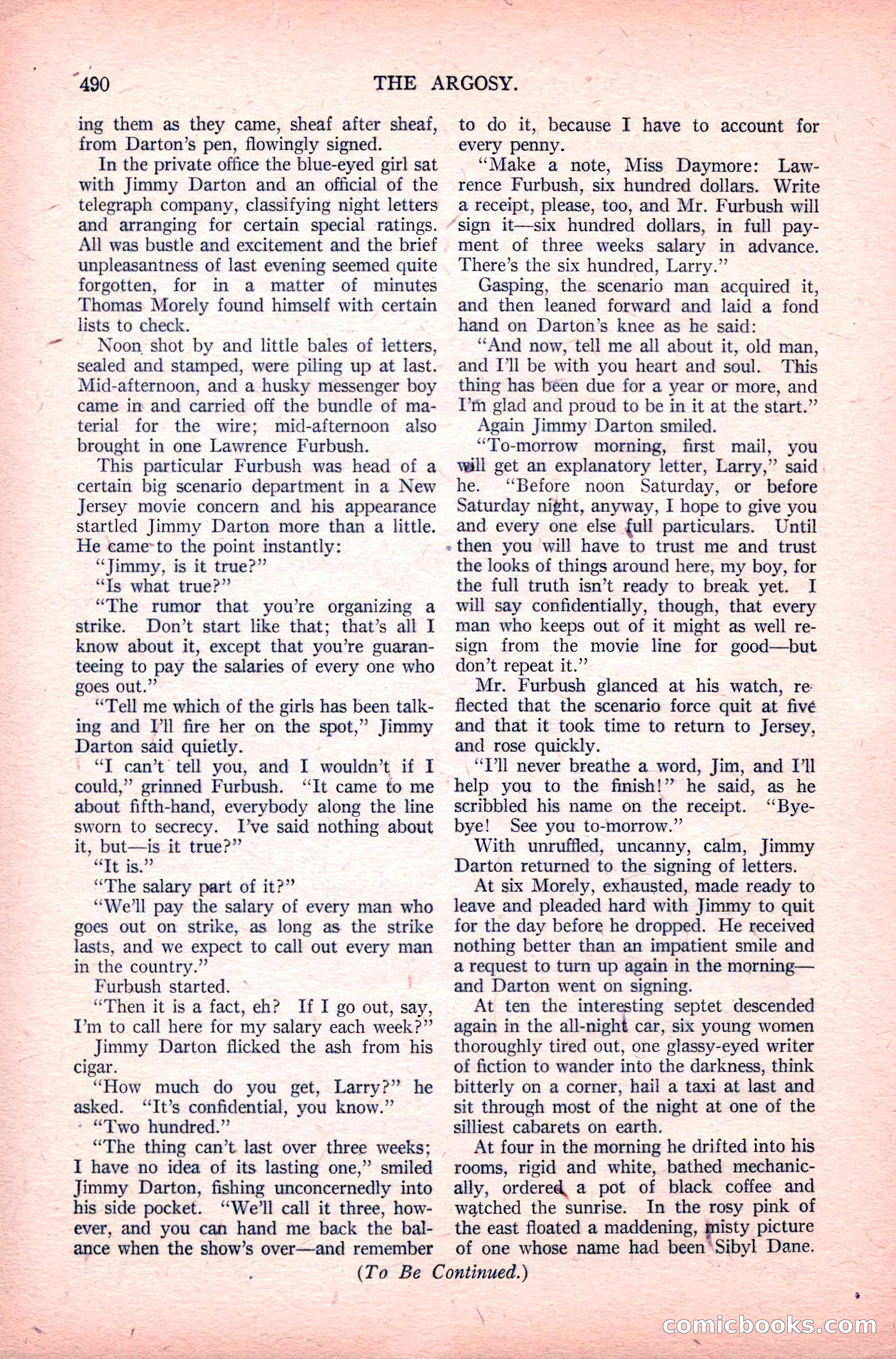
A restored page from Pulp Fiction, 1916. Page through the whole issue in the reader above.
📄 Transcribed text from this page (OCR, searchable)
Machine-transcribed from the original scan — historical spelling and the odd misread are preserved.
“490 THE ARGOSY. ing them as they came, sheaf after sheaf, from Darton’s pen, flowingly signed. In the private office the blue-eyed girl sat with Jimmy Darton and an official of the telegraph company, classifying night letters and arranging for certain special ratings. All was bustle and excitement and the brief unpleasantness of last evening seemed quite forgotten, for in a matter of minutes Thomas Morely found himself with certain lists to check. Noon shot by and little bales of letters, sealed and stamped, were piling up at last. Mid-afternoon, and a husky messenger boy came in and carried off the bundle of ma- terial for the wire; mid-afternoon also brought in one Lawrence Furbush. This particular Furbush was head of a certain big scenario department in a New Jersey movie concern and his appearance startled Jimmy Darton more than a little. He came~to the point instantly: “Jimmy, is it true?” “Ts what true?” “The rumor that you’re organizing a strike. Don’t start like that; that’s all I know about it, except that you’re guaran- teeing to pay the salaries of every one who goes out.” “Tell me which of the girls has been talk- ing and I’ll fire her on the spot,” Jimmy Darton said quietly. “T can’t tell you, and I wouldn’t if I could,” grinned Furbush. ‘It came to me about fifth-hand, everybody along the line sworn to secrecy. I’ve said nothing about it, but—is it true?” “is “The salary part of it?” “We'll pay the salary of every man who goes out on strike, as long as the strike lasts, and we expect to call out every man in the country.” Furbush started. “Then it is a fact, eh? If I go out, say, I’m to call here for my salary each week?” Jimmy Darton flicked the ash from his cigar. “How much do you get, Larry?” he asked. “It’s confidential, you know.” - “Two hundred.” “The thing can’t last over three weeks; I have no idea of its lasting one,” smiled Jimmy Darton, fishing unconcernedly into his side pocket. ‘We'll call it three, how- ever, and you can hand me back the bal- ance when the show’s over—and remember to do it, because I have to account for every penny. ‘Make a note, Miss Daymore: Law- rence Furbush, six hundred dollars. Write a receipt, please, too, and Mr. Furbush will ‘sign it—six hundred dollars, in full pay- ment of three weeks salary in advance. There’s the six hundred, Larry.” Gasping, the scenario man acquired it, and then leaned forward and laid a fond hand on Darton’s knee as he said: “And now, tell me all about it, old man, and I[’ll be with you heart and soul. This thing has been due for a year or more, and I’m glad and proud to be in it at the start.” Again Jimmy Darton smiled. “To-morrow morning, first mail, you will get an explanatory letter, Larry,” said he. “Before noon Saturday, or before Saturday night, anyway, I hope to give you and every one else full particulars. Until »then you will have to trust me and trust the looks of things around here, my boy, for the full truth isn’t ready to break yet. I will say confidentially, though, that every man who keeps out of it might as well re- sign from the movie line for good—but don’t repeat it.” Mr. Furbush glanced at his watch, re flected that the scenario force quit at fivé and that it took time to return to Jersey, and rose quickly. “ll never breathe a word, Jim, and Ill help you to the fmish!” he said, as he scribbled his name on the receipt. ‘Bye- bye! See you to-morrow.” With unruffled, uncanny, calm, Jimmy Darton returned to the signing of letters. At six Morely, exhausted, made ready to leave and pleaded hard with Jimmy to quit for the day before he dropped. He received nothing better than an impatient smile and a request to turn up again in the morning— and Darton went on signing. At ten the interesting septet descended again in the all-night car, six young women thoroughly tired out, one glassy-eyed writer of fiction to wander into the darkness, think bitterly on a corner, hail a taxi at last and sit through most of the night at one of the silliest cabarets on earth. At four in the morning he drifted into his rooms, rigid and white, bathed mechanic- ally, ordered a pot of black coffee and watched the sunrise. In the rosy pink of the east floated a maddening, misty picture of one whose name had been ‘Sibyl Dane. (To Be Continued.) EO LPMIG OOO; KS, (E@)