
Pulp Fiction, 1916 · page 137 of 216
The Argosy, Vol. 82 No. 2 — page 137: what you’re looking at
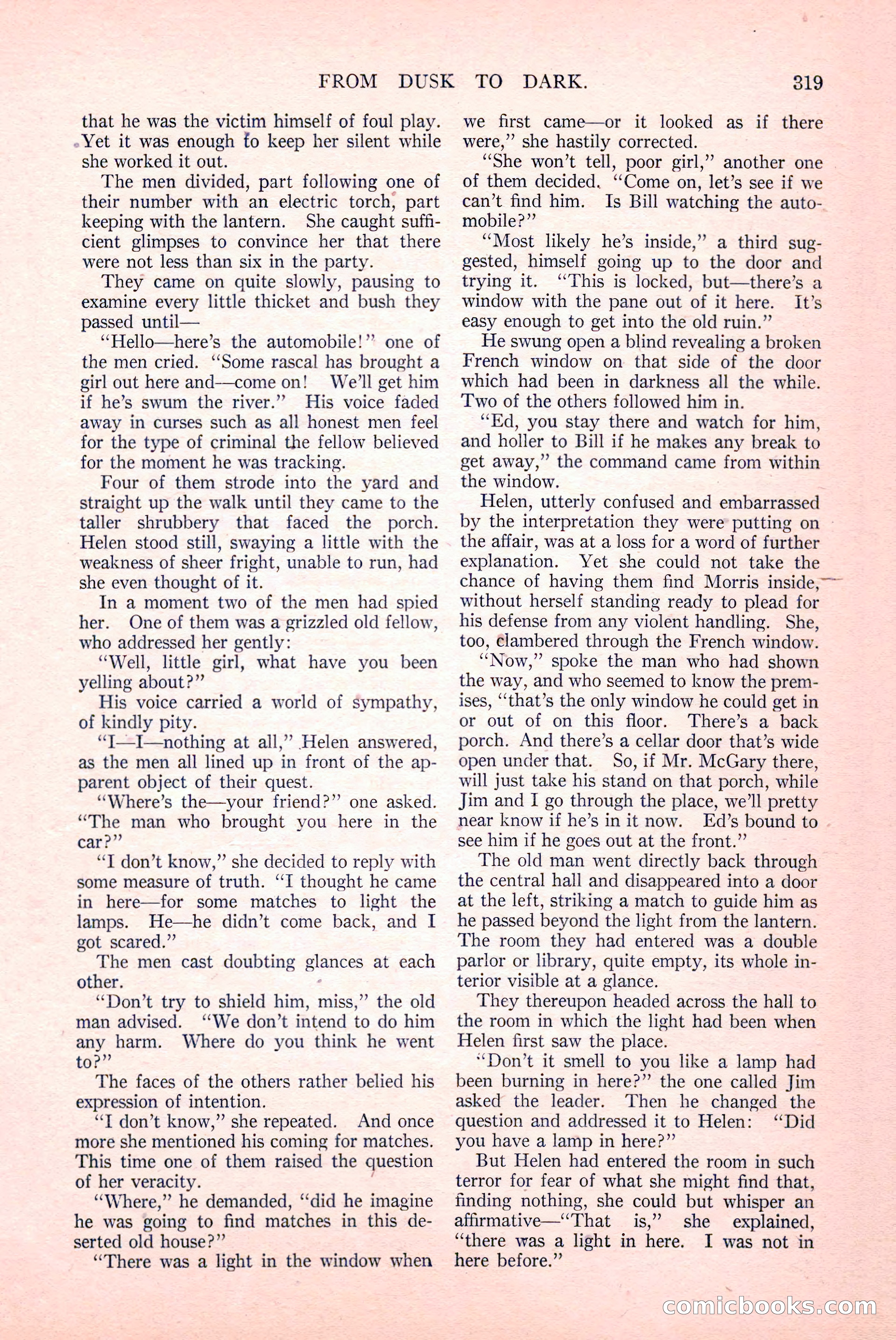
A restored page from Pulp Fiction, 1916. Page through the whole issue in the reader above.
📄 Transcribed text from this page (OCR, searchable)
Machine-transcribed from the original scan — historical spelling and the odd misread are preserved.
FROM that he was the victim himself of foul play. »Yet it was enough fo keep her silent while she worked it out. The men divided, part following one of their number with an electric torch, part keeping with the lantern. She caught suffi- cient glimpses to convince her that there were not less than six in the party. They came on quite slowly, pausing to examine every little thicket and bush they passed until— ‘“Hello—here’s the automobile!” one of the men cried. ‘‘Some rascal has brought a girl out here and—come on! We'll get him if he’s swum the river.”’ His voice faded away in curses such as all honest men feel for the type of criminal the fellow believed for the moment he was tracking. Four of them strode into the yard and straight up the walk until they came to the taller shrubbery that faced the porch. Helen stood still, swaying a little with the weakness of sheer fright, unable to run, had she even thought of it. In a moment two of the men had spied her. One of them was a grizzled old fellow, who addressed her gently: “Well, little girl, what have you been yelling about?” His voice carried a world of sympathy, of kindly pity. ‘“‘T—I—nothing at all,’ Helen answered, as the men all lined up in front of the ap- parent object of their quest. “‘Where’s the—your friend?” one asked. “The man who brought you here in the carr “T don’t know,” she decided to reply with some measure of truth. “I thought he came in here—for some matches to light the lamps. He—he didn’t come back, and I got scared.” The men cast doubting glances at each other. “Don’t try to shield him, miss,” the old man advised. ‘‘We don’t intend to do him any harm. Where do you think he went to?” The faces of the others rather belied his expression of intention. “T don’t know,” she repeated. And once more she mentioned his coming for matches. This time one of them raised the question of her veracity. | “Where,” he demanded, ‘‘did he imagine he was going to find matches in this de- serted old house?”’ “There was a light in the window when DUSK TO DARK. 319 we first came—or it looked as if there were,” she hastily corrected. ‘She won’t tell, poor girl,’ another one of them decided. ‘‘Come on, let’s see if we can’t find him. Is Bill watching the auto- mobile?”’ ‘Most likely he’s inside,” a third sug- gested, himself going up to the door and trying it. “This is locked, but—there’s a window with the pane out of it here. It’s easy enough to get into the old ruin.” He swung open a blind revealing a broken French window on that side of the door which had been in darkness all the while. Two of the others followed him in. ‘Ed, you stay there and watch for him, and holler to Bill if he makes any break to get away,” the command came from within the window. Helen, utterly confused and embarrassed by the interpretation they were putting on | the affair, was at a loss for a word of further explanation. Yet she could not take the chance of having them find Morris inside, without herself standing ready to plead for his defense from any violent handling. She, too, clambered through the French window. “Now,” spoke the man who had shown the way, and who seemed to know the prem- ises, “that’s the only window he could get in or out of on this floor. There’s a back porch. And there’s a cellar door that’s wide open under that. So, if Mr. McGary there, will just take his stand on that porch, while Jim and I go through the place, we’ll pretty near know if he’s init now. Ed’s bound to see him if he goes out at the front.” The old man went directly back through the central hall and disappeared into a door at the left, striking a match to guide him as he passed beyond the light from the lantern. The room they had entered was a double parlor or library, quite empty, its whole in- terior visible at a glance. They thereupon headed across the hall to the room in which the light had been when Helen first saw the place. “Don’t it smell to you like a lamp had been burning in here?” the one called Jim asked the leader. Then he changed the question and addressed it to Helen: ‘Did you have a lamp in here?” But Helen had entered the room in such terror for fear of what she might find that, finding nothing, she could but whisper an affirmative—‘That is,’ she explained, “there was a light in here. I was not in here before.” COMMICLOOKS tae (C@)