
Pulp Fiction, 1916 · page 138 of 216
The Argosy, Vol. 82 No. 2 — page 138: what you’re looking at
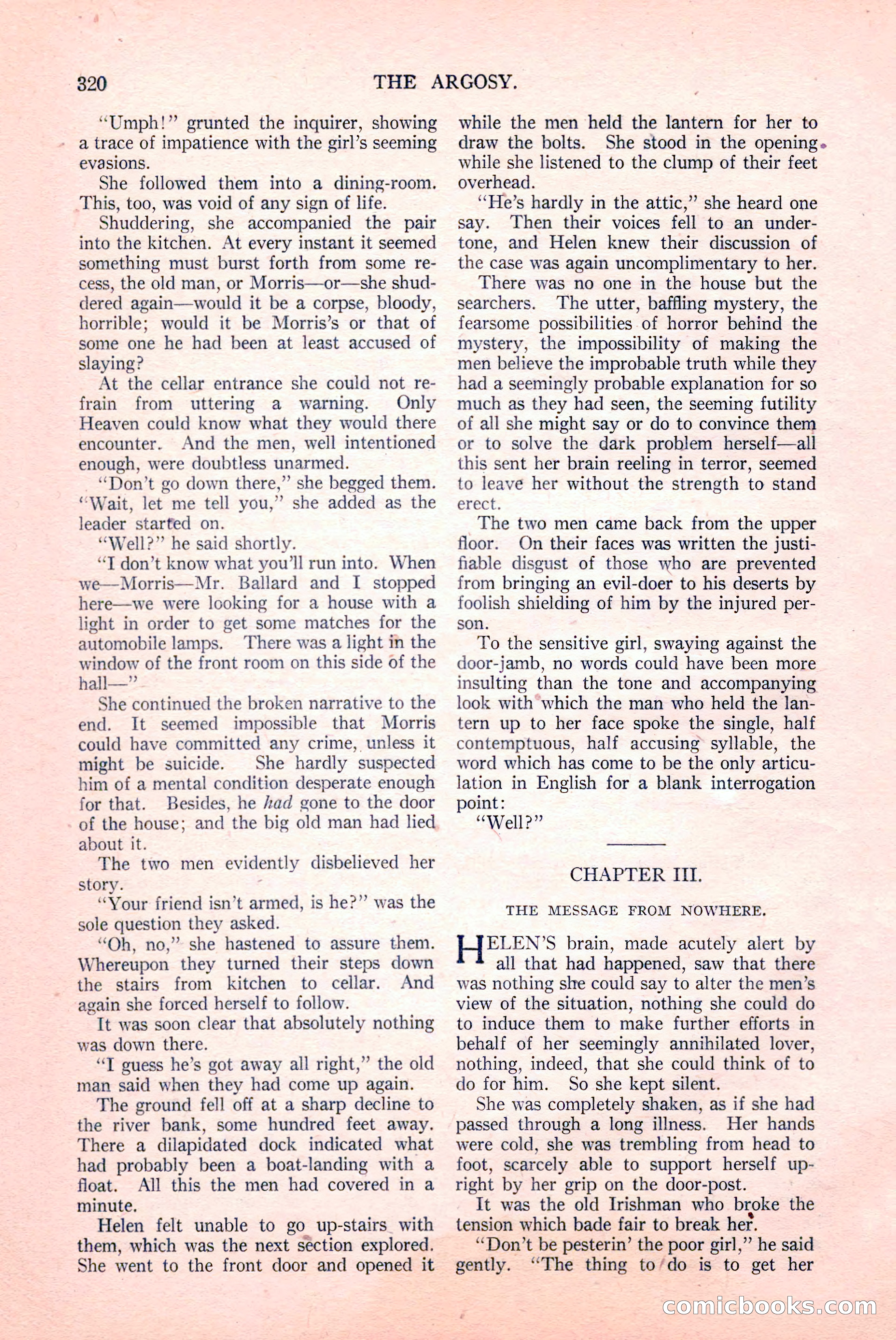
A restored page from Pulp Fiction, 1916. Page through the whole issue in the reader above.
📄 Transcribed text from this page (OCR, searchable)
Machine-transcribed from the original scan — historical spelling and the odd misread are preserved.
320 ‘“Umph!” grunted the inquirer, showing - a trace of impatience with the girl’s seeming evasions. She followed them into a dining-room. This, too, was void of any sign of life. Shuddering, she accompanied the pair into the kitchen. At every instant it seemed something must burst forth from some re- cess, the old man, or Morris—or—she shud- dered again—would it be a corpse, bloody, horrible; would it be Morris’s or that of some one he had been at least accused of slaying? At the cellar entrance she could not re- frain from uttering a warning. Only Heaven could know what they would there encounter. And the men, well intentioned enough, were doubtless unarmed. “Don’t go down there,” she begged them. “Wait, let me tell you,” she added as the leader started on. “Well?” he said shortly. “T don’t know what you'll run into. When we—Morris—Mr. Ballard and I stopped here—we were looking for a house with a light in order to get some matches for the automobile lamps. There was a light in the window of the front room on this side of the hall—” She continued the broken narrative to the end. It seemed impossible that Morris could have committed any crime, unless it might be suicide. She hardly suspected him of a mental condition desperate enough for that. Besides, he “ad gone to the door of the house; and the big old man had lied about it. The two men evidently disbelieved her story. “Vour friend isn’t armed, is he?” was the sole question they asked. “Oh, no,” she hastened to assure them. Whereupon they turned their steps down the stairs from kitchen to cellar. And again she forced herself to follow. It was soon clear that absolutely nothing was down there. “T guess he’s got away all right,” the old man said when they had come up again. The ground fell off at a sharp decline to the river bank, some hundred feet away. There a dilapidated dock indicated what had probably been a boat-landing with a float. All this the men had covered in a minute. Helen felt unable to go up-stairs with them, which was the next section explored. She went to the front door and opened it THE ARGOSY. while the men held the lantern for her to draw the bolts. while she listened to the clump of their feet overhead. ‘““He’s hardly in the attic,’”’ she heard one say. Then their voices fell to an under- tone, and Helen knew their discussion of the case was again uncomplimentary to her. There was no one in the house but the searchers. The utter, baffling mystery, the fearsome possibilities of horror behind the mystery, the impossibility of making the men believe the improbable truth while they had a seemingly probable explanation for so much as they had seen, the seeming futility of all she might say or do to convince them or to solve the dark problem herself—all this sent her brain reeling in terror, seemed to leave her without the strength to stand erect. The two men came back from the upper floor. On their faces was written the justi- fiable disgust of those who are prevented from bringing an evil-doer to his deserts by foolish shielding of him by the injured per- son. To the sensitive girl, swaying against the door-jamb, no words could have been more insulting than the tone and accompanying look with which the man who held the lan- tern up to her face spoke the single, half contemptuous, half accusing syllable, the word which has come to be the only articu- lation in English for a blank interrogation point: CHAPTER III. THE MESSAGE FROM NOWHERE. HELEN'S brain, made acutely alert by all that had happened, saw that there was nothing she could say to alter the men’s view of the situation, nothing she could do to induce them to make further efforts in behalf of her seemingly annihilated lover, nothing, indeed, that she could think of to do for him. So she kept silent. She was completely shaken, as if she had passed through a long illness. Her hands were cold, she was trembling from head to foot, scarcely able to support herself up- right by her grip on the door-post. It was the old Irishman who broke the tension which bade fair to break her. “Don’t be pesterin’ the poor girl,” he said gently. ‘The thing to/do is to get her COPNICLOOKS She stood in the opening - (C@