
Pulp Fiction, 1916 · page 136 of 216
The Argosy, Vol. 82 No. 2 — page 136: what you’re looking at
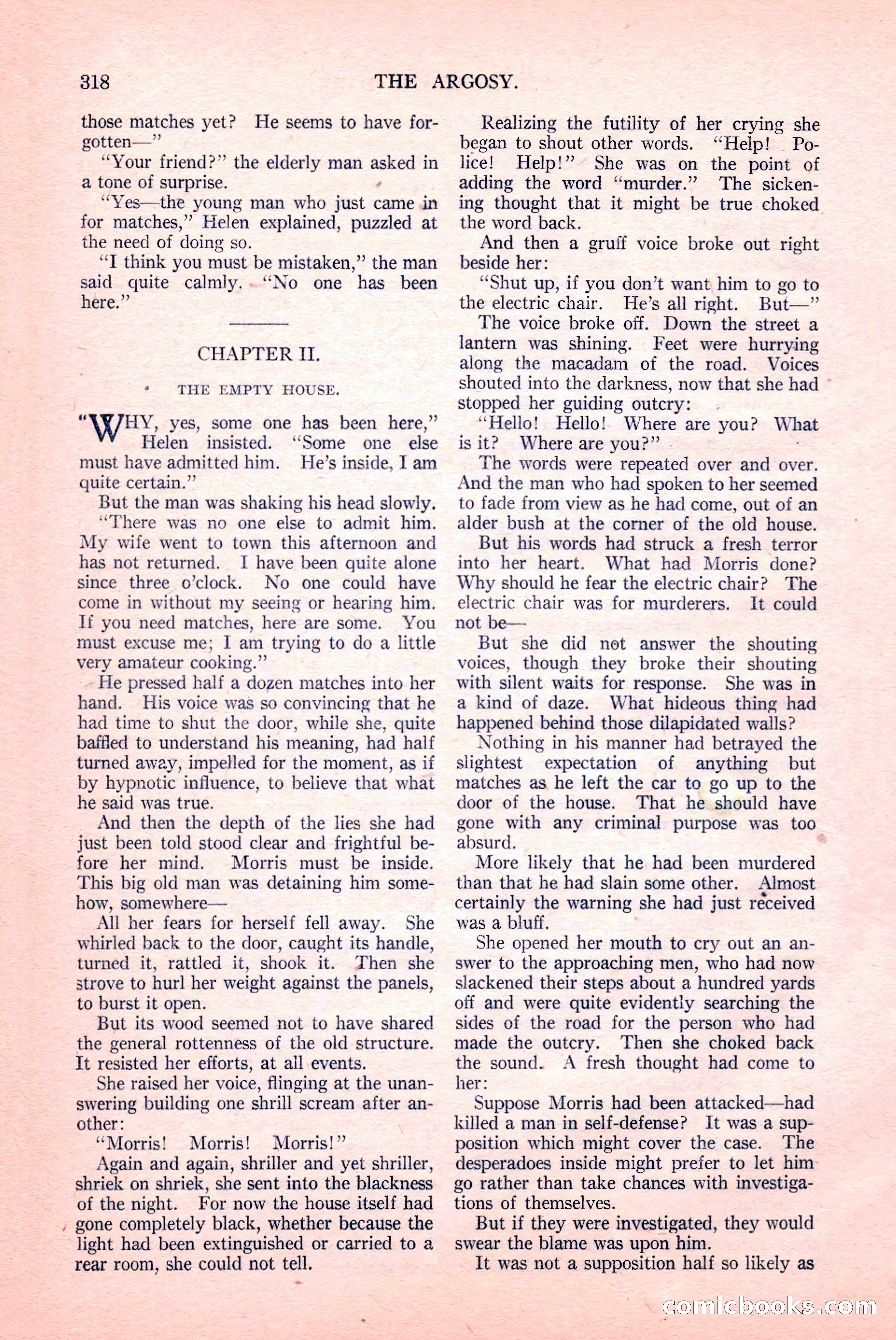
A restored page from Pulp Fiction, 1916. Page through the whole issue in the reader above.
📄 Transcribed text from this page (OCR, searchable)
Machine-transcribed from the original scan — historical spelling and the odd misread are preserved.
~ 318 those matches yet? He seems to have for- gotten— “Your friend?” the elderly man ake in a tone of surprise. “Yes—the young man who just came in for matches,” Helen explained, puzzled at the need of doing so. ‘“T think you must be mistaken,” the man said quite calmly..‘‘No one has been here.” CHAPTER II, THE EMPTY HOUSE. “WEY, yes, some one has been here,” Helen insisted. “Some one _ else must have admitted him. He’s inside, I am quite certain.” But the man was shaking his head slowly. ‘There was no one else to admit him. My wife went to town this afternoon and has not returned. I have been quite alone since three o’clock. No one could have come in without my seeing or hearing him. If you need matches, here are some. You must excuse me; I am trying to do a little very amateur cooking.” He pressed half a dozen matches into her hand. His voice was so convincing that he had time to shut the door, while she, quite baffled to understand his meaning, had half turned away, impelled for the moment, as if by hypnotic influence, to believe that what he said was true. And then the depth of the lies she had just been told stood clear and frightful be- fore her mind. Morris must be inside. This big old man was detaining him some- how, somewhere— All her fears for herself fell away. She whirled back to the door, caught its handle, turned it, rattled it, shook it. Then she strove to hurl her weight against the panels, to burst it open. But its wood seemed not to have shared the general rottenness of the old structure. It resisted her efforts, at ail events. She raised her voice, flinging at the unan- swering building one shrill scream after an- other: “Morris! Morris! Morris!” Again and again, shriller and yet shriller, shriek on shriek, she sent into the blackness of the night. For now the house itself had gone completely black, whether because the light had been extinguished or carried to a rear room, she could not tell. > THE ARGOSY. Realizing the futility of her crying she began to shout other words. ‘Help! — Po- lice! Help!” She was on the point of adding the word “murder.” The sicken- ing thought that it might be true choked the word back. And then a gruff voice broke out right beside her: “Shut up, if you don’t want him to go to the electric chair. He’s all right. But—” The voice broke off. Down the street a lantern was shining. Feet were hurrying along the macadam of the road. Voices shouted into the darkness, now that she had ~ stopped her guiding outcry: ‘‘Hello! Hello! Where are you? What is it? Where are you?” The words were repeated over and over. And the man who had spoken to her seemed to fade from view as he had come, out of an alder bush at the corner of the old house. But his words had struck a fresh terror into her heart. What had Morris done? Why should he fear the electric chair? The electric chair was for murderers. It could not be— But she did not answer the shouting voices, though they broke their shouting with silent waits for response. She was in a kind of daze. What hideous thing had happened behind those dilapidated walls? Nothing in his manner had betrayed the slightest expectation of anything but matches as he left the car to go up to the door of the house. That he should have gone with any criminal purpose was too absurd. More likely that he had been murdered than that he had slain some other. Almost certainly the warning she had just received was a bluff. She opened her mouth to cry out an an- swer to the approaching men, who had now slackened their steps about a hundred yards off and were quite evidently searching the sides of the road for the person who had made the outcry. Then she choked back the sound. A fresh thought had come to her: Suppose Morris had been attacked—had killed a man in self-defense? It was a sup- position which might cover the case. The desperadoes inside might prefer to let him go rather than take chances with investiga- tions of themselves. But if they were investigated, they would swear the blame was upon him. It was not a supposition half so likely as COMNlEOOKS (C@)