
Pulp Fiction, 1916 · page 135 of 216
The Argosy, Vol. 82 No. 2 — page 135: what you’re looking at
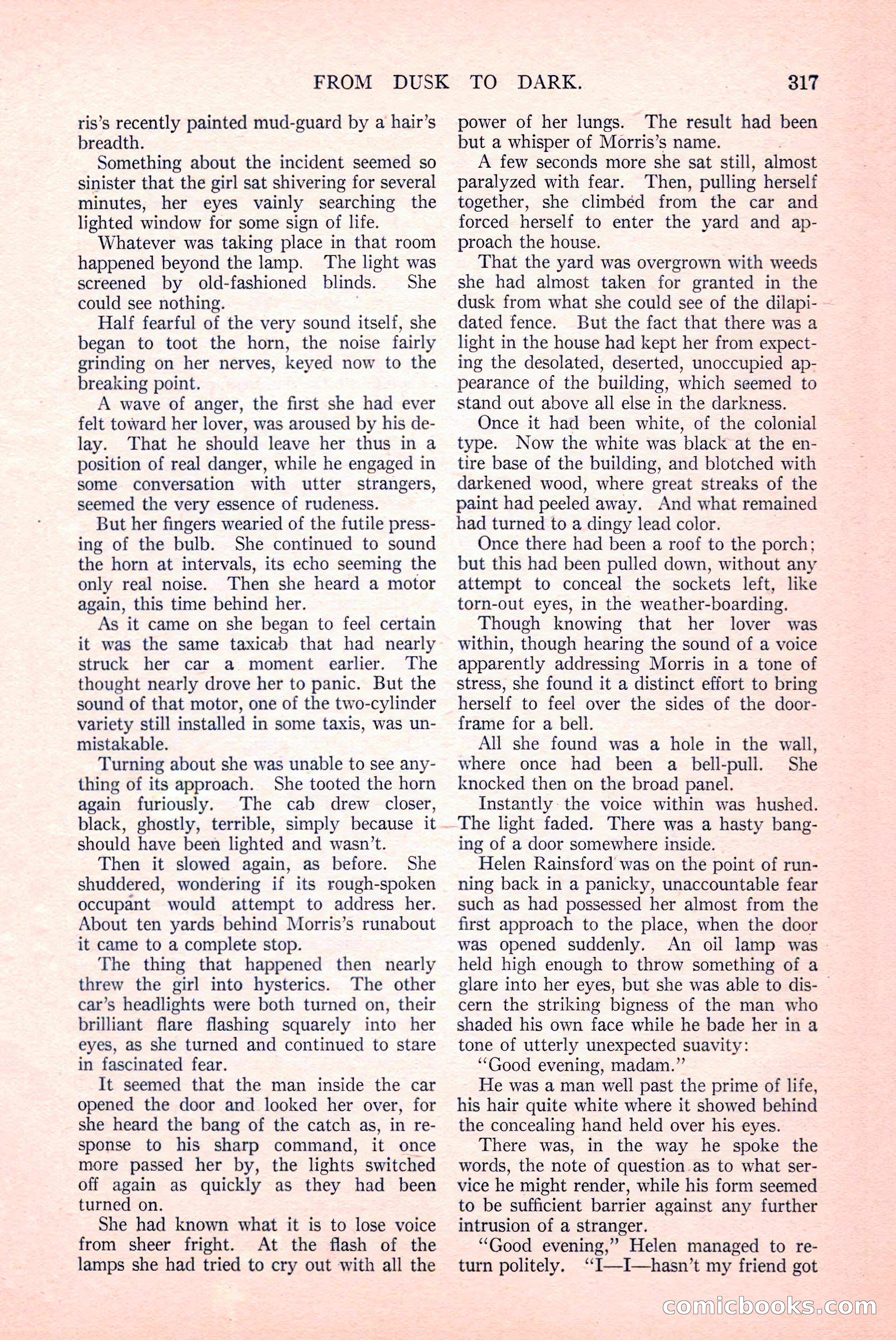
A restored page from Pulp Fiction, 1916. Page through the whole issue in the reader above.
📄 Transcribed text from this page (OCR, searchable)
Machine-transcribed from the original scan — historical spelling and the odd misread are preserved.
FROM ris’s recently painted mud-guard by a hair’s breadth. Something about the incident seemed so sinister that the girl sat shivering for several minutes, her eyes vainly searching the lighted window for some sign of life. Whatever was taking place in that room happened beyond the lamp. The light was screened by old-fashioned blinds. She could see nothing. Half fearful of the very sound itself, she began to toot the horn, the noise fairly grinding on her nerves, keyed now to the breaking point. A wave of anger, the first she had ever felt toward her lover, was aroused by his de- lay. That he should leave her thus in a position of real danger, while he engaged in some conversation with utter strangers, seemed the very essence of rudeness. But her fingers wearied of the futile press- ing of the bulb. She continued to sound the horn at intervals, its echo seeming the only real noise. ‘Then she heard a motor again, this time behind her. As it came on she began to feel certain it was the same taxicab that had nearly struck her car a moment earlier. The thought nearly drove her to panic. But the sound of that motor, one of the two-cylinder variety still installed in some taxis, was un- mistakable. Turning about she was unable to see any- thing of its approach. She tooted the horn again furiously. The cab drew closer, black, ghostly, terrible, simply because it should have been lighted and wasn’t. Then it slowed again, as before. She shuddered, wondering if its rough-spoken occupant would attempt to address her. About ten yards behind Morris’s runabout it came to a complete stop. The thing that happened then nearly threw the girl into hysterics. The other car’s headlights were both turned on, their brilliant flare flashing squarely into her eyes, as she turned and continued to stare in fascinated fear. It seemed that the man inside the car opened the door and looked her over, for she heard the bang of the catch as, in re- sponse to his sharp command, it once more passed her by, the lights switched off again as quickly as they had been turned on. She had known what it is to lose voice from sheer fright. At the flash of the lamps she had tried to cry out with all the DUSK TO DARK. 317 power of her lungs. The result had been but a whisper of Morris’s name. A few seconds more she sat still, almost paralyzed with fear. Then, pulling herself together, she climbéd from the car and forced herself to enter the yard and ap- proach the house. That the yard was overgrown with weeds she had almost taken for granted in the dusk from what she could see of the dilapi- dated fence. But the fact that there was a light in the house had kept her from expect- ing the desolated, deserted, unoccupied ap- pearance of the building, which seemed to stand out above all else in the darkness. Once it had been white, of the colonial type. Now the white was black at the en- tire base of the building, and blotched with darkened wood, where great streaks of the paint had peeled away. And what remained had turned to a dingy lead color. Once there had been a roof to the porch; but this had been pulled down, without any attempt to conceal the sockets left, like torn-out eyes, in the weather-boarding. Though knowing that her lover was within, though hearing the sound of a voice apparently addressing Morris in a tone of stress, she found it a distinct effort to bring herself to feel over the sides of the door- frame for a bell. All she found was a hole in the wall, where once had been a bell-pull. She knocked then on the broad panel. Instantly the voice within was hushed. The light faded. There was a hasty bang- ing of a door somewhere inside. Helen Rainsford was on the point of run- ning back in a panicky, unaccountable fear such as had possessed her almost from the first approach to the place, when the door was opened suddenly. An oil lamp was held high enough to throw something of a glare into her eyes, but she was able to dis- | cern the striking bigness of the man who shaded his own face while he bade her in a tone of utterly unexpected suavity: ‘““Good evening, madam.” He was a man well past the prime of life, his hair quite white where it showed behind the concealing hand held over his eyes. There was, in the way he spoke the words, the note of question as to what ser- vice he might render, while his form seemed to be sufficient barrier against any further intrusion of a stranger. “Good evening,” Helen managed to re- turn politely. ‘“I—I—hasn’t my friend got Go VOOLKS AMUNG (C@)