
Pulp Fiction, 1916 · page 134 of 216
The Argosy, Vol. 82 No. 2 — page 134: what you’re looking at
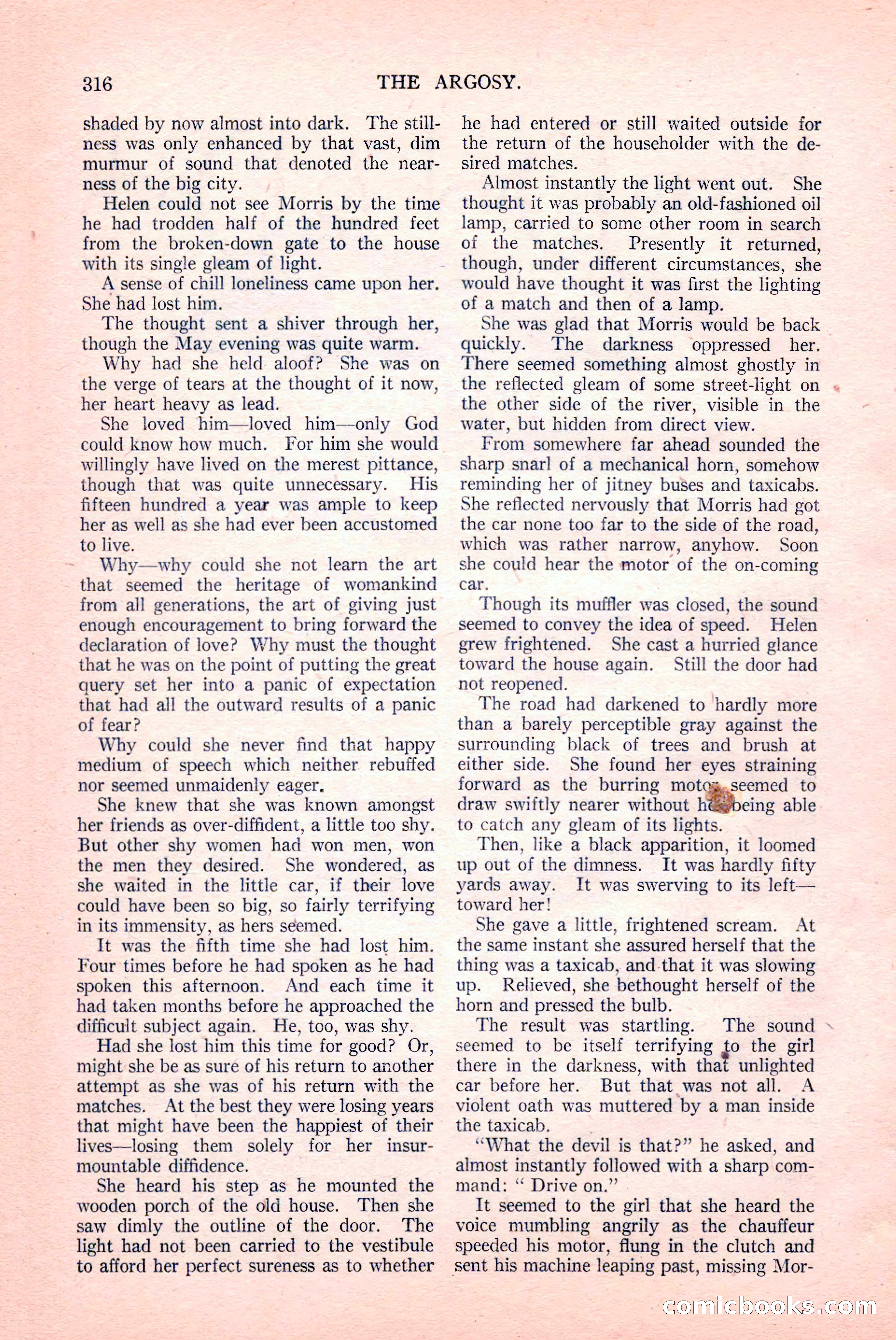
A restored page from Pulp Fiction, 1916. Page through the whole issue in the reader above.
📄 Transcribed text from this page (OCR, searchable)
Machine-transcribed from the original scan — historical spelling and the odd misread are preserved.
316 shaded by now almost into dark. The still- ness was only enhanced by that vast, dim murmur of sound that denoted the near- ness of the big city. Helen could not see Morris by the time he had trodden half of the hundred feet from the broken-down gate to the house with its single gleam of light. A sense of chill loneliness came upon her. She had lost him. The thought sent a shiver through her, though the May evening was quite warm. Why had she held aloof? She was on the verge of tears at the thought of it now, her heart heavy as lead. She loved him—loved him—only God could know how much. For him she would willingly have lived on the merest pittance, though that was quite unnecessary. His fifteen hundred a year was ample to keep her as well as she had ever been accustomed to live. Why—why could she not learn the art that seemed the heritage of womankind from all generations, the art of giving just enough encouragement to bring forward the declaration of love? Why must the thought that he was on the point of putting the great query set her into a panic of expectation that had all the outward results of a panic of fear? Why could she never find that happy medium of speech which neither rebuffed nor seemed unmaidenly eager. She knew that she was known amongst her friends as over-diffident, a little too shy. But other shy women had won men, won the men they desired. She wondered, as she waited in the little car, if their love could have been so big, so fairly terrifying in its immensity, as hers seemed. It was the fifth time she had lost him. Four times before he had spoken as he had spoken this afternoon. And each time it had taken months before he approached the difficult subject again. He, too, was shy. Had she lost him this time for good? Or, might she be as sure of his return to another attempt as she was of his return with the matches. At the best they were losing years that might have been the happiest of their lives—losing them solely for her insur- mountable diffidence. She heard his step as he mounted the wooden porch of the old house. Then she saw dimly the outline of the door. The light had not been carried to the vestibule to afford her perfect sureness as to whether THE ARGOSY. he had entered or still waited outside for the return of the householder with the de- sired matches. Almost instantly the light went out. She thought it was probably an old-fashioned oil lamp, carried to some other room in search oi the matches. Presently it returned, though, under different circumstances, she would have thought it was first the lighting of a match and then of a lamp. She was glad that Morris would be back quickly. The darkness oppressed her. There seemed something almost ghostly in the reflected gleam of some street-light on the other side of the river, visible in the water, but hidden from direct view. From somewhere far ahead sounded the sharp snarl of a mechanical horn, somehow reminding her of jitney buses and taxicabs. She reflected nervously that Morris had got the car none too far to the side of the road, which was rather narrow, anyhow. Soon she could hear the motor of the on-coming car. Though its muffler was closed, the sound seemed to convey the idea of speed. Helen grew frightened. She cast a hurried glance toward the house again. Still the door had not reopened. The road had darkened to hardly more than a barely perceptible gray against the surrounding black of trees and brush at either side. She found her eyes straining forward as the burring motam seemed to draw swiftly nearer without hégbeing able to catch any gleam of its lights. Then, like a black apparition, it loomed up out of the dimness. It was hardly fifty yards away. It was swerving to its left— toward her! She gave a little, frightened scream. At the same instant she assured herself that the thing was a taxicab, and that it was slowing up. Relieved, she bethought herself of the horn and pressed the bulb. The result was startling. seemed to be itself terrifying f° the girl there in the darkness, with that unlighted car before her. But that was not all. A violent oath was muttered by a man inside the taxicab. | “What the devil is that?” he asked, and almost instantly followed with a sharp com- mand: “ Drive on.” It seemed to the girl that she heard the voice mumbling angrily as the chauffeur speeded his motor, flung in the clutch and sent his machine leaping past, missing Mor- -COMMICOO® S The sound » (C@