
Pulp Fiction, 1916 · page 133 of 216
The Argosy, Vol. 82 No. 2 — page 133: what you’re looking at
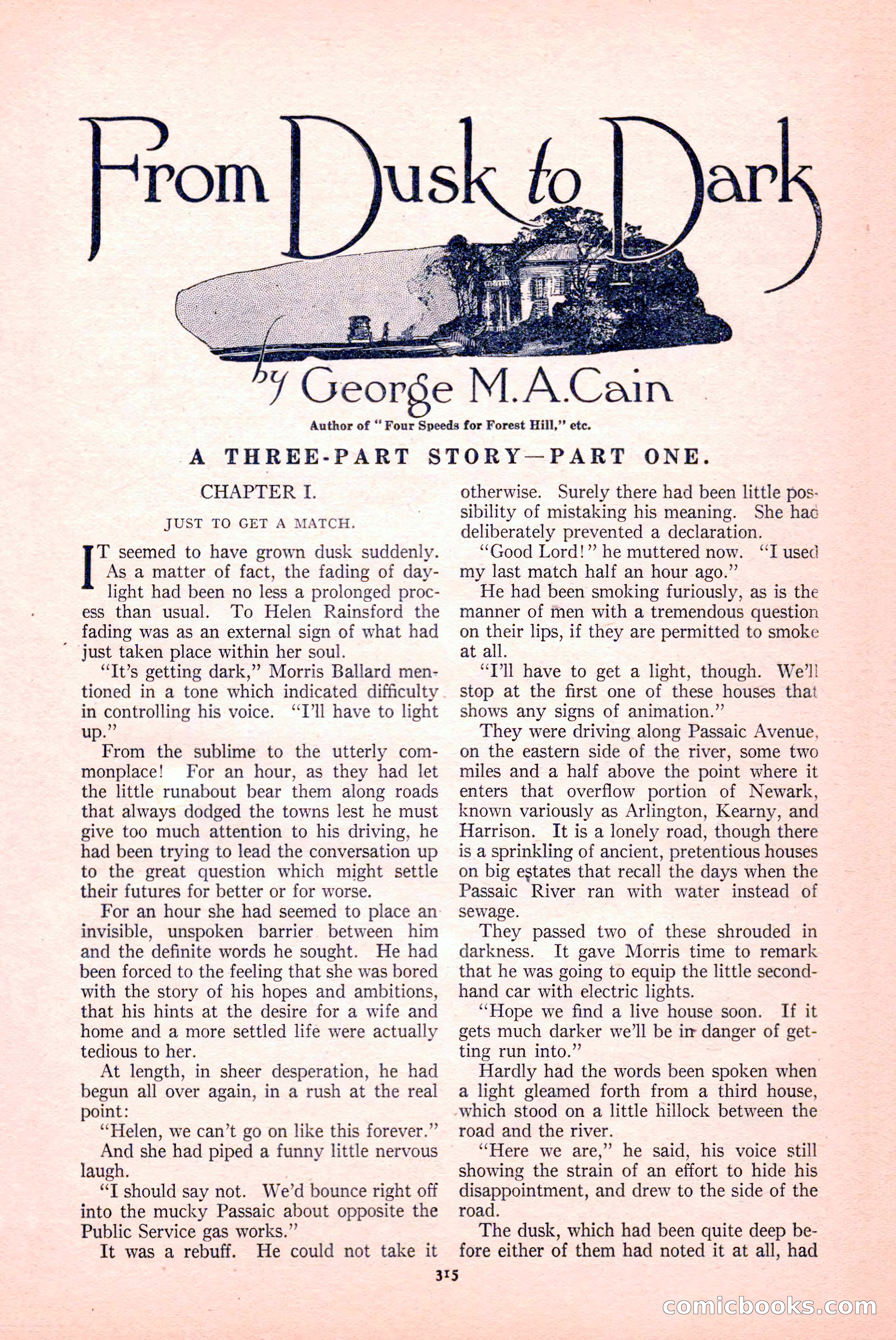
A restored page from Pulp Fiction, 1916. Page through the whole issue in the reader above.
📄 Transcribed text from this page (OCR, searchable)
Machine-transcribed from the original scan — historical spelling and the odd misread are preserved.
Author of “ Four Speeds for Forest Hill,” etc. A THREE-PART STORY—PART ONE. CHAPTER I. JUST TO GET A MATCH. T seemed to have grown dusk suddenly. As a matter of fact, the fading of day- light had been no less a prolonged proc- ess than usual. To Helen Rainsford the fading was as an external sign of what had ' just taken place within her soul. “It’s getting dark,” Morris Ballard men- tioned in a tone which indicated difficulty in controlling his voice. “I'll have to light up.” From the sublime to the utterly com- monplace! For an hour, as they had let the little runabout bear them along roads that always dodged the towns lest he must give too much attention to his driving, he had been trying to lead the conversation up to the great question which might settle their futures for better or for worse. For an hour she had seemed to place an invisible, unspoken barrier between him and the definite words he sought. He had been forced to the feeling that she was bored with the story of his hopes and ambitions, that his hints at the desire for a wife and home and a more settled life were actually tedious to her. At length, in sheer desperation, he had begun all over again, in a rush at the real point: “Helen, we can’t go on like this forever.” And she had piped a funny little nervous laugh. “T should say not. We’d bounce right off into the mucky Passaic about opposite the Public Service gas works.” It was a rebuff. He could not take it otherwise. Surely there had been little pos- sibility of mistaking his meaning. She hac deliberately prevented a declaration. ‘“Good Lord!” he muttered now. “I used my last match half an hour ago.” He had been smoking furiously, as is the manner of men with a tremendous question on their lips, if they are permitted to smoke at all. “Tl have to get a light, though. We’l! Stop at the first one of these houses that shows any signs of animation.” They were driving along Passaic Avenue, on the eastern side of the river, some two miles and a half above the point where it enters that overflow portion of Newark, known variously as Arlington, Kearny, and Harrison. It is a lonely road, though there is a sprinkling of ancient, pretentious houses on big estates that recall the days when the Passaic River ran with water instead of sewage. They passed two of these shrouded in darkness. It gave Morris time to remark that he was going to equip the little second- hand car with electric lights. ‘“‘Hope we find a live house soon. [If it gets much darker we’ll be im danger of get- ting run into.” Hardly had the words been spoken when a light gleamed forth from a third house, which stood on a little hillock between the road and the river. “Here we are,” he said, his voice still showing the strain of an effort to hide his disappointment, and drew to the side of the road. The dusk, which had been quite deep be- fore either of them had noted it at all, had 315 CORMICLOOOKS (C@)