
Pulp Fiction, 1916 · page 110 of 216
The Argosy, Vol. 82 No. 2 — page 110: what you’re looking at
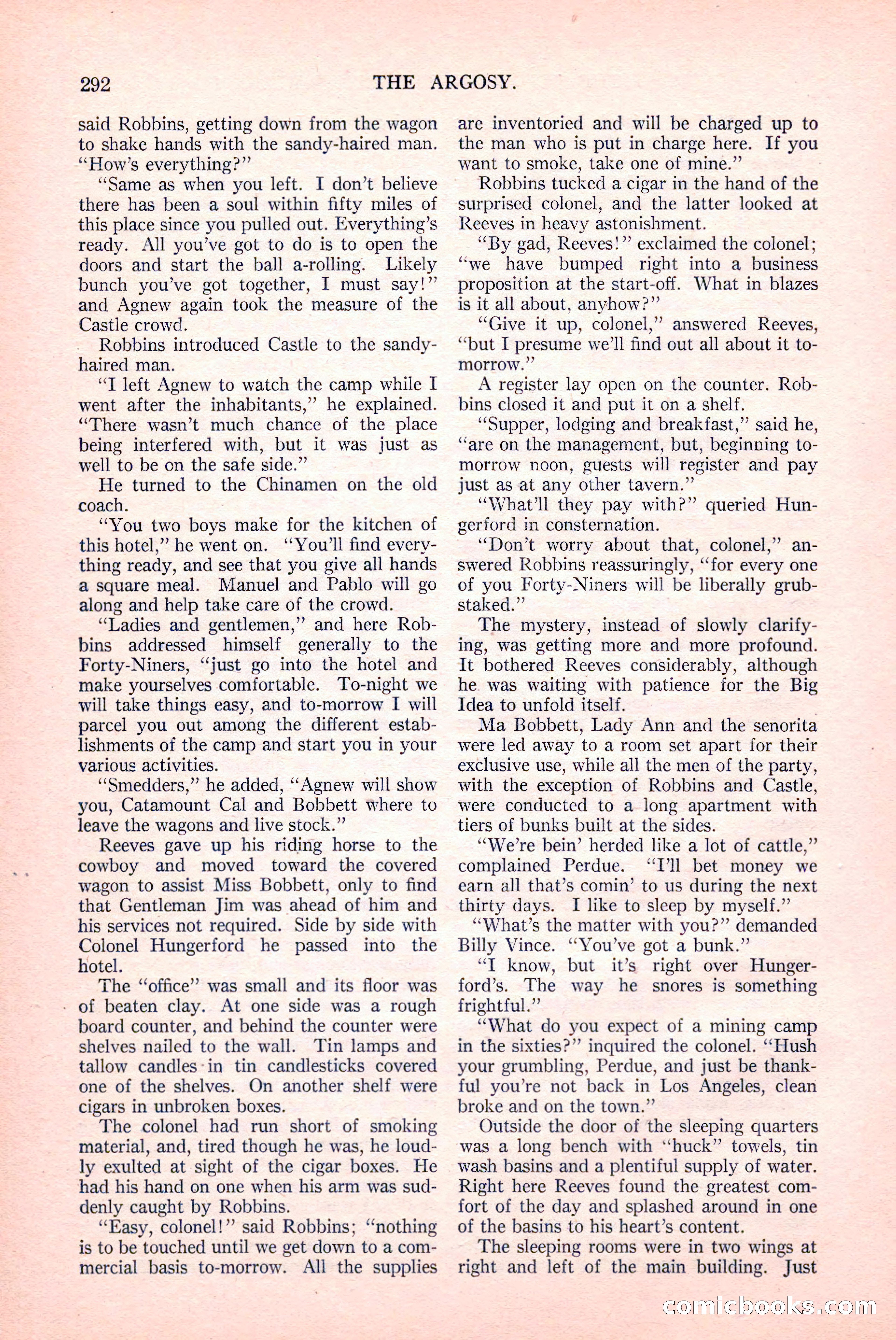
A restored page from Pulp Fiction, 1916. Page through the whole issue in the reader above.
📄 Transcribed text from this page (OCR, searchable)
Machine-transcribed from the original scan — historical spelling and the odd misread are preserved.
292 said Robbins, getting down from the wagon to shake hands with the sandy-haired man. “How’s everything?”’ “Same as when you left. I don’t believe there has been a soul within fifty miles of this place since you pulled out. Everything’s ready. All you’ve got to do is to open the doors and start the ball a-rolling. Likely bunch you’ve got together, I must say!” and Agnew again took the measure of the Castle crowd. Robbins introduced Castle to the sandy- haired man. “T left Agnew to watch the camp while I went after the inhabitants,” he explained. “There wasn’t much chance of the place being interfered with, but it was just as well to be on the safe side.” He turned to the Chinamen on the old coach. “You two boys make for the kitchen of this hotel,” he went on. ‘Youll find every- thing ready, and see that you give all hands a square meal. Manuel and Pablo will go along and help take care of the crowd. “Ladies and gentlemen,” and here Rob- bins addressed himself generally to the Forty-Niners, “just go into the hotel and make yourselves comfortable. To-night we will take things easy, and to-morrow I will parcel you out among the different estab- lishments of the camp and start you in your various activities. ““Smedders,” he added, ‘‘Agnew will show you, Catamount Cal and Bobbett where to leave the wagons and live stock.” Reeves gave up his riding horse to the cowboy and moved toward the covered wagon to assist Miss Bobbett, only to find that Gentleman Jim was ahead of him and his services not required. Side by side with Colonel Hungerford he passed into the hotel. The “office” was small and its floor was - of beaten clay. At one side was a rough board counter, and behind the counter were shelves nailed to the wall. Tin lamps and tallow candles-in tin candlesticks covered one of the shelves. On another shelf were cigars in unbroken boxes. The colonel had run short of smoking material, and, tired though he was, he loud- ly exulted at sight of the cigar boxes. He had his hand on one when his arm was sud- denly caught by Robbins. ‘Easy, colonel!” said Robbins; “nothing is to be touched until we get down to a com- mercial basis to-morrow. All the supplies THE ARGOSY. are inventoried and will be charged up to the man who is put in charge here. If you want to smoke, take one of mine.” Robbins tucked a cigar in the hand of the surprised colonel, and the latter looked at Reeves in heavy astonishment. “By gad, Reeves!” exclaimed the colonel; “we have bumped right into a business proposition at the start-off. What in blazes is it all about, anyhow?” “Give it up, colonel,’ answered Reeves, “but I presume we’ll find out all about it to- morrow.” A register lay open on the counter. Rob- bins closed it and put it on a shelf. “Supper, lodging and breakfast,” said he, “are on the management, but, beginning to- morrow noon, guests will register and pay just as at any other tavern.” ‘“What’ll they pay with?” queried Hun- gerford in consternation. ‘Don’t worry about that, colonel,’ an- swered Robbins reassuringly, “for every one of you Forty-Niners will be liberally grub- staked.” The mystery, instead of slowly clarify- ing, was getting more and more profound. It bothered Reeves considerably, although he was waiting with patience for the Big Idea to unfold itself. | Ma Bobbett, Lady Ann and the senorita were led away to a room set apart for their exclusive use, while all the men of the party, with the exception of Robbins and Castle, were conducted to a long apartment with tiers of bunks built at the sides. “We're bein’ herded like a lot of cattle,” complained Perdue. ‘I'll bet money we earn all that’s comin’ to us during the next thirty days. I like to sleep by myself.” ‘““What’s the matter with you?” demanded Billy Vince. “‘You’ve got a bunk.” “T know, but it’s right over Hunger- ford’s. The way he snores is something frightful.” “What do you expect of a mining camp in the sixties?”’ inquired the colonel. ““Hush your grumbling, Perdue, and just be thank- ful you’re not back in Los Angeles, clean broke and on the town.”’ Outside the door of the sleeping quarters was a long bench with ‘“‘huck” towels, tin wash basins and a plentiful supply of water. Right here Reeves found the greatest com- fort of the day and splashed around in one of the basins to his heart’s content. The sleeping rooms were in two wings at right and left of the main building. Just (EO) 0)(0\) AMUG S (C@)