
Pulp Fiction, 1916 · page 109 of 216
The Argosy, Vol. 82 No. 2 — page 109: what you’re looking at
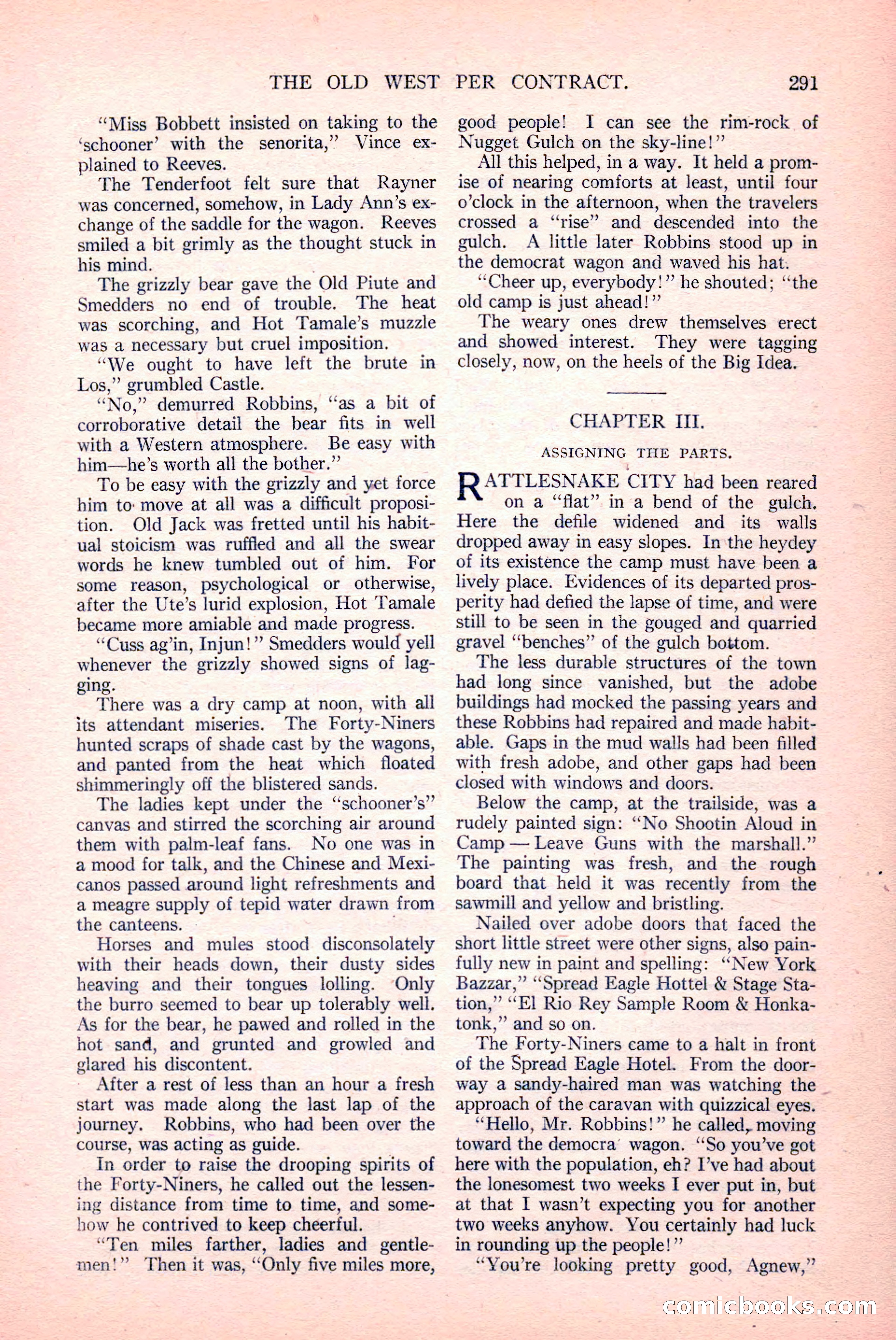
A restored page from Pulp Fiction, 1916. Page through the whole issue in the reader above.
📄 Transcribed text from this page (OCR, searchable)
Machine-transcribed from the original scan — historical spelling and the odd misread are preserved.
THE OLD WEST “Miss Bobbett insisted on taking to the ‘schooner’ with the senorita,” Vince ex- plained to Reeves. The Tenderfoot felt sure that Rayner was concerned, somehow, in Lady Ann’s ex- change of the saddle for the wagon. Reeves smiled a bit grimly as the thought stuck in his mind. . The grizzly bear gave the Old Piute and Smedders no end of trouble. The heat was scorching, and Hot Tamale’s muzzle was a necessary but cruel imposition. “We ought to have left the brute in Los,” grumbled Castle. “No,” demurred Robbins, “as a bit of corroborative detail the bear fits in well with a Western atmosphere. Be easy with him—he’s worth all the bother.” To be easy with the grizzly and yet force him to: move at all was a difficult proposi- tion. Old Jack was fretted until his habit- ual stoicism was ruffled and all the swear words he knew tumbled out of him. for some reason, psychological or otherwise, after the Ute’s lurid explosion, Hot Tamale became more amiable and made progress. “Cuss ag’in, Injun!”’ Smedders would yell whenever the grizzly showed signs of lag- ing. : There was a dry camp at noon, with all its attendant miseries. The Forty-Niners hunted scraps of shade cast by the wagons, and panted from the heat which floated shimmeringly off the blistered sands. The ladies kept under the ‘“schooner’s” canvas and stirred the scorching air around them with palm-leaf fans. No one was in a mood for talk, and the Chinese and Mexi- canos passed around light refreshments and a meagre supply of tepid water drawn from the canteens. - Horses and mules stood disconsolately with their heads down, their dusty sides heaving and their tongues lolling. “Only the burro seemed to bear up tolerably well. As for the bear, he pawed and rolled in the hot sand, and grunted and growled and glared his discontent. After a rest of less than an hour a fresh start was made along the last lap of the journey. Robbins, who had been over the course, was acting as guide. | In order to raise the drooping spirits of the Forty-Niners, he called out the lessen- ing distance from time to time, and some- how he contrived to keep cheerful. “Ten miles farther, ladies and gentle- men!” Then it was, “Only five miles more, PER CONTRACT. 291 good people! I can see the rim-rock of Nugget Gulch on the sky-line!”’ All this helped, in a way. It held a prom- ise of nearing comforts at least, until four o’clock in the afternoon, when the travelers crossed a “rise” and descended into the gulch. A little later Robbins stood up in the democrat wagon and waved his hat. “Cheer up, everybody!” he shouted; ‘‘the old camp is just ahead!” The weary ones drew themselves erect and showed interest. They were tagging closely, now, on the heels of the Big Idea. CHAPTER III. ASSIGNING THE PARTS. ATTLESNAKE CITY had been reared on a “flat” in a bend of the gulch. Here the defile widened and its walls dropped away in easy slopes. In the heydey of its existence the camp must have been a lively place. Evidences of its departed pros- perity had defied the lapse of time, and were still to be seen in the gouged and quarried gravel “benches” of the gulch bottom. The less durable structures of the town had long since vanished, but the adobe buildings had mocked the passing years and these Robbins had repaired and made habit- able. Gaps in the mud walls had been filled with fresh adobe, and other gaps had been closed with windows and doors. Below the camp, at the trailside, was a rudely painted sign: ‘“‘No Shootin Aloud in Camp — Leave Guns with the marshall.” The painting was fresh, and the rough board that held it was recently from the sawmill and yellow and bristling. Nailed over adobe doors that faced the short little street were other signs, also pain- fully new in paint and spelling: “New York Bazzar,” “Spread Eagle Hottel & Stage Sta- tion,” ““El Rio Rey Sample Room & Honka- tonk,” and so on. The Forty-Niners came to a halt in front of the Spread Eagle Hotel. From the door- way a sandy-haired man was watching the _ approach of the caravan with quizzical eyes. “Hello, Mr. Robbins!” he called, moving toward the democra’ wagon. “So you’ve got here with the population, eh? I’ve had about the lonesomest two weeks I ever put in, but at that 1 wasn’t expecting you for another two weeks anyhow. You certainly had luck in rounding up the people!” “Youre looking pretty good, Agnew,” COMMUC <S) .OO EO)