
Pulp Fiction, 1916 · page 111 of 216
The Argosy, Vol. 82 No. 2 — page 111: what you’re looking at
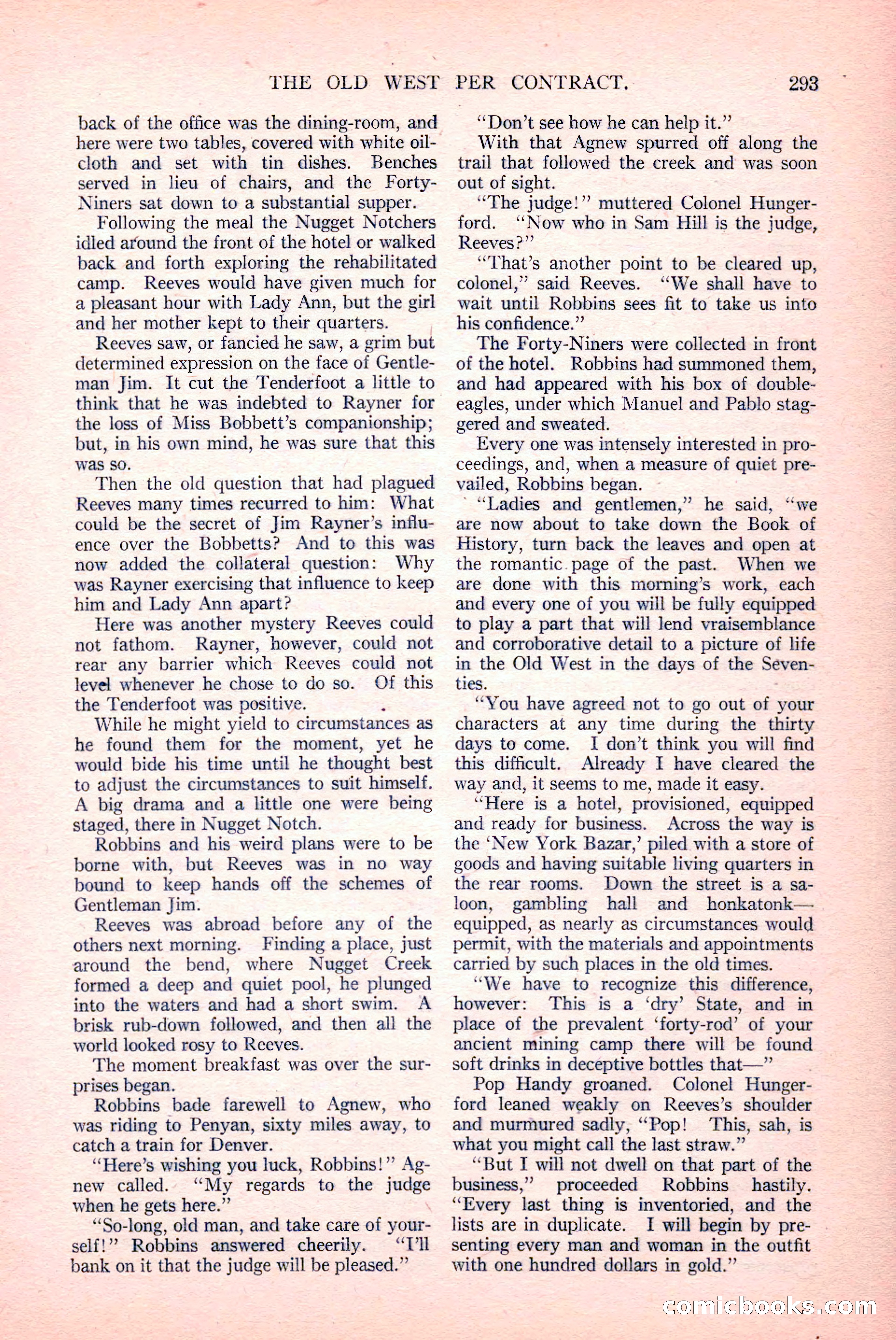
A restored page from Pulp Fiction, 1916. Page through the whole issue in the reader above.
📄 Transcribed text from this page (OCR, searchable)
Machine-transcribed from the original scan — historical spelling and the odd misread are preserved.
THE OLD WEST back of the office was the dining-room, and here were two tables, covered with white oil- cloth and set with tin dishes. Benches served in lieu of chairs, and the Forty- Niners sat down to a substantial supper. Following the meal the Nugget Notchers idled around the front of the hotel or walked back and forth exploring the rehabilitated camp. Reeves would have given much for a pleasant hour with Lady Ann, but the girl and her mother kept to their quarters. Reeves saw, or fancied he saw, a grim but determined expression on the face of Gentle- man Jim. It cut the Tenderfoot a little to think that he was indebted to Rayner for the loss of Miss Bobbett’s companionship; but, in his own mind, he was sure that this was So. Then the old question that had plagued Reeves many times recurred to him: What could be the secret of Jim Rayner’s influ- ence over the Bobbetts? And to this was now added the collateral question: Why was Rayner exercising that influence to keep him and Lady Ann apart? Here was another mystery Reeves could not fathom. Rayner, however, could not rear any barrier which Reeves could not level whenever he chose to do so. Of this the Tenderfoot was positive. While he might yield to circumstances as he found them for the moment, yet he would bide his time until he thought best to adjust the circumstances to suit himself. A big drama and a little one were being staged, there in Nugget Notch. Robbins and his weird plans were to be borne with, but Reeves was in no way bound to keep hands off the schemes of Gentleman Jim. Reeves was abroad before any of the others next morning. Finding a place, just around the bend, where Nugget Creek formed a deep and quiet pool, he plunged into the waters and had a short swim. A brisk rub-down followed, and then all the world looked rosy to Reeves. The moment breakfast was over the sur- prises began. Robbins bade farewell to Agnew, who was riding to Penyan, sixty miles away, to catch a train for Denver. ‘Here’s wishing you luck, Robbins!” Ag- new called. ‘My regards to the judge when he gets here.” “‘So-long, old man, and take care of your- self!” Robbins answered cheerily. “I'll bank on it that the judge will be pleased.” PER CONTRACT, — 298 “Don’t see how he can help it.” With that Agnew spurred off along the trail that followed the creek and was soon out of sight. “The judge!” muttered Colonel Hunger- ford. ‘‘Now who in Sam Hill is the judge, Reeves?” ‘“That’s another point to be cleared up, colonel,” said Reeves. ‘‘We shall have to wait until Robbins sees fit to take us into his confidence.” | The Forty-Niners were collected in front of the hotel. Robbins had summoned them, and had appeared with his box of double- eagles, under which Manuel and Pablo stag- gered and sweated. Every one was intensely interested in pro- ceedings, and, when a measure of quiet pre- vailed, Robbins began. ' “Ladies and gentlemen,” he said, ‘we are now about to take down the Book of History, turn back the leaves and open at the romantic. page of the past. When we are done with this morning’s work, each and every one of you will be fully equipped to play a part that will lend vraisemblance and corroborative detail to a picture of life in the Old West in the days of the Seven- ties. “You have agreed not to go out of your characters at any time during the thirty days to come. I don’t think you will find this difficult. Already I have cleared the way and, it seems to me, made it easy. “Here is a hotel, provisioned, equipped and ready for business. Across the way is the ‘New York Bazar,’ piled with a store of goods and having suitable living quarters in the rear rooms. Down the street is a sa- loon, gambling hall and honkatonk— equipped, as nearly as circumstances would permit, with the materials and appointments carried by such places in the old times. ‘We have to recognize this difference, however: This is a ‘dry’ State, and in place of the prevalent ‘forty-rod’ of your ancient mining camp there will be found soft drinks in deceptive bottles that—” Pop Handy groaned. Colonel Hunger- ford leaned weakly on Reeves’s shoulder and murmured sadly, “Pop! This, sah, is what you might call the last straw.” “But I will not dwell on that part of the business,” proceeded Robbins hastily. “Every last thing is inventoried, and the lists are in duplicate. I will begin by pre- senting every man and woman in the outfit with one hundred dollars in gold.” CORMICLOOOKS (E@)