
Pulp Fiction, 1916 · page 82 of 216
The Argosy, Vol. 81, No. 4 — page 82: what you’re looking at
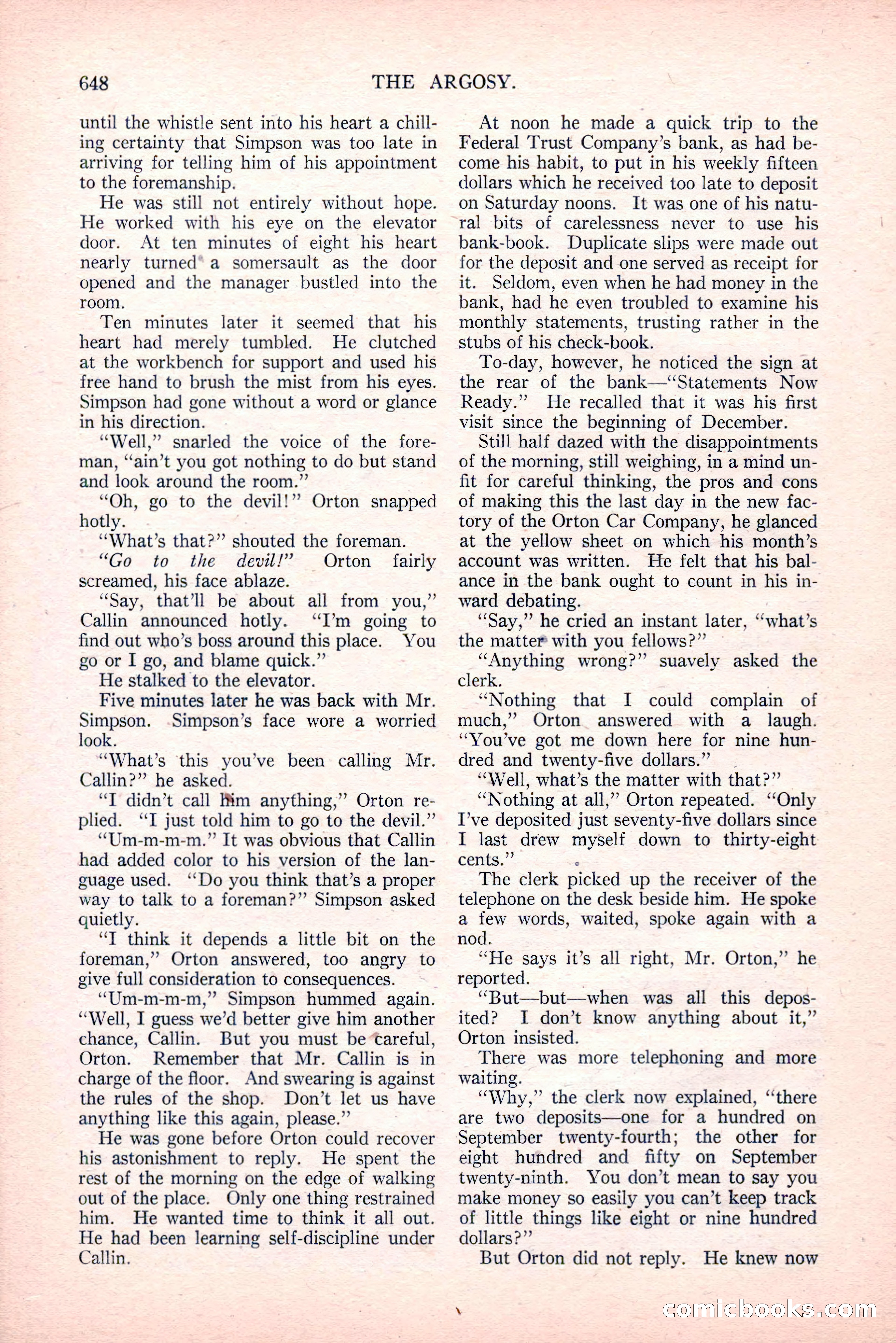
A restored page from Pulp Fiction, 1916. Page through the whole issue in the reader above.
📄 Transcribed text from this page (OCR, searchable)
Machine-transcribed from the original scan — historical spelling and the odd misread are preserved.
648 until the whistle sent into his heart a chill- ing certainty that Simpson was too late in arriving for telling him of his appointment to the foremanship. He was still not entirely without hope. He worked with his eye on the elevator door. At ten minutes of eight his heart nearly turned® a somersault as the door opened and the manager bustled into the room. Ten minutes later it seemed that his heart had merely tumbled. He clutched at the workbench for support and used his free hand to brush the mist from his eyes. Simpson had gone without a word or glance in his direction. “Well,” snarled the voice of the fore- man, “‘ain’t you got nothing to do but stand and look around the room.” “Oh, go to the devil!” Orton snapped hotly. ‘“‘What’s that?” shouted the foreman. “Go to the devil!” Orton fairly screamed, his face ablaze. “Say, that’ll be about all from you,” Callin announced hotly. “I’m going to find out who’s boss around this place. You go or I go, and blame quick.” He stalked to the elevator. Five minutes later he was back with Mr. Simpson. -Simpson’s face wore a worried look. ‘“What’s this you’ve been calling Mr. Callin?” he asked. ‘“T didn’t call fim anything,” Orton re- plied. ‘TI just told him to go to the devil.” ‘“Um-m-m-m.” It was obvious that Callin had added color to his version of the lan- guage used. ‘‘Do you think that’s a proper way to talk to a foreman?” Simpson asked quietly. “T think it depends a little bit on the foreman,” Orton answered, too angry to give full consideration to consequences. ‘“Um-m-m-m,” Simpson hummed again. “Well, I guess we’d better give him another chance, Callin. But you must be Careful, Orton. Remember that Mr. Callin is in charge of the floor. And swearing is against the rules of the shop. Don’t let us have anything like this again, please.” He was gone before Orton could recover his astonishment to reply. He spent the rest of the morning on the edge of walking out of the place. Only one thing restrained him. He wanted time to think it all out. He had been learning self-discipline under Callin. \ COMMUC THE ARGOSY. At noon he made a quick trip to the Federal Trust Company’s bank, as had be- come his habit, to put in his weekly fifteen dollars which he received too late to deposit on Saturday noons. It was one of his natu- ral bits of carelessness never to use his bank-book. Duplicate slips were made out for the deposit and one served as receipt for it. Seldom, even when he had money in the bank, had he even troubled to examine his monthly statements, trusting rather in the stubs of his check-book. To-day, however, he noticed the sign at the rear of the bank—‘Statements Now Ready.” He recalled that it was his first visit since the beginning of December. Still half dazed with the disappointments of the morning, still weighing, in a mind un- fit for careful thinking, the pros and cons of making this the last day in the new fac- tory of the Orton Car Company, he glanced at the yellow sheet on which his month’s account was written. He felt that his bal- ance in the bank ought to count in his in- ward debating. “Say,” he cried an instant later, ‘“‘what’s the matter with you fellows?” “Anything wrong?” suavely asked the clerk. “Nothing that I could complain of much,” Orton answered with a laugh. “You’ve got me down here for nine hun- dred and twenty-five dollars.” . “Well, what’s the matter with that?” “Nothing at all,” Orton repeated. “Only I’ve deposited just seventy-five dollars since I last drew myself down to thirty-eight cents.”’ : The clerk picked up the receiver of the telephone on the desk beside him. He spoke a few words, waited, spoke again with a nod. “He says it’s all right, Mr. Orton,” he reported. | “But—but—when was all this depos- ited? I don’t know anything about it,” Orton insisted. There was more telephoning and more waiting. “Why,” the clerk now explained, “there are two deposits—one for a hundred on September twenty-fourth; the other for eight hundred and fifty on September twenty-ninth. You don’t mean to say you make money so easily you can’t keep track of little things like eight or nine hundred dollars?” But Orton did not reply. He knew now VNOOLKS (C@)