
Pulp Fiction, 1916 · page 83 of 216
The Argosy, Vol. 81, No. 4 — page 83: what you’re looking at
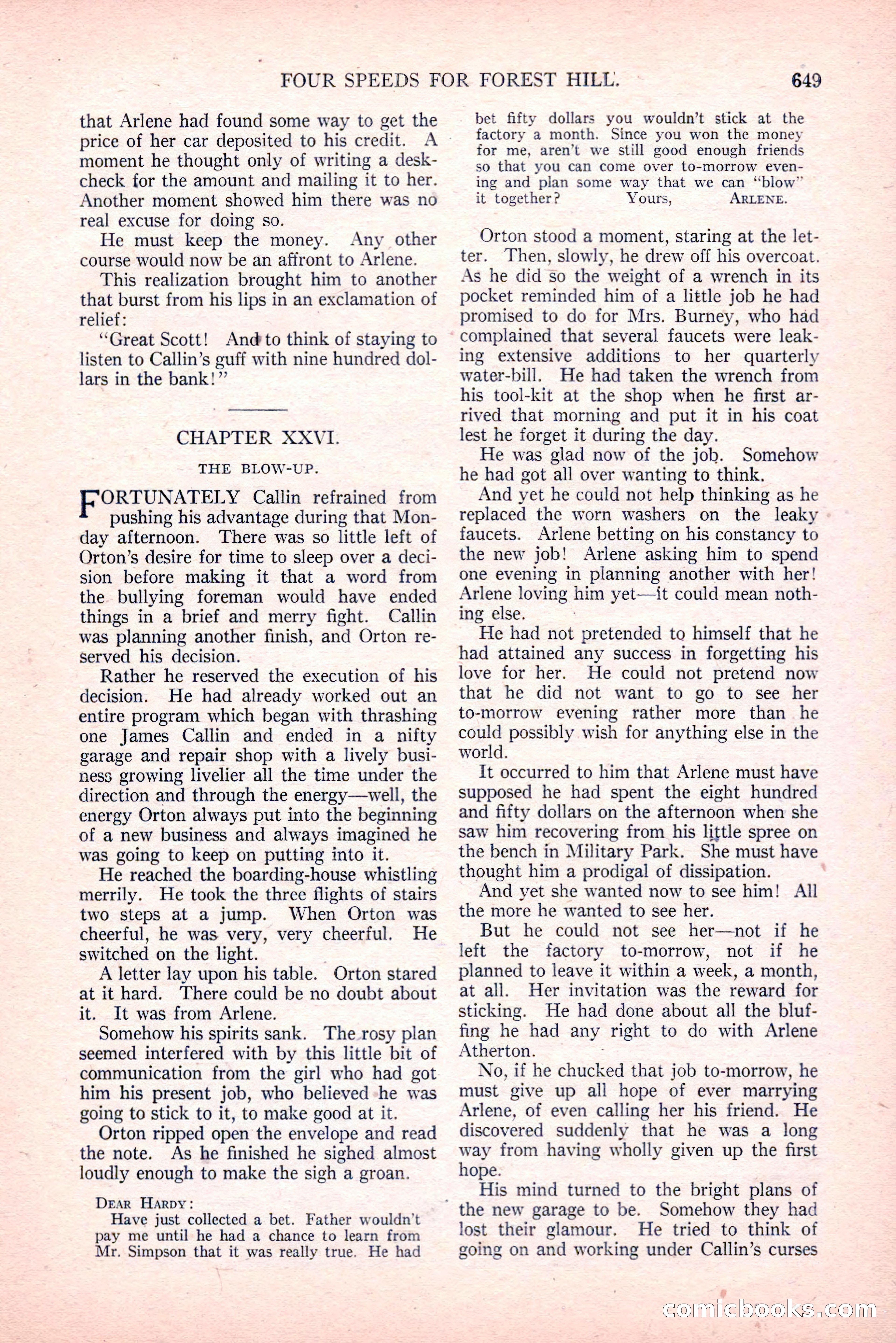
A restored page from Pulp Fiction, 1916. Page through the whole issue in the reader above.
📄 Transcribed text from this page (OCR, searchable)
Machine-transcribed from the original scan — historical spelling and the odd misread are preserved.
FOUR SPEEDS FOR FOREST HILL. that Arlene had found some way to get the price of her car deposited to his credit. moment he thought only of writing a desk- check for the amount and mailing it to her. Another moment showed him there was no real excuse for doing so. He must keep the money. Any other course would now be an affront to Arlene. This realization brought him to another that burst from his lips in an exclamation of relief: “Great Scott! Andto think of staying to listen to Callin’s guff with nine hundred dol- lars in the bank!” CHAPTER XXVI. THE BLOW-UP. ORTUNATELY Callin refrained from pushing his advantage during that Mon- day afternoon. There was so little left of Orton’s desire for time to sleep over a deci- sion before making it that a word from the bullying foreman would have ended things in a brief and merry fight. Callin was planning another finish, and Orton re- served his decision. Rather he reserved the execution of his decision. He had already worked out an entire program which began with thrashing one James Callin and ended in a nifty earage and repair shop with a lively busi- ness growing livelier all the time under the direction and through the energy—well, the energy Orton always put into the beginning of a new business and always imagined he was going to keep on putting into it. He reached the boarding-house whistling merrily. He took the three flights of stairs two steps at a jump. When Orton was cheerful, he was very, very cheerful. switched on the light. | A letter lay upon his table. Orton stared at it hard. There could be no doubt about it. It was from Arlene. Somehow his spirits sank. The rosy plan seemed interfered with by this little bit of communication from the girl who had got him his present job, who believed he was going to stick to it, to make good at it. Orton ripped open the envelope and read the note. As he finished he sighed almost loudly enough to make the sigh a groan. Dear Harpy: Have just collected a bet. Father wouldn’t pay me until he had a chance to learn from Mr. Simpson that it was really true. He had He ' the new garage to be. 649 bet fifty dollars you wouldn’t stick at the factory a month. Since you won the money for me, aren’t we still good enough friends so that you can come over to-morrow even- ing and plan some way that we can “blow” it together? Yours, ARLENE. Orton stood a moment, staring at the let- ter. Then, slowly, he drew off his overcoat. As he did so the weight of a wrench in its pocket reminded him of a little job he had promised to do for Mrs. Burney, who had complained that several faucets were leak- ing extensive additions to her quarterly water-bill. He had taken the wrench from his tool-kit at the shop when he first ar- rived that morning and put it in his coat lest he forget it during the day. He was glad now of the job. Somehow he had got all over wanting to think. And yet he could not help thinking as he replaced the worn washers on the leaky faucets. Arlene betting on his constancy to the new job! Arlene asking him to spend one evening in planning another with her! Arlene loving him yet—it could mean noth- ing else. He had not pretended to himself that he had attained any success in forgetting his love for her. He could not pretend now that he did not want to go to see her to-morrow evening rather more than he could possibly wish for anything else in the world. It occurred to him that Arlene must have supposed he had spent the eight hundred and fifty dollars on the afternoon when she saw him recovering from his little spree on the bench in Military Park. She must have thought him a prodigal of dissipation. And yet she wanted now to see him! All the more he wanted to see her. But he could not see her—not if he left the factory to-morrow, not if he planned to leave it within a week, a month, at all. Her invitation was the reward for sticking. He had done about all the bluf- fing he had any right to do with Arlene Atherton. No, if he chucked that job to-morrow, he must give up all hope of ever marrying Arlene, of even calling her his friend. He discovered suddenly that he was a long way from having wholly given up the first hope. His mind turned to the bright plans of Somehow they had lost their glamour. He tried to think of going on and working under Callin’s curses COMMichboo SS (C@)