
Pulp Fiction, 1916 · page 81 of 216
The Argosy, Vol. 81, No. 4 — page 81: what you’re looking at
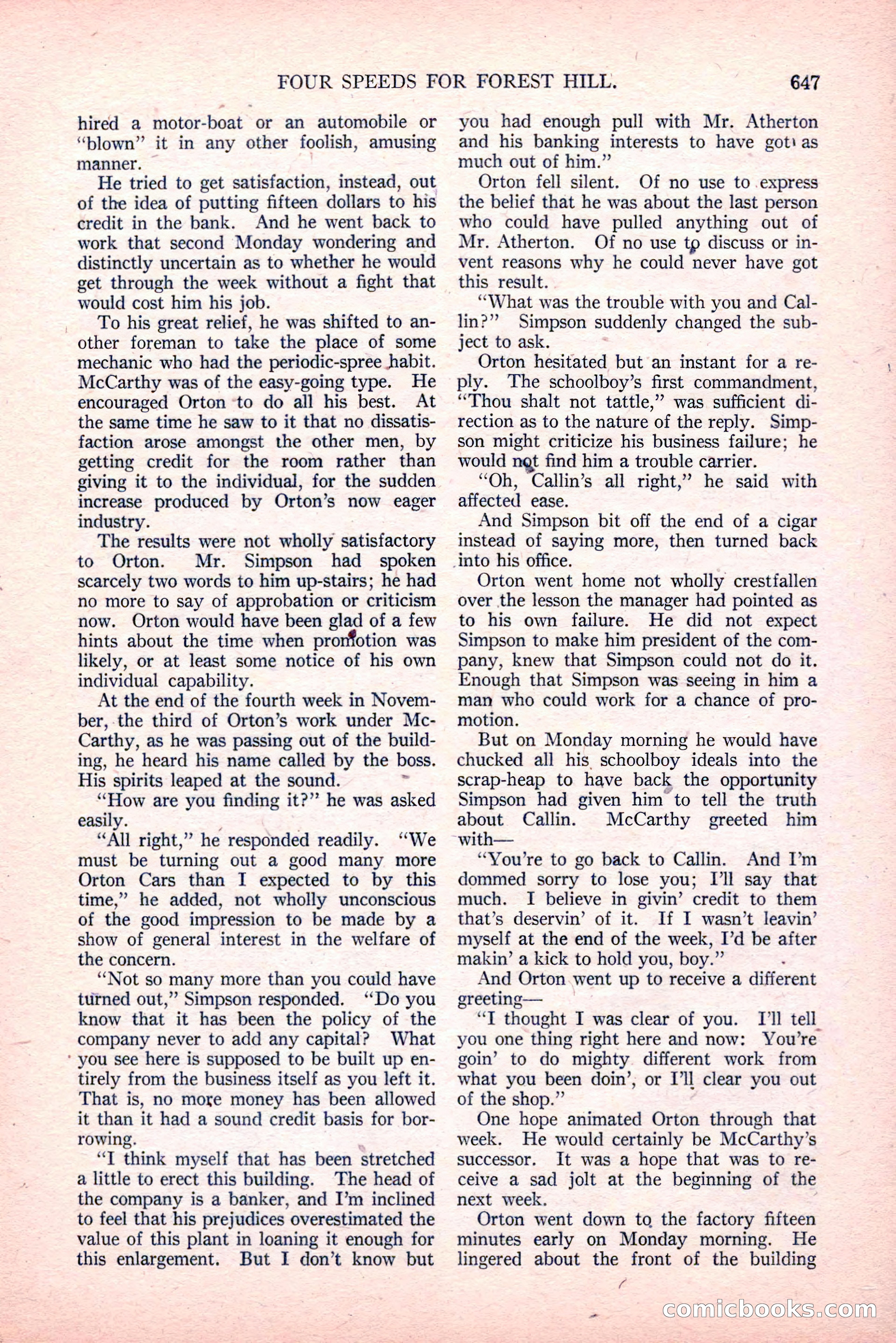
A restored page from Pulp Fiction, 1916. Page through the whole issue in the reader above.
📄 Transcribed text from this page (OCR, searchable)
Machine-transcribed from the original scan — historical spelling and the odd misread are preserved.
FOUR SPEEDS FOR FOREST HILL. hired a motor-boat or an automobile or “blown” it in any other foolish, amusing manner. He tried to get satisfaction, instead, out of the idea of putting fifteen dollars to his credit in the bank. And he went back to work that second Monday wondering and distinctly uncertain as to whether he would get through the week without a fight that would cost him his job. To his great relief, he was shifted to an- other foreman to take the place of some mechanic who had the periodic-spree habit. McCarthy was of the easy-going type. He encouraged Orton ‘to do all his best. At the same time he saw to it that no dissatis- faction arose amongst the other men, by getting credit for the room rather than giving it to the individual, for the sudden increase produced by Orton’s now eager industry. The results were not wholly satisfactory to Orton. Mr. Simpson had _ spoken scarcely two words to him up-stairs; he had no more to say of approbation or criticism now. Orton would have been glad of a few hints about the time when prorfotion was likely, or at least some notice of his own individual capability. At the end of the fourth week in Novem- ber, the third of Orton’s work under Mc- Carthy, as he was passing out of the build- ing, he heard his name called by the boss. His spirits leaped at the sound. “How are you finding it?” he was asked easily. | “All right,” he responded readily. “‘We must be turning out a good many more Orton Cars than I expected to by this time,” he added, not wholly unconscious of the good impression to be made by a show of general interest in the welfare of the concern. ‘“‘Not so many more than you could have turned out,” Simpson responded. ‘‘Do you know that it has been the policy of the company never to add any capital? What ‘ you see here is supposed to be built up en- tirely from the business itself as you left it. That is, no more money has been allowed it than it had a sound credit basis for bor- rowing. “T think myself that has been stretched a little to erect this building. The head of the company is a banker, and I’m inclined to feel that his prejudices overestimated the value of this plant in loaning it enough for this enlargement. But I don’t know but 647 you had enough pull with Mr. Atherton and his banking interests to have gotias much out of him.” Orton fell silent. Of no use to express the belief that he was about the last person who could have pulled anything out of Mr. Atherton. Of no use tg discuss or in- vent reasons why he could never have got this result. “What was the trouble with you and Cal- lin?” Simpson suddenly changed the sub- ject to ask. Orton hesitated but an instant for a re- ply. The schoolboy’s first commandment, “Thou shalt not tattle,” was sufficient di- rection as to the nature of the reply. Simp- son might criticize his business failure; he would not find him a trouble carrier. “Oh, Callin’s all right,” he said with affected ease. And Simpson bit off the end of a cigar instead of saying more, then turned back into his office. Orton went home not wholly crestfallen over the lesson the manager had pointed as to his own failure. He did not expect Simpson to make him president of the com- pany, knew that Simpson could not do it. Enough that Simpson was seeing in him a man who could work for a chance of pro- motion. But on Monday morning he would have chucked all his schoolboy ideals into the scrap-heap to have back the opportunity Simpson had given him to tell the truth about Callin. with— “You're to go back to Callin. And I’m dommed sorry to lose you; I'll say that much. I believe in givin’ credit to them that’s deservin’ of it. If I wasn’t leavin’ myself at the end of the week, I’d be after makin’ a kick to hold you, boy.” ‘ And Orton went up to receive a different greeting — “T thought I was clear of you. you one thing right here and now: You’re goin’ to do mighty different work from what you been doin’, or I[’ll clear you out of the shop.” One hope animated Orton through that week. He would certainly be McCarthy’s successor. It was a hope that was to re- ceive a sad jolt at the beginning of the next week. Orton went down to the factory fifteen minutes early on Monday morning. He lingered about the front of the building Z > COMMUC NOOLKS I'l tell McCarthy greeted him — (E@