
Pulp Fiction, 1916 · page 80 of 216
The Argosy, Vol. 81, No. 4 — page 80: what you’re looking at
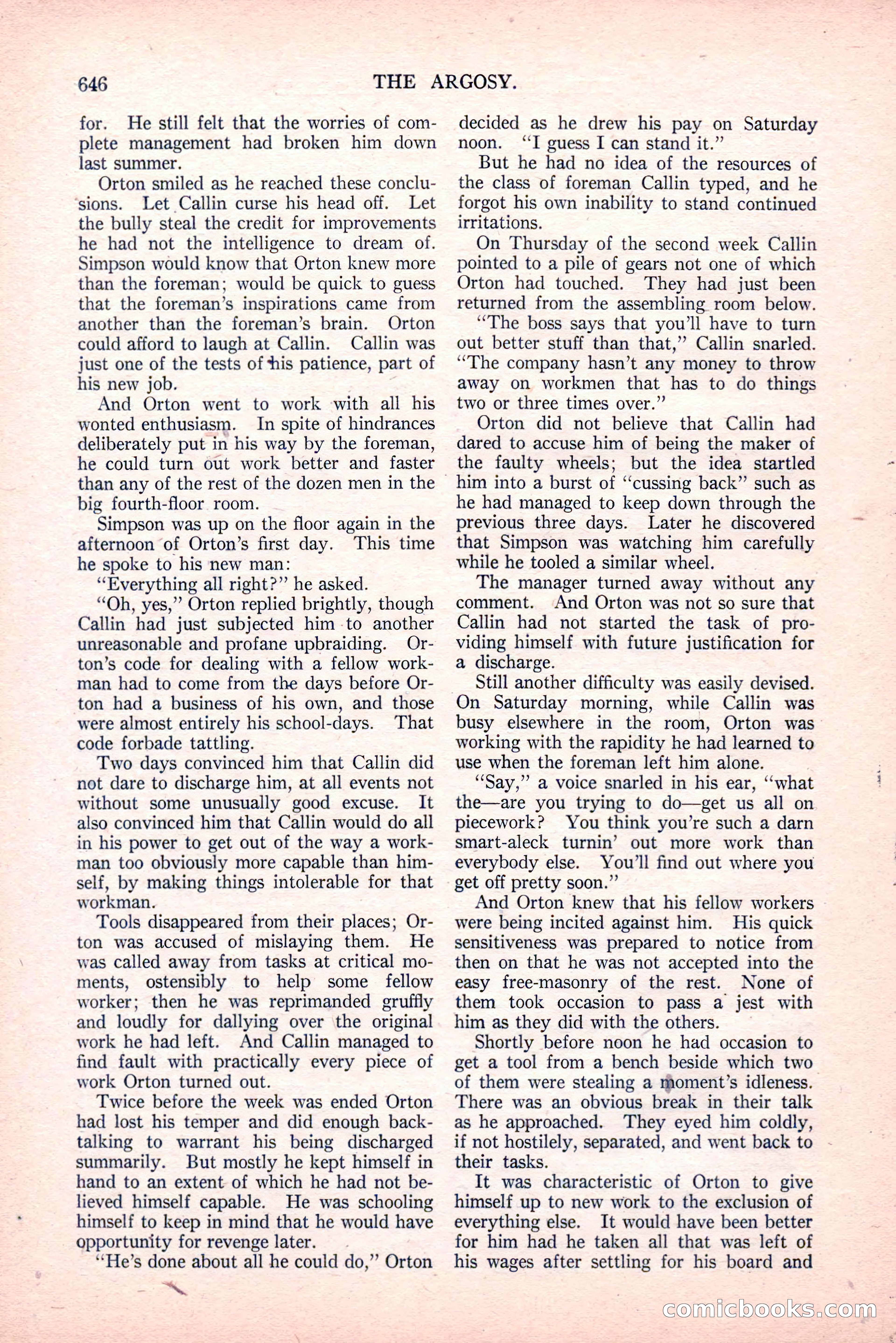
A restored page from Pulp Fiction, 1916. Page through the whole issue in the reader above.
📄 Transcribed text from this page (OCR, searchable)
Machine-transcribed from the original scan — historical spelling and the odd misread are preserved.
646 for. He still felt that the worries of com- plete management had broken him down last summer. Orton smiled as he reached these conclu- ‘sions. Let Callin curse his head off. Let the bully steal the credit for improvements he had not the intelligence to dream of. Simpson would know that Orton knew more than the foreman; would be quick to guess that the foreman’s inspirations came from another than the foreman’s brain. Orton could afford to laugh at Callin. Callin was just one of the tests of this patience, part of his new job. And Orton went to work with all his wonted enthusiasm. In spite of hindrances deliberately put in his way by the foreman, he could turn out work better and faster than any of the rest of the dozen men in the | big fourth-floor room. Simpson was up on the floor again in the afternoon of Orton’s first day. This time he spoke to his new man: “Everything all right?” he asked. “Oh, yes,”’ Orton replied brightly, though Callin had just subjected him -to another unreasonable and profane upbraiding. Or- ton’s code for dealing with a fellow work- man had to come from the days before Or- ton had a business of his own, and those were almost entirely his school-days. That code forbade tattling. Two days convinced him that Callin did not dare to discharge him, at all events not without some unusually good excuse. It also convinced him that Callin would do all in his power to get out of the way a work- man too obviously more capable than him- self, by making things intolerable for that workman. Tools disappeared from their places; Or- ton was accused of mislaying them. He was called away from tasks at critical mo- ments, ostensibly to help some fellow worker; then he was reprimanded gruffly and loudly for dallying over the original work he had left. And Callin managed to find fault with practically every piece of work Orton turned out. Twice before the week was ended Orton had lost his temper and did enough back- talking to warrant his being discharged summarily. But mostly he kept himself in hand to an extent of which he had not be- lieved himself capable. He was schooling himself to keep in mind that he would have opportunity for revenge later. ‘“He’s done about all he could do,”’ Orton on THE ARGOSY. decided as he drew his pay on Saturday noon. “I guess I can stand it.” But he had no idea of the resources of the class of foreman Callin typed, and he forgot his own inability to stand continued irritations. On Thursday of the second week Callin pointed to a pile of gears not one of which Orton had touched. They had just been returned from the assembling room below. ‘The boss says that you'll have to turn out better stuff than that,” Callin snarled. ‘The company hasn’t any money to throw away on workmen that has to do things two or three times over.” Orton did not believe that Callin had dared to accuse him of being the maker of the faulty wheels; but the idea startled him into a burst of ‘‘cussing back” such as he had managed to keep down through the previous three days. Later he discovered that Simpson was watching him carefully while he tooled a similar wheel. The manager turned away without any comment. And Orton was not so sure that Callin had not started the task of pro- viding himself with future justification for a discharge. Still another difficulty was easily devised. On Saturday morning, while Callin was busy elsewhere in the room, Orton was working with the rapidity he had learned to use when the foreman left him alone. ‘‘Say,” a voice snarled in his ear, ‘“‘what the—are you trying to do—get us all on piecework? You think you’re such a darn smart-aleck turnin’ out more work than everybody else. You'll find out where you get off pretty soon.” And Orton knew that his fellow workers were being incited against him. His quick sensitiveness was prepared to notice from then on that he was not accepted into the easy free-masonry of the rest. None of them took occasion to pass a jest with him as they did with the others. Shortly before noon he had occasion to get a tool from a bench beside which two of them were stealing a moment’s idleness. There was an obvious break in their talk as he approached. They eyed him coldly, if not hostilely, separated, and went back to their tasks. It was characteristic of Orton to give himself up to new work to the exclusion of everything else. It would have been better for him had he taken all that was left of his wages after settling for his board and CORIGLOOOKS (C@)