
Pulp Fiction, 1916 · page 79 of 216
The Argosy, Vol. 81, No. 4 — page 79: what you’re looking at
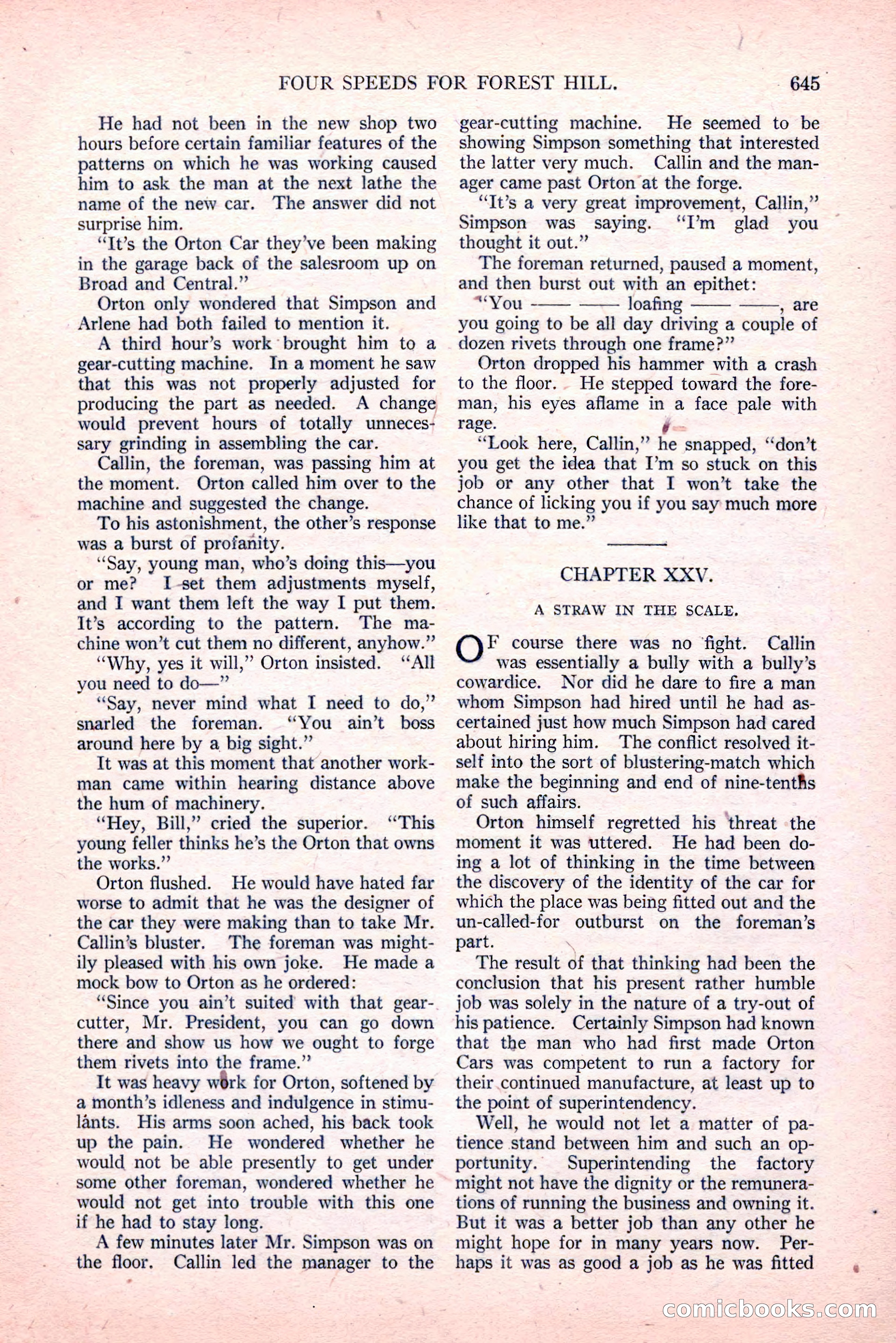
A restored page from Pulp Fiction, 1916. Page through the whole issue in the reader above.
📄 Transcribed text from this page (OCR, searchable)
Machine-transcribed from the original scan — historical spelling and the odd misread are preserved.
FOUR SPEEDS FOR FOREST HILL. He had not been in the new shop two hours before certain familiar features of the patterns on which he was working caused him to ask the man at the next lathe the name of the new car. The answer did not surprise him. “Tt’s the Orton Car they’ve been making in the garage back of the salesroom up on Broad and Central.” Orton only wondered that Simpson and Arlene had both failed to mention it. A third hour’s work brought him to a gear-cutting machine. In a moment he saw that this was not properly adjusted for producing the part as needed. A change would prevent hours of totally unneces- sary grinding in assembling the car. Callin, the foreman, was passing him at the moment. Orton called him over to the machine and suggested the change. To his astonishment, the other’s response was a burst of profanity. “Say, young man, who’s doing this—you or me? I-set them adjustments myself, and I want them left the way I put them. It’s according to the pattern. The ma- chine won’t cut them no different, anyhow.” ‘Why, yes it will,” Orton insisted. ‘All you need to do—”’ “Say, never mind what I need to do,” snarled the foreman. “You ain’t boss around here by a big sight.” It was at this moment that another work- man came within hearing distance above the hum of machinery. “Hey, Bill,” cried the superior. “This young feller thinks he’s the Orton that owns the works.”’ Orton flushed. He would have hated far worse to admit that he was the designer of the car they were making than to take Mr. Callin’s bluster. The foreman was might- ily pleased with his own joke. He made a mock bow to Orton as he ordered: “Since you ain’t suited with that gear- cutter, Mr. President, you can go down there and show us how we ought to forge them rivets into the frame.” It was heavy wrk for Orton, softened by a month’s idleness and indulgence in stimu- lants. His arms soon ached, his back took up the pain. He wondered whether he would not be able presently to get under some other foreman, wondered whether he would not get into trouble with this one if he had to stay long. A few minutes later Mr. Simpson was on the floor, Callin led the manager to the gear-cutting machine. He seemed to be showing Simpson something that interested the latter very much. Callin and the man- ager came past Orton at the forge. “Tt’s a very great improvement, Callin,” Simpson was saying. “I’m glad you thought it out.” The foreman returned, paused a moment, and then burst out with an epithet: “You -—— loafing ——, are you going to be all day driving a couple of dozen rivets through one frame?” Orton dropped his hammer with a crash to the floor. He stepped toward the fore- man, his eyes aflame in a face pale with rage. é- “Look here, Callin,’”’ he snapped, “don’t you get the idea that I’m so stuck on this job or any other that I won’t take the chance of licking you if you say much more like that to me.” CHAPTER XXV. A STRAW IN THE SCALE, IF course there was no ‘fight. Callin was essentially a bully with a bully’s cowardice. Nor did he dare to fire a man whom Simpson had hired until he had as- certained just how much Simpson had cared about hiring him. The conflict resolved it- self into the sort of blustering-match which make the beginning and end of nine-tenths of such affairs. Orton himself regretted his threat the moment it was uttered. He had been do- ing a lot of thinking in the time between the discovery of the identity of the car for which the place was being fitted out and the un-called-for outburst on the foreman’s part. The result of that thinking had been the conclusion that his present rather humble job was solely in the nature of a try-out of his patience. Certainly Simpson had known that the man who had first made Orton Cars was competent to run a factory for their continued manufacture, at least up to the point of superintendency. Well, he would not let a matter of pa- tience stand between him and such an op- portunity. Superintending the factory might not have the dignity or the remunera- tions of running the business and owning it. But it was a better job than any other he might hope for in many years now. Per- haps it was as good a job as he was fitted CORMICLOOKS 645 (C@)