
Pulp Fiction, 1916 · page 78 of 216
The Argosy, Vol. 81, No. 4 — page 78: what you’re looking at
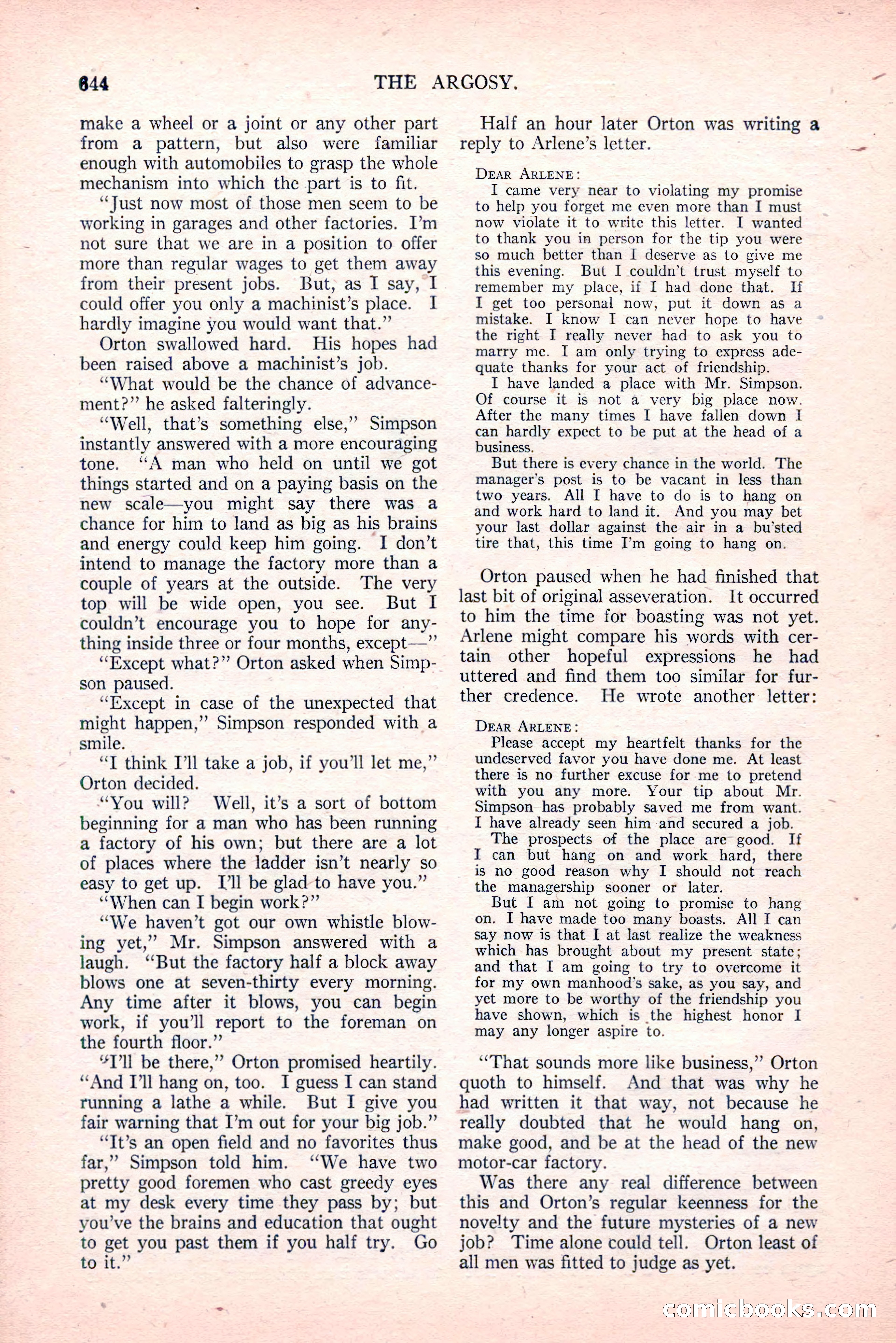
A restored page from Pulp Fiction, 1916. Page through the whole issue in the reader above.
📄 Transcribed text from this page (OCR, searchable)
Machine-transcribed from the original scan — historical spelling and the odd misread are preserved.
644 THE make a wheel or a joint or any other part from a pattern, but also were familiar enough with automobiles to grasp the whole mechanism into which the part is to fit. “Just now most of those men seem to be working in garages and other factories. I’m not sure that we are in a position to offer more than regular wages to get them away from their present jobs. But, as I say, I could offer you only a machinist’s place. I hardly imagine you would want that.” Orton swallowed hard. His hopes had been raised above a machinist’s job. ‘“‘What would be the chance of advance- ment?” he asked falteringly. “Well, that’s something else,’ Simpson instantly answered with a more encouraging tone. ‘A man who held on until we got things started and on a paying basis on the new scale—you might say there was a chance for him to land as big as his brains and energy could keep him going. I don’t intend to manage the factory more than a couple of years at the outside. The very top will be wide open, you see. But I couldn’t encourage you to hope for any- thing inside three or four months, except—”’ “Except what?” Orton asked when Simp- son paused. “Except in case of the unexpected that might happen,”’ Simpson responded with a smile. “T think T’ll take a job, if you'll let me,” Orton decided. “You will? Well, it’s a sort of bottom beginning for a man who has been running a factory of his own; but there are a lot of places where the ladder isn’t nearly so easy to get up. [ll be glad to have you.” ‘When can I begin work?” “We haven’t got our own whistle blow- ing yet,” Mr. Simpson answered with a laugh. “But the factory half a block away blows one at seven-thirty every morning. Any time after it blows, you can begin work, if you'll report to the foreman on the fourth floor.”’ “T’ll be there,” Orton promised heartily. “And [ll hang on, too. I guess I can stand running a lathe a while. But I give you fair warning that I’m out for your big job.” “Tt’s an open field and no favorites thus far,” Simpson told him. ‘We have two pretty good foremen who cast greedy eyes at my desk every time they pass by; but you’ve the brains and education that ought to get you past them if you half try. Go to it.” ARGOSY. Half an hour later Orton was writing a reply to Arlene’s letter. DeEAR ARLENE: I came very near to violating my promise to help you forget me even more than I must now violate it to write this letter. I wanted to thank you in person for the tip you were so much better than I deserve as to give me this evening. But I couldn’t trust myself to remember my place, if I had done that. Ti I get too personal now, put it down as a mistake. I know I can never hope to have the right I really never had to ask you to marry me. I am only trying to express ade- quate thanks for your act of friendship. I have landed a place with Mr. Simpson. Of course it is not a very big place now. After the many times I have fallen down I can hardly expect to be put at the head of a business. But there is every chance in the world. The manager's post is to be vacant in less than two years. All I have to do is to hang on and work hard to land it. And you may bet your last dollar against the air in a bu’sted tire that, this time I’m going to hang on. Orton paused when he had finished that last bit of original asseveration. It occurred to him the time for boasting was not yet. Arlene might compare his words with cer- tain other hopeful expressions he had uttered and find them too similar for fur- ther credence. He wrote another letter: DEAR ARLENE: Please accept my heartfelt thanks for the undeserved favor you have done me. At least there is no further excuse for me to pretend with you any more. Your tip about Mr. Simpson has probably saved me from want. I have already seen him and secured a job. The prospects of the place are good. If I can but hang on and work hard, there is no good reason why I should not reach the managership sooner or later. But I am not going to promise to hang on. I have made too many boasts. All I can say now is that I at last realize the weakness which has brought about my present state; and that I am going to try to overcome it for my own manhood’s sake, as you say, and yet more to be worthy of the friendship you have shown, which is the highest honor I may any longer aspire to. ‘““That sounds more like business,’ Orton quoth to himself. And that was why he had written it that way, not because he really doubted that he would hang on, make good, and be at the head of the new motor-car factory. Was there any real difference between this and Orton’s regular keenness for the novelty and the future mysteries of a new job? Time alone could tell. Orton least of all men was fitted to judge as yet. Go 0)()) AMUC SS (C@)