
Pulp Fiction, 1916 · page 77 of 216
The Argosy, Vol. 81, No. 4 — page 77: what you’re looking at
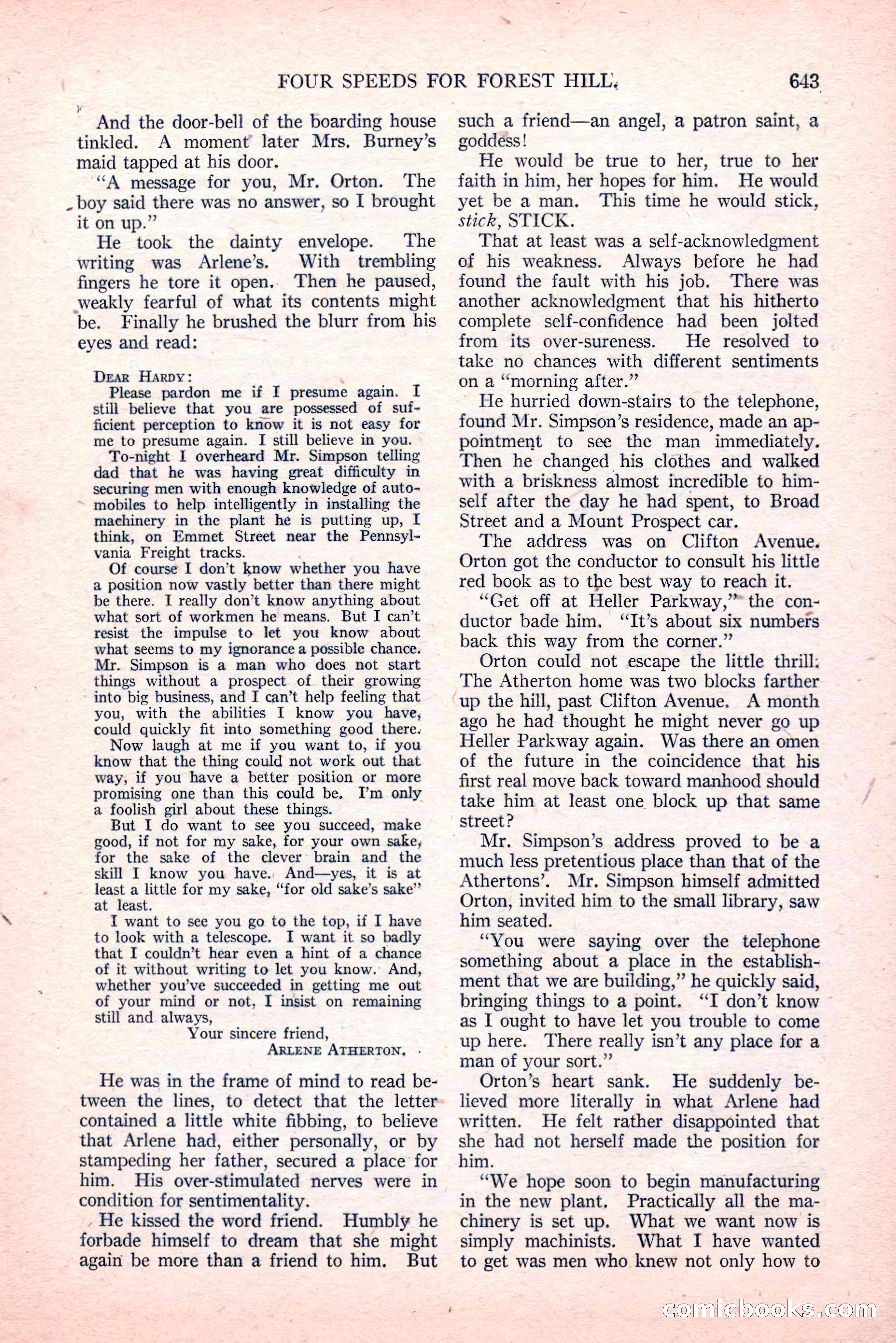
A restored page from Pulp Fiction, 1916. Page through the whole issue in the reader above.
📄 Transcribed text from this page (OCR, searchable)
Machine-transcribed from the original scan — historical spelling and the odd misread are preserved.
FOUR SPEEDS FOR FOREST HILL. And the door-bell of the boarding house tinkled. A moment later Mrs, Burney’s maid tapped at his door. ‘““A message for you, Mr. Orton. The _ boy said there was no answer, so I brought it on up.” He took the dainty envelope. The writing was Arlene’s. With trembling fingers he tore it open.. Then he paused, weakly fearful of what its contents might be. Finally he brushed the blurr from his eyes and read: Dear Harpy: Please pardon me if I presume again. I[ still believe that you are possessed of suf- ficient perception to know it is not easy for me to presume again. I still believe in you. To-night I overheard Mr. Simpson telling dad that he was having great difficulty in securing men with enough knowledge of auto- mobiles to help intelligently in installing the machinery in the plant he is putting up, I think, on Emmet Street near the Pennsyl- vania Freight tracks. Of course I don’t know whether you have a position now vastly better than there might be there. I really don’t know anything about what sort of workmen he means. But I can’t resist the impulse to let you know about what seems to my ignorance a possible chance. Mr. Simpson is a man who does not start things without a prospect of their growing into big business, and I can’t help feeling that you, with the abilities I know you have, could quickly fit into something good there. Now laugh at me if you want to, if you know that the thing could not work out that way, if you have a better position or more promising one than this could be. I’m only a foolish girl about these things. But I do want to see you succeed, make good, if not for my sake, for your own sake; for the sake of the clever brain and the skill I know you have.. And—yes, it is at least a little for my sake, ‘“‘for old sake’s sake” at least. I want to see you go to the top, if I have to look with a telescope. I want it so badly that I couldn’t hear even a hint of a chance of it without writing to let you know. And, whether you’ve succeeded in getting me out of your mind or not, I insist on remaining still and always, Your sincere friend, ARLENE ATHERTON, - He was in the frame of mind to read be- tween the lines, to detect that the letter contained a little white fibbing, to believe that Arlene had, either personally, or by stampeding her father, secured a place for him. His over-stimulated nerves were in condition for sentimentality. _ He kissed the word friend. Humbly he forbade himself to dream that she might again be more than a friend to him. But such a friend—an angel, a patron saint, a goddess! He would be true to her, true to her faith in him, her hopes for him. He would yet be a man, This time he would stick, stick, STICK. That at least was a self-acknowledgment of his weakness. Always before he had found the fault with his job. There was another acknowledgment that his hitherto complete self-confidence had been jolted from its over-sureness. He resolved to take no chances with different sentiments on a “morning after.” He hurried down-stairs to the telephone, found Mr. Simpson’s residence, made an ap- pointtment to see the man immediately. Then he changed his clothes and walked with a briskness almost incredible to him- self after the day he had spent, to Broad Street and a Mount Prospect car. The address was on Clifton Avenue. Orton got the conductor to consult his little red book as to the best way to reach it. “Get off at Heller Parkway,” the con- ductor bade him, “It’s about six numbers back this way from the corner.” Orton could not escape the little thrill: The Atherton home was two blocks farther up the hill, past Clifton Avenue, A month ago he had thought he might never go up Heller Parkway again. Was there an omen of the future in the coincidence that his first real move back toward manhood should take him at least one block up that same street? Mr. Simpson’s address proved to be a much less pretentious place than that of the Athertons’. Mr. Simpson himself admitted Orton, invited him to the small library, saw him seated. “You were saying over the telephone something about a place in the establish- ment that we are building,” he quickly said, bringing things to a point. “I don’t know as I ought to have let you trouble to come up here. There really isn’t any place for a man of your sort.” Orton’s heart sank. He suddenly be- lieved more literally in what Arlene had written. He felt rather disappointed that she had not herself made the position for him. “We hope soon to begin manufacturing in the new plant, Practically all the ma- chinery is set up. What we want now is simply machinists. What I have wanted to get was men who knew not only how to 643 CORMICLOO® S (C@)