
Pulp Fiction, 1916 · page 76 of 216
The Argosy, Vol. 81, No. 4 — page 76: what you’re looking at
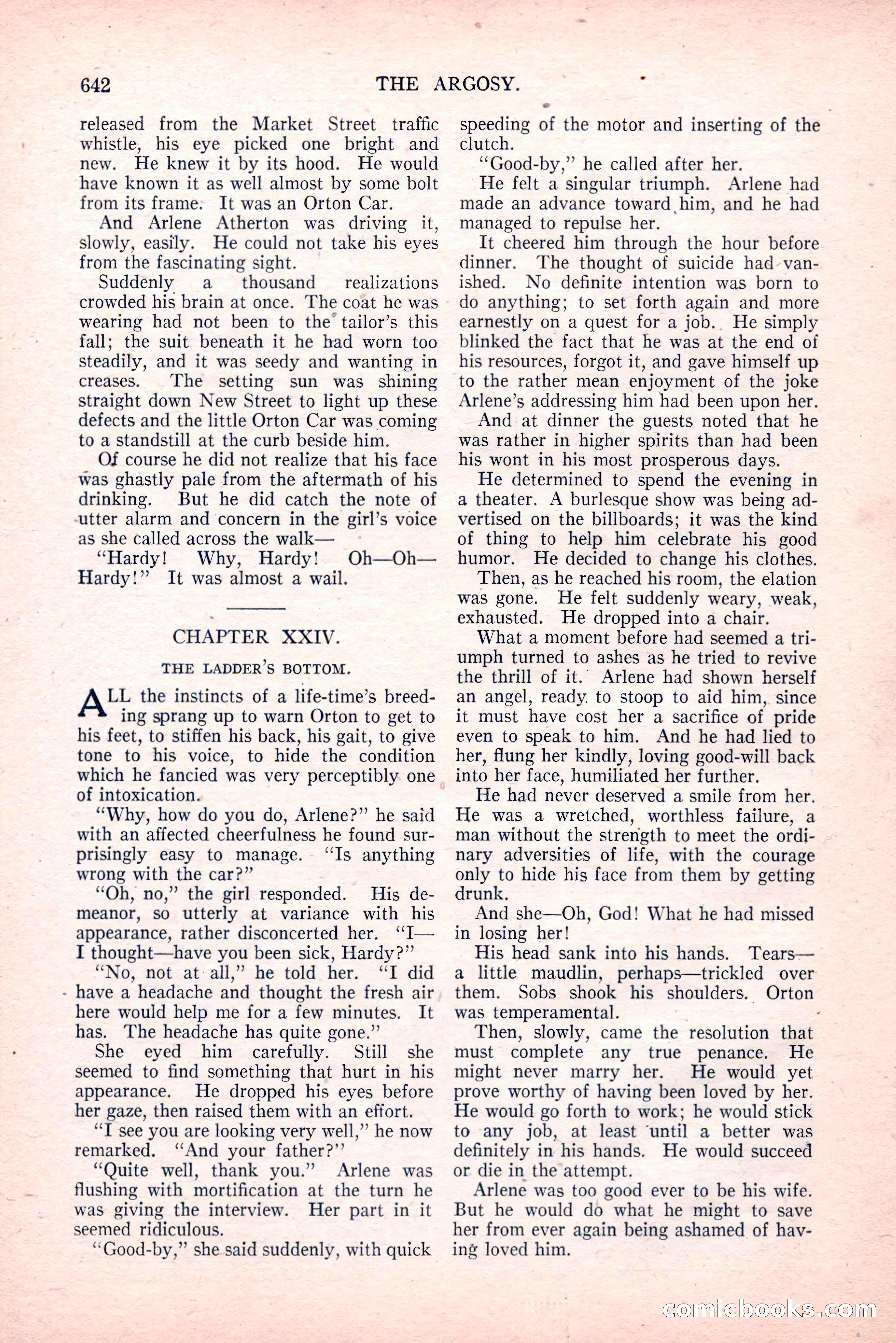
A restored page from Pulp Fiction, 1916. Page through the whole issue in the reader above.
📄 Transcribed text from this page (OCR, searchable)
Machine-transcribed from the original scan — historical spelling and the odd misread are preserved.
642 released from the Market Street traffic whistle, his eye picked one bright and new. He knew it by its hood. He would have known it as well almost by some bolt from its frame. It was an Orton Car. And Arlene Atherton was driving it, slowly, easily. He could not take his eyes from the fascinating sight. Suddenly a thousand _ realizations crowded his brain at once. The coat he was wearing had not been to the tailor’s this fall; the suit beneath it he had worn too steadily, and it was seedy and wanting in creases. The setting sun was shining straight down New Street to light up these defects and the little Orton Car was coming to a standstill at the curb beside him. Of course he did not realize that his face was ghastly pale from the aftermath of his drinking. But he did catch the note of utter alarm and concern in the girl’s voice as she called across the walk— “Hardy! Why, Hardy! Oh—Oh— Hardy!” It was almost a wail. CHAPTER XXIV. THE LADDER’S BOTTOM. LL the instincts of a life-time’s breed- ing sprang up to warn Orton to get to his feet, to stiffen his back, his gait, to give tone to his voice, to hide the condition which he fancied was very perceptibly one of intoxication. “Why, how do you do, Arlene?” he said with an affected cheerfulness he found sur- prisingly easy to manage. “Is anything wrong with the car?” “Oh, no,” the girl responded. His de- meanor, so utterly at variance with his appearance, rather disconcerted her. ‘‘I— I thought—have you been sick, Hardy?” “No, not at-all,” he told her. “I did - have a headache and thought the fresh air here would help me for a few minutes. It has. The headache has quite gone.” She eyed him carefully. Still she seemed to find something that hurt in his appearance. He dropped his eyes before her gaze, then raised them with an effort. ‘“f see you are looking very well,’ he now remarked. “And your father?”’ “Quite well, thank you.” Arlene was flushing with mortification at the turn he was giving the interview. Her part in it seemed ridiculous. ‘““Good-by,” she said suddenly, with quick THE ARGOSY. ‘ speeding of the motor and inserting of the clutch. ‘“Good-by,” he called after her. He felt a singular triumph. Arlene had made an advance toward him, and he had managed to repulse her. It cheered him through the hour before dinner. The thought of suicide had-van- ished. No definite intention was born to do anything; to set forth again and more earnestly on a quest for a job. He simply blinked the fact that he was at the end of his resources, forgot it, and gave himself up to the rather mean enjoyment of the joke Arlene’s addressing him had been upon her. And at dinner the guests noted that he was rather in higher spirits than had been his wont in his most prosperous days. He determined to spend the evening in a theater. A burlesque show was being ad- vertised on the billboards; it was the kind of thing to help him celebrate his good humor. He decided to change his clothes. Then, as he reached his room, the elation was gone. He felt suddenly weary, weak, exhausted. He dropped into a chair. What a moment before had seemed a tri- umph turned to ashes as he tried to revive the thrill of it. Arlene had shown herself an angel, ready. to stoop to aid him, since it must have cost her a sacrifice of pride even to speak to him. And he had lied to her, flung her kindly, loving good-will back into her face, humiliated her further. He had never deserved a smile from her. He was a wretched, worthless failure, a man without the strength to meet the ordi- nary adversities of life, with the courage only to hide his face from them by getting drunk. And she—Oh, God! What he had missed in losing her! His head sank into his hands. Tears— a little maudlin, perhaps—trickled over them. Sobs shook his shoulders. Orton was temperamental. Then, slowly, came the resolution that must complete any true penance. He might never marry her. He would yet prove worthy of having been loved by her. He would go forth to work; he would stick to any job, at least ‘until a better was definitely in his hands. He would succeed or die in the attempt. Arlene was too good ever to be his wife. But he would do what he might to save her from ever again being ashamed of hav- ing loved him. Gomichbook (C@