
Pulp Fiction, 1916 · page 75 of 216
The Argosy, Vol. 81, No. 4 — page 75: what you’re looking at
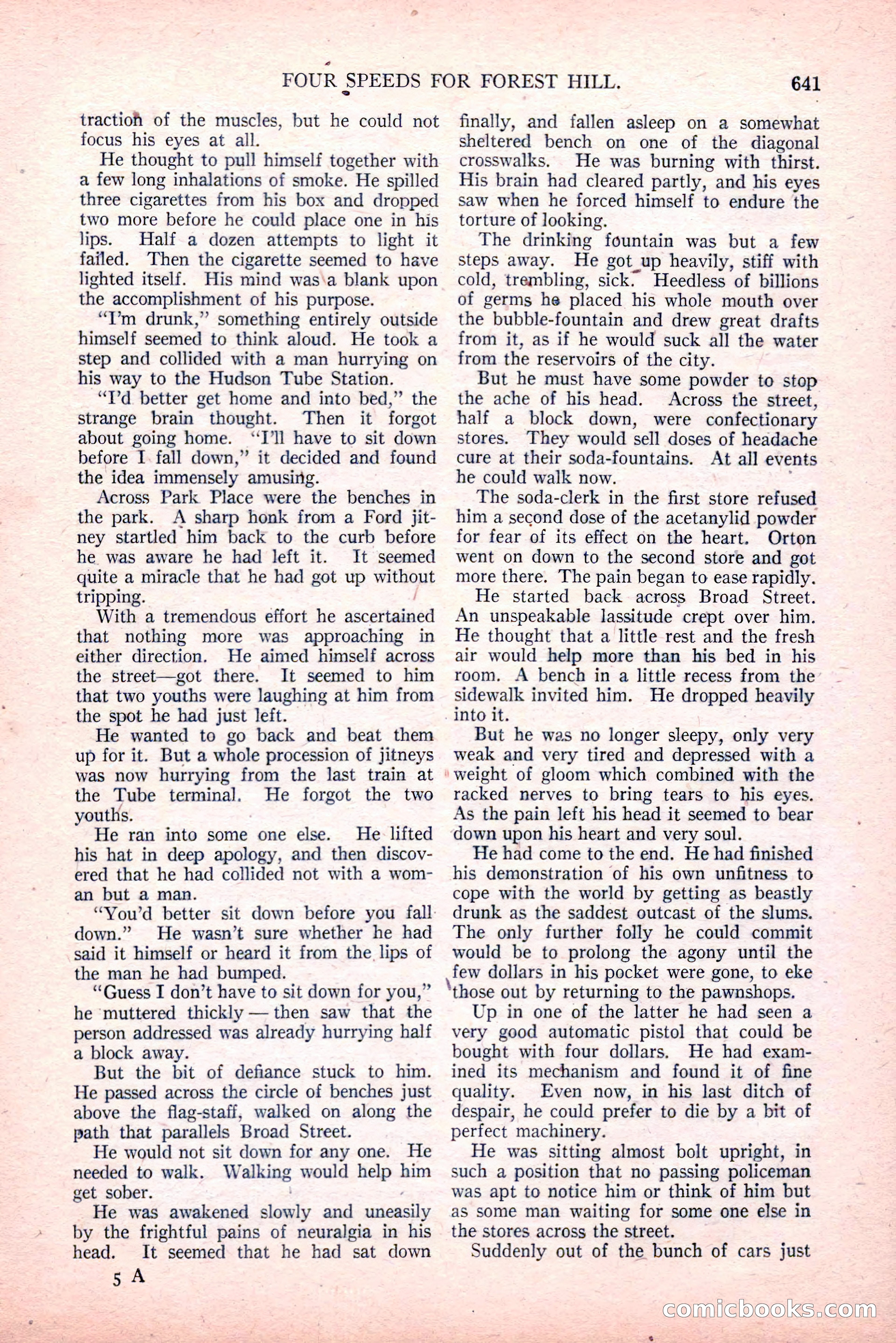
A restored page from Pulp Fiction, 1916. Page through the whole issue in the reader above.
📄 Transcribed text from this page (OCR, searchable)
Machine-transcribed from the original scan — historical spelling and the odd misread are preserved.
FOUR SPEEDS FOR FOREST HILL. traction of the muscles, but he could not focus his eyes at all. He thought to pull himself together with a few long inhalations of smoke. He spilled three cigarettes from his box and dropped two more before he could place one in his lips. Half a dozen attempts to light it failed. Then the cigarette seemed to have lighted itself. His mind was\a blank upon the accomplishment of his purpose. “T’m drunk,” something entirely outside himself seemed to think aloud. He took a step and collided with a man hurrying on his way to the Hudson Tube Station. “Yd better get home and into bed,” the Strange brain thought. Then it forgot about going home. ‘“‘I’ll have to sit down before I. fall down,” it decided and found the idea immensely amusirig. Across Park Place were the benches in the park. A sharp honk from a Ford jit- ney startled him back to the curb before he was aware he had left it. It seemed quite a miracle that he had got up without tripping. With a tremendous effort he ascertaiael that nothing more was approaching in either direction. He aimed himself across the street—got there. It seemed to him that two youths were laughing at him from the spot he had just left. He wanted to go back and beat them up for it. But a whole procession of jitneys was now hurrying from the last train at the Tube terminal. He forgot the two youths. He ran into some one else. He lifted his hat in deep apology, and then discov- ered that he had collided not with a wom- an but a man. “Vou’d better sit down before you fall: down.” He wasn’t sure whether he had said it himself or heard it from the lips of the man he had bumped. “Guess I don’t have to sit down for you,” he muttered thickly — then saw that the person addressed was already hurrying half a block away. But the bit of defiance stuck to him. He passed across the circle of benches just above the flag-staff, walked on along the path that parallels Broad Street. He would not sit down for any one. He needed to walk. Walking would help him get sober. He was awakened iloale and uneasily by the frightful pains of neuralgia in his head. It seemed that he had sat down 5A 641 finally, and fallen asleep on a somewhat sheltered bench on one of the diagonal crosswalks. He was burning with thirst. His brain had cleared partly, and his eyes saw when he forced himself to endure the torture of looking. The drinking fountain was but a few steps away. He got_up heavily, stiff with cold, trembling, sick> Heedless of billions of germs he placed his whole mouth over the bubble-fountain and drew great drafts from it, as if he would suck all the water from the reservoirs of the city. But he must have some powder to stop the ache of his head. Across the street, half a block down, were confectionary stores. They would sell doses of headache cure at their soda-fountains. At all events he could walk now. The soda-clerk in the first store refused him a second dose of the acetanylid powder for fear of its effect on the heart. Orton went on down to the second store and got more there. The pain began to ease rapidly. He started back across Broad Street. An unspeakable lassitude crept over him. He thought that a little rest and the fresh air would help more than his bed in his room. A bench in a little recess from the sidewalk invited him. He dropped heavily into it. But he was no longer sleepy, only very weak and very tired and depressed with a ‘weight of gloom which combined with the racked nerves to bring tears to his eyes. As the pain left his head it seemed to bear down upon his heart and very soul. He had come to the end. He had finished his demonstration of his own unfitness to cope with the world by getting as beastly drunk as the saddest outcast of the slums. The only further folly he could commit would be to prolong the agony until the few dollars in his pocket were gone, to eke — those out by returning to the pawnshops. Up in one of the latter he had seen a very good automatic pistol that could be bought with four dollars. He had exam- ined its mechanism and found it of fine quality. Even now, in his last ditch of despair, he could prefer to die by a bit of perfect machinery. He was sitting almost bolt upright, in such a position that no passing policeman was apt to notice him or think of him but as some man waiting for some one else in the stores across the street. Suddenly out of the bunch of cars just CORMICGLOOOKS (E@)