
Pulp Fiction, 1916 · page 74 of 216
The Argosy, Vol. 81, No. 4 — page 74: what you’re looking at
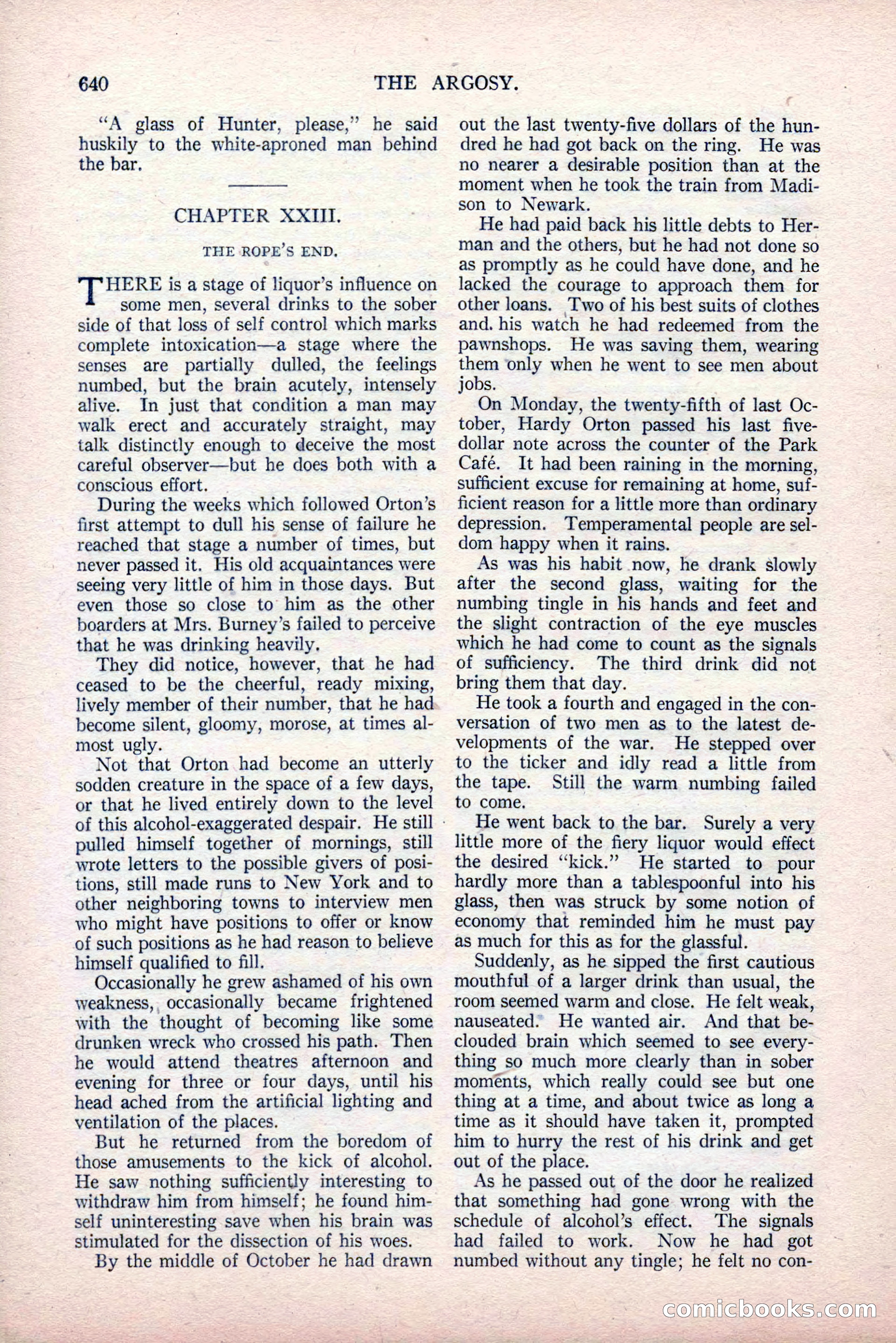
A restored page from Pulp Fiction, 1916. Page through the whole issue in the reader above.
📄 Transcribed text from this page (OCR, searchable)
Machine-transcribed from the original scan — historical spelling and the odd misread are preserved.
640 “A glass of Hunter, please,” he said huskily to the white-aproned man behind the bar. CHAPTER XXIII, THE ROPE’S END, g He is a stage of liquor’s influence on some men, several drinks to the sober side of that loss of self control which marks complete intoxication—a stage where the senses are partially dulled, the feelings numbed, but the brain acutely, intensely alive. In just that condition a man may walk erect and accurately straight, may talk distinctly enough to deceive the most careful observer—but he does both with a conscious effort. During the weeks which followed Orton’s first attempt to dull his sense of failure he reached that stage a number of times, but never passed it. His old acquaintances were seeing very little of him in those days. But even those so close to him as the other boarders at Mrs. Burney’s failed to perceive that he was drinking heavily. They did notice, however, that he had ceased to be the cheerful, ready mixing, lively member of their number, that he had become silent, gloomy, morose, at times al- most ugly. Not that Orton had become an utterly sodden creature in the space of a few days, or that he lived entirely down to the level of this alcohol-exaggerated despair. He still - pulled himself together of mornings, still wrote letters to the possible givers of posi- tions, still made runs to New York and to other neighboring towns to interview men who might have positions to offer or know of such positions as he had reason to believe himself qualified to fill. Occasionally he grew ashamed of his own weakness, occasionally became frightened with the thought of becoming like some drunken wreck who crossed his path. Then he would attend theatres afternoon and evening for three or four days, until his head ached from the artificial lighting and ventilation of the places. But he returned from the boredom of those amusements to the kick of alcohol. He saw nothing sufficiently interesting to withdraw him from himself; he found him- self uninteresting save when his brain was stimulated for the dissection of his woes. By the middle of October he had drawn THE ARGOSY. out the last twenty-five dollars of the hun- dred he had got back on the ring. He was no nearer a desirable position than at the moment when he took the train from Madi- son to Newark. He had paid back his little debts to Her- man and the others, but he had not done so as promptly as he could have done, and he lacked the courage to approach them for other loans. Two of his best suits of clothes and. his watch he had redeemed from the pawnshops. He was saving them, wearing ee only when he went to see men about jobs. On Monday, the twenty-fifth of last Oc- tober, Hardy Orton passed his last five- dollar note across the counter of the Park Café. It had been raining in the morning, sufficient excuse for remaining at home, suf- ficient reason for a little more than ordinary depression. ‘Temperamental people are sel- dom happy when it rains. As was his habit now, he drank slowly after the second glass, waiting for the numbing tingle in his hands and feet and the slight contraction of the eye muscles which he had come to count as the signals of sufficiency. The third drink did not bring them that day. He took a fourth and engaged in the con- versation of two men as to the latest de- velopments of the war. He stepped over to the ticker and idly read a little from the tape. Still the warm numbing failed to come, He went back to the bar. Surely a very little more of the fiery liquor would effect the desired “kick.” He started to pour hardly more than a tablespoonful into his glass, then was struck by some notion of economy that reminded him he must pay as much for this as for the glassful. Suddenly, as he sipped the first cautious mouthful of a larger drink than usual, the room seemed warm and close. He felt weak, nauseated. He wanted air. And that be- clouded brain which seemed to see every- thing so much more clearly than in sober moments, which really could see but one thing at a time, and about twice as long a time as it should have taken it, prompted him to hurry the rest of his drink and get out of the place. As he passed out of the door he realized that something had gone wrong with the schedule of alcohol’s effect. The signals had failed to work. Now he had got numbed without any tingle; he felt no con- COMIC OOOKS (E@)